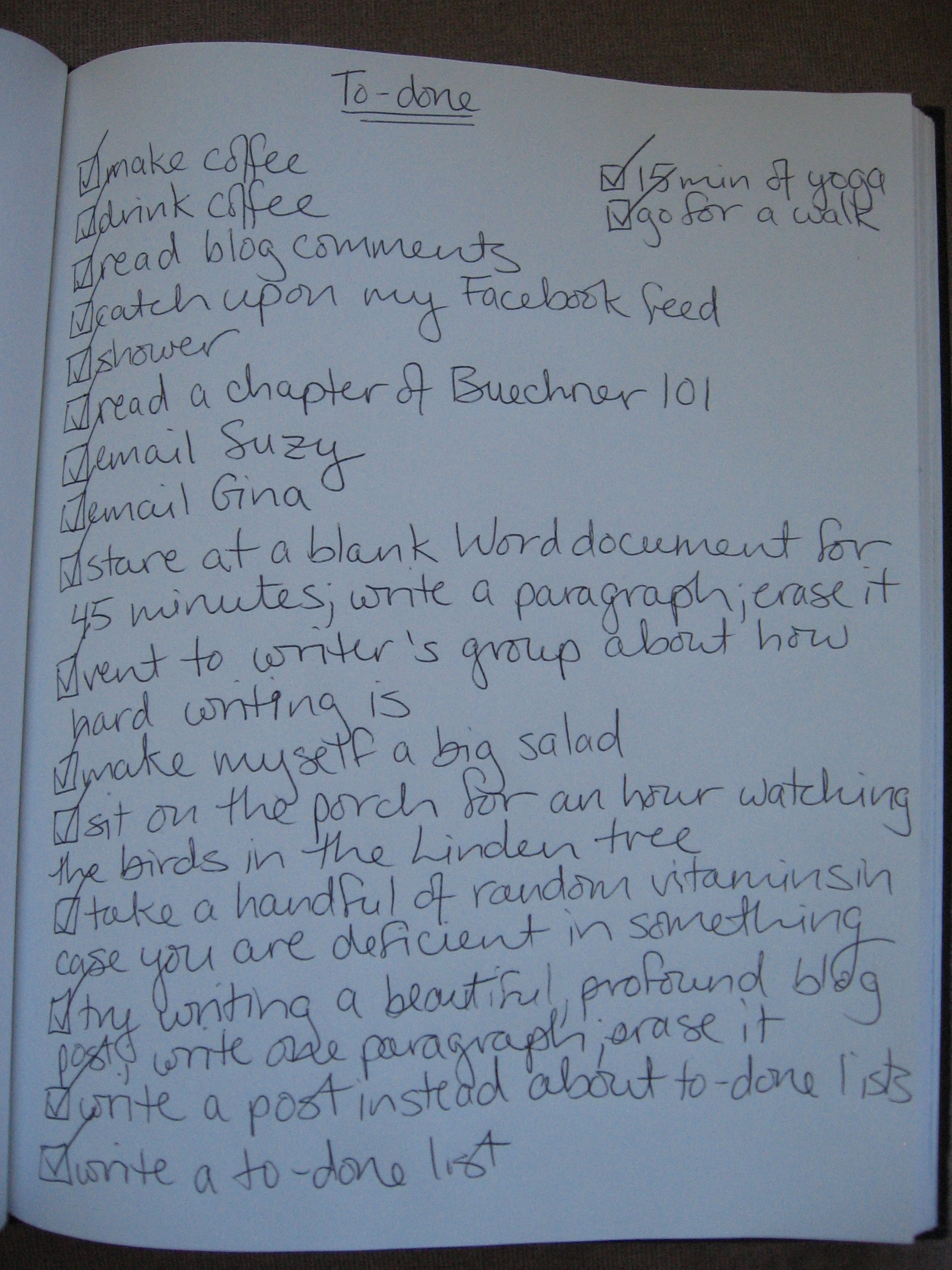
1) Go about your day. Be as spacey and scattered as you want, it’s okay. Introverts and artists need days to just wander around doing nothing in particular. If you are not an introvert or an artist, I don’t know what to tell you. I’m not sure what you people do. Go to parties? Accomplish things? Those are not my areas of expertise. 🙂 Whatever it is, do your thing.
2) At the end of the day, sit down and think about what you’ve done. Write it all down, all of it. Include anything that involved moving yourself or objects, creating something, communicating with people in any way, having deep thoughts, having shallow thoughts, exercising, stretching, taking your meds, taking your vitamins, and any form of resting and recharging, even watching TV or playing computer games. Everything counts. Write it down with a little box in front of each item.
3) Take your pen proudly in hand, and go down the list, confidently checking each item without pausing to consider if it has been done. If it’s on the list, it has been done. It’s a to-done list.
That’s all! You did it! Great job!
You can read my original post, How to write a to-do list, here.
I don’t post on this blog very often anymore, but come check out my new website, JessicaKantrowitz.com for new posts and writing news! Or follow me on Twitter, Facebook, or Instagram.
In Acts chapter 10 Peter was up on the rooftop praying. He was a follower of the risen Christ, and he was a good Jewish boy — at that time the two pretty much went hand in hand. Jesus was Jewish, his disciples had all been Jewish except for the occasional woman at the well. Peter followed the commandments in the Torah, and this included the laws that prohibited eating certain animals.
So when he had a vision of a sheet of prohibited animals being lowered, and a voice told him, “Get up, Peter. Kill and eat,” he knew the answer: “Surely not, Lord! I have never eaten anything impure or unclean.” He probably wondered why God was testing him, but he felt secure in his answer. He had spent his whole life studying God’s word, and his time with Jesus had only strengthened that commitment. After all, hadn’t Jesus said, in his hearing, “I have not come to abolish the Law or the Prophets, but to fulfill them”? Maybe Peter thought his mind was playing tricks on him, since he was hungry and tired. Or perhaps he thought it was Satan tempting him away from the right path. But when the voice from heaven replied, “Do not call anything impure that God has made clean,” he may have thought to himself, huh, that does sound like something Jesus would say. But, still, no. He wasn’t going to abandon what he believed that easily.
Then it happened again. The sheet was lowered, the instruction repeated: “Kill and eat.” Peter again protested, and again the voice from heaven said, “Do not call anything impure that God has made clean.” It happened a third time, and then the sheet was lifted back up to heaven. As he was wondering what this meant, some messengers came for him from Cornelius the centurion — a Gentile (Gentile means not Jewish). And Peter began to understand. It wasn’t about the food. It was about the people. God was opening wide the kingdom to those who had not been welcome into it before.
And then he went and listened to Cornelius’ story, and learned that God had spoken to Cornelius, too. And then, and then — a second Pentecost. The Holy Spirit came upon Cornelius and the other Gentiles gathered there, just as the Spirit had come upon Jesus’ disciples in Acts 2. “The circumcised believers who had come with Peter were astonished that the gift of the Holy Spirit had been poured out even on Gentiles. For they heard them speaking in tongues and praising God.” In the next chapter, Peter related this story to the other Jewish disciples and said to them, “So if God gave them the same gift he gave us who believed in the Lord Jesus Christ, who was I to think that I could stand in God’s way?”
I was reading Acts 10 and 11 the other day, and I suddenly realized: This is how it happened for me. This is the same process I went through in my understanding of homosexuality from a Christian perspective. And I think this is how it happened, and is happening, to other Christians, too. We were up on the roof praying. Or we were watching TV, or reading a newspaper, or just going about our lives. And we heard a voice from heaven. Some heard a loud voice, and some heard it softly, in their hearts, the way they were accustomed to hearing God’s voice. Some of us didn’t recognize the voice right away — we thought it was just a thought passing through our mind, a question, a wondering. For some it took the form of, “If God created gay people, who am I to call them unclean?” For others we just felt a sense of our comfort being challenged. We were good Evangelicals, or Catholics, or other Bible-believing Christians. We knew what the Bible said, and how we were taught to interpret it, how our church, our school, our seminary interpreted it. So we dismissed the thought. “Never, Lord,” we said, each in our own way.
Some of us are there right now. The question has yet to be posed for a second time. We are still on the roof, praying.
Others of us have heard the voice a second time, and rejected it a second time. We are still on the roof, praying.
Others have heard the voice a third time, and pushed back against it a third time. We have come down from the roof and are wondering what it means.
For me, when I came down from the roof, the question burning in my heart and mind, I did what Peter did. I took the idea, the theory, into its context. Just as Peter went to Cornelius’ house, I went to the homes of gay couples, cared for their children (I am a nanny, in my day job), listened to their stories, and payed attention to what the Spirit was doing there. I started reading the stories of gay Christians who had struggled with their sexuality. I stopped talking about what I thought, and I started listening. And what I saw were people who were seeking God and wanting to serve God with their lives, just like I was. I didn’t see people in rebellion, rejecting God and choosing their sinful desires over God’s will. I saw people who had been called by God and who had received his Spirit, just as I had. I sawpeople like these, who attend Nadia-Bolz Weber’s church, A House For Saints and Sinners. And I saw young people like these, who fought for a long time to change who they were before they finally listened to God’s voice, and heard, “Do not call anything impure that God has made clean.” I saw people who thought they had to change to be a part of the body of Christ, but who were discovering that God created them that way for a reason, for his glory. I saw people who were using their same-sex relationships to love and serve God and feed his sheep, just as heterosexual couples were.
(I heard other stories, as well. Some gay people believed that God was calling them to celibacy, and I want to make space for them in my thinking and my writing, too. As I’ve said probably seventy times by now, that’s one of the reasons I love the Gay Christian Network, because they create that space.)
Many of us Christians have come down from the roof, and are still praying, still wondering.
Some of us have started listening to the stories of gay Christians, but we are not yet sure.
Some of us have seen the Spirit descend on LGBT Christians, and we are starting to wonder, “If God gave them the same gift he gave us who believed in the Lord Jesus Christ, who am I to think that I could stand in God’s way?”
Me, I’m pretty sure of it. It took a while, and it took many times of me saying, “Never, Lord.” But there are only so many times you can cling to your beliefs in the presence of the Living God. There are only so many times you can repeat the words of scripture to the God that wrote them and expect to win the argument. Job and his friends learned that lesson, as they tried for chapter after long chapter to lecture each other about what God was doing, only to be silenced when God himself showed up. Paul learned that lesson when he took what his faith taught him about Jesus to the nth degree, only to be thrown to the ground and blinded when he met the Man himself. And Peter, dear Peter, who betrayed Jesus, who said the silliest things sometimes (oh, I do relate to Peter), and who was chosen, nevertheless, to lead and feed Jesus’ sheep — Peter learned that lesson when he saw the Holy Spirit poured out on those whom he thought were other, separate, not part of God’s plan. “Do not call anything impure that God has made clean.”
I believe God is speaking this into the hearts of many Christians. I believe that God is moving among his people in a similar way to which he moved in Acts. Walls are being broken down. The Kingdom is expanding. Gentiles are invited in, along with Jews; gay, lesbian, and bisexual people are invited in, along with straight people; transgender along with cis. Those who are not there yet, who are still on the rooftop praying, are invited in, too. There is room for all of us here. There is room.
***
Update: I am embedding the two videos I mentioned earlier, because I really want you to watch them. The first is five minutes long, and the second about 45 minutes.
***
For more testimonies of LGBT people of faith, visit Faithfully LGBT.
A note on comment moderation: I value everyone who takes the time to read and to comment, even if you disagree with me. But I do not post all the comments. I know that’s hard. But my goal is to create a space here at Ten Thousand Places where people’s stories can be heard above the din, and where those whose lives we are discussing have a chance to speak for themselves. I do post comments by those who disagree with me, but I might not post all of them. I do my best to read all of them, though. Thank you so much for being here.
Love,
Jessica
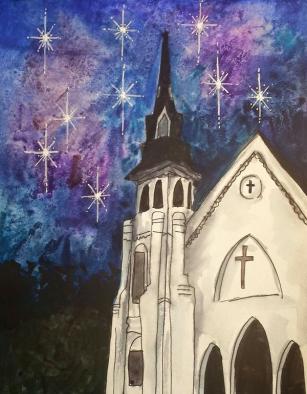
Ever since Wednesday night I’ve been reading post after post by black women and men sharing about what Charleston means to them, and the deep pain and injustice that is still inflicted, every day, on people of color in this country. One theme that has been emerging is the request for white people to do something — to first say they’re sorry for what has happened and listen to the pain and the stories of black men and women, and to then find ways to work to combat the systemic racism in America. Some writers offered suggestions. But many emphasized that it is up to white people to find ways to do it. As Karen Walrund wrote:
“Finally, remember that while racism is an issue that black and brown people have to deal with, it is not our issue to fix. Racism is a systemic problem created by those in power — white power — and therefore it is an issue that only those in power can fix. So please keep this in mind before asking any of your black friends or acquaintances what it is you can do to fight racism: while the question comes from an instinct that is certainly understandable, as an ally, what we really need is for you to be creative and come up with ways that you can put an end to racism yourself. To be even more blunt: being creative for you is not our job.”
I don’t have many ideas yet. But I’m still listening, and I’m trying to be creative. I definitely appreciate that Karen’s call is to be creative, rather than to be organized or to be efficient — creative is more up my alley.
I did have two ideas, neither of which made a lot of sense, but which I did anyway. One was to write a poem, which I’ll share in a minute. And the other was to go to church. If you know me or have been following this blog for a while, you know that it has been a while, and that I’ve had a long and complicated relationship with Christian community. It was just two weeks ago that I wrote about a nightmare I had about going to a church service.
But I just kept thinking about those nine people, faithfully showing up for a Wednesday night prayer meeting, and I knew I had to be brave and go, to honor them. It was a good Sunday to be there, for other reasons that I’ll probably write about soon. It wasn’t particularly profound in terms of the reason I’d come, to bear witness to the men and women killed in Charleston, grieve with the body of Christ, and vow to work towards racial justice in this country. The pastor spoke briefly about Charleston and said a prayer, naming all nine of the people murdered. The rest of the service was dedicated to something big happening at that specific church which needed to be discussed, and that was fine. But I felt whatever purpose I’d had in going had been fulfilled. We prayed, we bore witness. And the things the church is working through will help it to continue to work for justice and reconciliation.
But there is more to be done. It’s a busy week, so I don’t have time to write much more. But I’ll share my poem. It was inspired by Yolanda Pierce, Osheta Moore, Karen Walrund, Deidre Riggs, Austin Channing Brown, and many others. It was inspired by black women, but it was written to white people, and to myself in particular. What will our response to Charleston be? What work are we being called to do?
On the murders in Charleston
If you only have something nice to say,
Be quiet.
Now is not the time for niceties,
For crying, “Peace, peace”
When there is no peace.
If you have a voice
HOWL
If you have a soul
LAMENT
If you have a prayer, fine.
Say it softly to yourself.
But if you want God to hear you
SHOUT
If you want to pray for peace
WAIL
Rend your garments
Fall to the ground
And stay there until God answers you.
And then get up and do the work.
I don’t know what to do right now, but I know one thing I can always do, besides pray, is listen: Listen to the voices of those whose experience is different than mine, listen to those who are struggling and suffering, listen to those for whom current events represent more than an isolated day of horror. Two women who I am listening to right now are Austin Channing Brown and Dr. Yolanda Pierce. If you want to listen, too, they are on Twitter, talking about Charleston and what it means to them. https://twitter.com/austinchanning, and https://twitter.com/YNPierce
Sam Lamott is my new hero. His mother, Anne, whom I adore and whose books I read for the same reasons I call a good friend — to relax, to laugh, and to feel understood and at home — made a couple of really awful comments about Caitlyn Jenner on twitter yesterday. I won’t repeat them here, but they were snarky and mean and insensitive. This was really surprising to me, and saddening. But then her son, Sam (of Operating Instructions fame) replied to her with such love and grace, it left me stunned:
“The pee pee tweet is not truth, love, or funny. I’ll explain it all. Let’s start by deleting it.”
“You can be part of the noise, but when the noise quiets down…you’ll wish were part of the change, it lasts longer.”
And then just as gently and articulately he asked for grace for his mom:
“Everybody gets to make mistakes. It’s a shame this lesson is so public, but the best lessons are often painful and embarrassing.”
“I know. It’s shocking. When the adrenaline wears off, remember that before you knew about trans issues, you didn’t know.”
“I learned about trans life from a close FTM friend who was willing and patient to answer my ignorant and incredibly personal questions.”
“Trans life is so outside pop culture, and my moms small town life. This is how the truth gets out, this is how we evolve. We talk about it.”
Anne retweeted Sam’s quotes. And then, after a while, she apologized.
“I am so sorry to have caused pain to people in the transgender community, esp to parents of transgender children. You are loved and chosen.”
The whole exchange gives me so much hope that beneath the yelling and arguing and hyperbole that I’ve been seeing in my Facebook and Twitter feed, there may actually be some new, fragile-green growth. Before you knew, you didn’t know. Listen to those whose lives you are discussing. Listen to their stories and ask questions (ask, first, if it’s okay to ask questions, though). And offer grace to others who trip and stumble along the way. I hope to follow Sam’s example in my life and in my writing. And I hope that Ten Thousand Places can be a place where we practice that same loving, and listening, and extending grace.
Come join me on Facebook, Twitter, and Instagram and let’s try! (I’ll tell you a secret: I’m feistiest on Twitter!)
One day last week I’d been working from home and struggling with how much there was to do, and how many things were falling apart (my car, my teeth, my finances). Worse than that, I hadn’t had time to just be and process all these things, because I had to just keep doing them. I was feeling overwhelmed and disconnected from my own heart and mind. Does anyone else find that unprocessed feelings build up and create a sense of chaos? I need to get them out, by writing, drawing, or just spending time thinking.
Finally, that evening, I closed my computer and my to do list, and went for a walk in the arboretum. It was a beautiful warm spring evening, with a perfect cool breeze. A stillness seemed to settle on the world, and on myself, as I walked up Peter’s Hill and down the other side, past Conifer Path, and around to where the short, twisted pear trees gave off an intriguing scent. And — the birds! There are so many birds in the arboretum. In Jamaica Plain I was used to seeing robins, sparrows, and the occasional cardinal. I know the songs of all of those. But here there were so many more, and they were singing out with the joy overtakes birds in the mornings and evenings. “…everything smiling in the sun, and the song-birds just going it!” as Huckleberry Finn said.
The birds’ clear song, the cool breeze rustling the trees, and the movement of my arms and legs began to clear my heart and my mind, and the stress of the day began to slowly sink through my feet into the ground. It was just what I needed. Another half hour or so, I thought, and I would be better, ready to go back home and re-engage with my life.
Then the birdsong was interrupted by the tinny sound of pop music coming over a cheap speaker. I looked up and realized I was gaining on a group of three girls, one of whom was holding up a smart phone blaring this unholy sound. They were walking slowly — I was gaining on them but by the time I passed them and got away from their music I would be almost home, and my chance to enjoy the peace of the evening would be ruined. I slowed down, debating whether to try to pass them or take a different route, and they glanced back and caught my eye.
I gave them a look, I’m afraid. I don’t know how it came across to them, but in my heart at that moment I was thinking, “I don’t want you here, you’re bothering me.” A grown-up look, a scolding look. And then, while still trying to decide where to walk, I began to notice things I hadn’t at first. The girl with the phone was lagging behind her two friends. She was overweight, and struggling with the slope of the hill. Her friends were encouraging her, calling her forward: “You can do it! Keep going!” She was holding the phone up in the air, the music helping her to keep putting one foot in front of the other. This was *her* evening, too — her triumph at getting out of the house, her healing walk. And I had given her a look.
I moved onto a side path, away from the music and away from my guilt. Hopefully they hadn’t noticed my look. I said a prayer for them, as I faded into the woods and their music faded away. And I said a prayer for myself for a better heart. Back amidst the trees and the birdsong I felt peaceful again. It is so much easier to love people when they are just a thought or a memory. So much harder to love when they are right in front of you. Next time, Lord, I prayed. Next time let me give an encouraging smile. Next time let me be as pure and joyful as the birds, who didn’t begrudge me my presence in their woods, who sang out just as joyfully and freely as if they had been alone. Next time let me see the girls’ beauty first, before I judge them. Next time let me love my neighbors as myself, even when they are playing pop music.
 How to write a to-done list in three easy steps:



 Ten Thousand Places