On resting well

restwell
Yesterday, after a Saturday spent in a familiar struggle, I wrote a letter to myself in my journal. I thought I’d share it here, in case some of you could relate.

Jessica,

Here are some things you’ll need to remember: When you’ve been pushing hard and are really tired, you’ll need to rest. You’ll be looking forward to that rest. But when it comes you probably won’t be able to enjoy it very much. It won’t feel nice and peaceful. You’ll feel bored and lonely. You’ll have a migraine and you’ll feel resentful that the migraines are keeping you from leading a normal life. You’ll wish you could be outside taking advantage of the beautiful weather, or at least at the gym exercising. You’ll wish you could be with friends and you’ll start to feel like you don’t have any friends. You’ll think you should be working more and you’ll worry about money. You’ll feel the depression edging in and you’ll start to worry that if you don’t do something it will come to stay. You’ll worry about eating too much or too little, and that if you spend the day lying around you’ll get fat. You’ll question every hour, and if you should be doing something other than what you’re doing.

All of that will happen, as it always does. And you’ll try to reinvent the wheel and reexamine your life and your game plan, every time. The problem is, that’s not restful. So here are the three things you need to know:

  1. You need the rest.
  2. You’re doing your best.
  3. You can trust God to do what you can’t.

Here are some other things to remember:

You used to eat a lot more. Remember those big bowls of popcorn with butter and Parmesan cheese, those variety packs of candy? The salt and sugar from those binges produced dopamine. Eating + watching TV lulled you and allowed your mind to rest. Without the food you’re more squirrely. It’s okay. It was a coping strategy when the migraines and depression were so bad, but it was bad for you. It’s good that your eating is healthier now. But it makes sense that it would take some time to re-learn rest without that coping strategy. Remember the lesson from centering prayer and savasana: Observe your feelings without judging them. And trust that the good habits you’re learning will continue to fill in the gaps left by the bad ones.

Also, don’t compare your life and schedule now to when you were running and exercising hard four or more times a week. You were only working three easy days then, and now you’re working four and two of them are quite hard (three small kids for ten hours). Plus, you get home later, and need to go to bed earlier to wake up earlier. You’re not going to be able to replicate 2011’s schedule of coming home from work and going straight to the gym for two hours. That’s okay. Do a little yoga. Maybe go for a walk — but it’s okay if you’re not even up for that. Your two ten hour work days are like a marathon, and the other nanny days take energy as well. Just listen to your body and do what you can.

And — You’re living well at work! You pay attention, take in the beauty of the days and the children. You have good relationships with the kids and their parents. You use your mind and your body. You laugh and make other people laugh. You exercise — lifting the kids, pushing the stroller, cleaning up after them. You get outside. You do fun things. It’s not a typical social life, but it’s a good life. So it’s okay not to do a lot on your days off — Your days on are packed!

Last thing: You actually do a lot outside of work, too. Just this summer you went to a writer’s conference, went to two of Glennon’s talks in Boston, and went to a Shakespeare play on Boston common. You spent time with Laura, Suzy, David, Megan, Gina, and the Lundquists. You went to Walden Pond, to Crane’s Beach, to Hale Reservation; you swam and kayaked. You went to the library and to the Arboretum, to Lars Anderson park, to Jamaica Pond. You went to church three whole times! You write a blog and are doing a flash fiction contest, you’re on Sarah Bessey’s launch team (#outofsortsbook), you’re in a writer’s group. You keep in good touch with your friends, you visit your parents often and you went to Connecticut to see your brother. You try to be a good friend to Mark and a good housemate to Jill, you offer support and encouragement to commenters on your blog, on Momastery, and on Facebook. You make soup. You do yoga. You keep your house clean and keep more than a dozen houseplants alive. You put out sugar water for hummingbirds and seeds for the other birds.

You read books, albeit slowly. You read articles and blogs. You think deeply about things. You sometimes pray.

You do a lot.

The resting is a part of the doing.

Rest well.

Love,

Jessica

He suffers with us


When I first started this blog back in the summer of 2007 I was about to fall into one of the darkest times of my life. As I look back at the first several posts, I can see I was still fighting it, still trying to find cheerfulness around me and write about it, even though inside I felt a growing desolation and despair. I had created a category that I called “Wrestling the Tigers” to describe my struggle with migraines, something that I had been dealing with since I was a kid. But a deep depression was settling in as well, and I soon started writing about that under the tigers category. The migraines were to worsen, the depression become debilitating, things in the community get progressively harder, my job as a minister to international students fall apart, and my felt-relationship with God disappear. But in 2007 and 2008 I was still fighting it. I was still trying to find a way to figure out work, to talk through things at the community, to medicate the migraines and the depression, and to re-find the connection I’d had with God.

By the end of 2008 things were falling apart. I moved from one house in the community to another, to try to relieve the strain of one of the difficult relationships, but that triggered more stress and difficulties. I had a scary reaction to a migraine medication and had to miss a work retreat, and when I was scolded and threatened with being put on probation because of it, I finally realized that I was not going to be able to make the job work, and I quit. I tried to rally and choose another career — applied to nursing schools and took a statistics class as a prerequisite. But after a few weeks of struggling to take the two trains to my class every week I realized that going back to school wasn’t feasible. I took a full time nanny job but had to quit after three weeks because I felt so sick. In 2009 I finally gave into the depression and migraines, and collapsed into bed. I stayed there for ten months, getting up only once or twice a day to go downstairs for coffee or food. I hardly left the house or had social interactions beyond a few strained words with my housemates and community-mates. It was next to impossible to chat about normal things when I was in so much pain, both physical and mental, and people soon grew tired of hearing me talk about how bad I was feeling. I don’t blame them. I was sick and tired of talking about it, too. It was easier to be alone.

The worst part about that time, though, was feeling like I’d lost all the ways of connecting with God that used to be so precious to me. Reading the Bible had been as much a part of my day as my morning coffee, but now the words were empty of the power and beauty they used to hold. But it was worse than that: I would read the empty words and remember how much they used to mean, and feel that loss so intensely that I couldn’t bear it. It was too hard. Sometimes I read them anyway, and just cried. Prayer was hard, too. I used to find such solace in prayer, pouring out my heart to my best friend and giving my life to him daily. But now I just felt emptiness. All I could feel was the depression and the constant pain of the migraines.

IMG_0347Then, one day on a whim, I bought a little crucifix online. I was raised in the Protestant tradition and remember being told that Catholic theology was wrong because they kept Jesus on the cross, whereas Protestant crosses were empty, representing the resurrection. When the package came, and I took out the little plastic Jesus it seemed so strange — a little Jesus doll when what I wanted was the real man, present in my heart, mind, and spirit, as he used to be. But one day, when the pain was at its worst, I placed my fingers on the nails in his hands, studied his face and his body, and wept with understanding: Jesus was in pain, too. He was suffering, too. I might not understand why it was happening to me, or why he wouldn’t answer my prayers to take it away, but now I knew that He was in it with me. For the days and months to come I lay in bed, clutching the crucifix to me and crying. Here’s what I wrote one night:

This did not go at all as planned, if I ever had a plan.  It had something to do with impressing everybody, but doing it without appearing to, effortlessly, the way I tell jokes,without smiling, looking away afterwards, leaving people to laugh or not, too cool to acknowledge my own cleverness.

But I was broken out of my intellect, my intention, my talent by the brokenness of my body, and though I wanted to relate to Christ in his witty repartee, his compassion, his healing, I now relate most to his twisted form on the cross, eyes shut in pain, not yet dead, not yet resurrected, not yet ascended. My Lord, the suffering, naked, four inch plastic form on the eight inch wooden cross.

I am not making a theology out of this.  Far be it from me. I am telling you what I do not know, not what I know. I am in pain all the time. I am dizzy, nauseous, exhausted, and this is before the side effects from the medications kick in.

Jesus’ features are not twisted in agony. If you didn’t know better you might almost think he looked peaceful. But I think that I recognize the movement inward that a long-suffering spirit makes. It is close to meditation. You have less to do with the world, with what is going on around you. Physical and emotional sensation take over and then, somehow, you sink below that, to a place deeper than that.

The contemplatives teach that at our very center the Spirit is constantly praying; that our act of prayer consists of joining in awareness with that ongoing prayer.  This is the only kind of prayer I can hope for, now.

I place a finger on each nail and press the wooden cross to my heart, the broken body of Christ against my own.

i-came-here-to-kneel

Taken from my bed — my home for many months — a ray of sunlight makes its way in and I reach through it to the cross.

The dark time lasted for six years, all told. Those two years, from the end of 2007 to the end of 2009 were the worst of it; after that I found a better (for me) migraine doctor and better meds, was able to start working a little bit and exercising, and learned what I needed to do to support my mental health. I still have migraines — almost every day, in fact — but they’re not as bad, and I know how to manage them. The depression has gotten slowly but continually better — these days it only visits occasionally, and I know what to do: Slow down, breath, meditate, do yoga and centering prayer. The spiritual stuff took the longest, though. I’ve written about that elsewhere, and I’m writing more. But for today I wanted to share this post about what the crucifix meant to me in that dark time, in case it might be helpful for someone who is in the darkness now. I don’t know why your prayers for healing have not been answered, or if the answer is, “no” or “not yet.” But I know the God that loves you is with you, and knows how you feel. He suffers with you, as he suffered with me back them. You are not alone.

Consider the birds of the air

Thirteen robins

Thirteen robins

It’s February 16th and the record breaking snow and frigid temperatures continue in Boston. I took this picture (on my cheap camera phone, sorry) as the 3 yr old and I sat in the car waiting to pick up his big sister from school. You can’t really see unless you make it bigger (ctrl +) but there are eleven robins in that little tree above the snow bank, and three right at the bottom of the snow bank. There were berries in the tree and on the ground that they were nibbling on. But the wind was biting, and they were all puffed up to more than twice their usual size. When the wind blew they would turn towards it so it blew with the grain of their feathers; when the wind caught them facing the wrong direction it pushed their feathers out painfully and blew them across the snow till they reoriented themselves. It was a strange and pathetic sight, and both sad and ironic to me to see those little emblems of spring struggling moment to moment through this harsh winter.

That evening I left the kids with their parents and tramped down to take the subway then a bus home. I usually drive to that job, but there were no parking spaces on their narrow, one way street that weren’t being desperately saved by the residents. The previous week I’d taken the T (short for Massachusetts Bay Transit Authority, for those who aren’t from around here) to their house and they’d called an Uber for me to get home, but this week, when they asked me to come in earlier because the 3 yr old was home, sick, from school, I offered to reverse it and have them Uber me there so I could get there sooner. But that meant that I had to wait for the train and bus outside, after dark, on one of the coldest nights of the year.

I made the first leg okay, but then I stood outside waiting for the 51 bus for 45 minutes, and it never came. Three should have come during that time, according to the schedule, but the T, like most of the rest of us Bostonians, isn’t dealing that well with all the snow. When I couldn’t feel my face or toes anymore I limped the two blocks to Harvest Market and warmed up for a few minutes, then went out to wait for another bus which came more often but didn’t take me as close to home. Ten more minutes in the freezing cold and the bus finally came. I climbed on but couldn’t even get past the yellow line because of the crowd. This bus would take me a mile in the right direction, and then I’d have to walk the rest of the way.

At the next stop I had to quickly step back into the cold to make room for the people getting out. An elderly woman with a small child got on. And I thought, as I have often this winter, of the people who have it so much worse than I do. I’ve had a couple of snow days, when my employers didn’t have work so I didn’t either, but I got paid for them. Most hourly workers don’t, and have missed work through no fault of their own, and will have to pay just as many bills this month, but with a smaller paycheck. I’ve also been able to drive to work, most days — my other employers have a driveway I can use. But many Bostonians, even those with money, have no choice but to use the T, and delays have been severe. It took me two hours to get home that night — a 3.5 mile drive. Many people have had two hour commutes both ways for days. And some people have to get their kids to daycare by public transportation, get themselves to work, and then repeat the process on the way home.

I looked at the woman and child on the bus and I thought again how the knowledge that some people have it a lot worse than I do wasn’t helpful to me. “It could be a lot worse,” the thought meant to cheer me up, to make me grateful for what I have, instead makes me despair even more. Now I feel the weight not only of my own trials and suffering, but of numberless others as well. And I wish even more that I were stronger, more well off, so that I had extra energy and money to actually help some of those others. I limp along (literally now, since I pulled a muscle yesterday shoveling), getting my own stuff done, shoveling my own sidewalk and car, and making it to my own jobs. It’s been hard, and I feel overwhelmed, but I am doing okay so far. But how I would love to be able to do more than okay, and to offer a hand to others as well: To dig an elderly neighbor out of the snow, to offer rides to some of those struggling to get to and from work.

The people haunt me; the fourteen little robins haunt me. The robins, of course, make me think of Jesus’ assurances in the Sermon on the Mount–

“Therefore I tell you, do not worry about your life, what you will eat or drink; or about your body, what you will wear. Is not life more than food, and the body more than clothes? Look at the birds of the air; they do not sow or reap or store away in barns, and yet your heavenly Father feeds them. Are you not much more valuable than they? Can any one of you by worrying add a single hour to your life?”

Last Monday my two housemates were both away for the storm, and I struggled out that evening to clear a path through our driveway to my car. I was feeling really badly — anxious and depressed and tired — and I didn’t know if I could do what needed to be done. But when I started shoveling I realized that there was something other than the snow weighing on me. I’d been reading The Irrational Season by Madeleine L’Engle, and it was much more of a devotional book than the autobiography I’d expected it to me. The first few chapters were her thoughts about God, in essays and poems. And it was hard for me to read, for the same reason the Bible is hard for me to read lately: Those thoughts, words, and emotions that used to mean so much to me, that used to lift my heart and my spirit, now were empty. And the deep meaning they used to have for me was like a mockery of the emptiness I now felt. John of the Cross called this the Dark Night of the Soul, and it is something that I have struggled with for several years now.
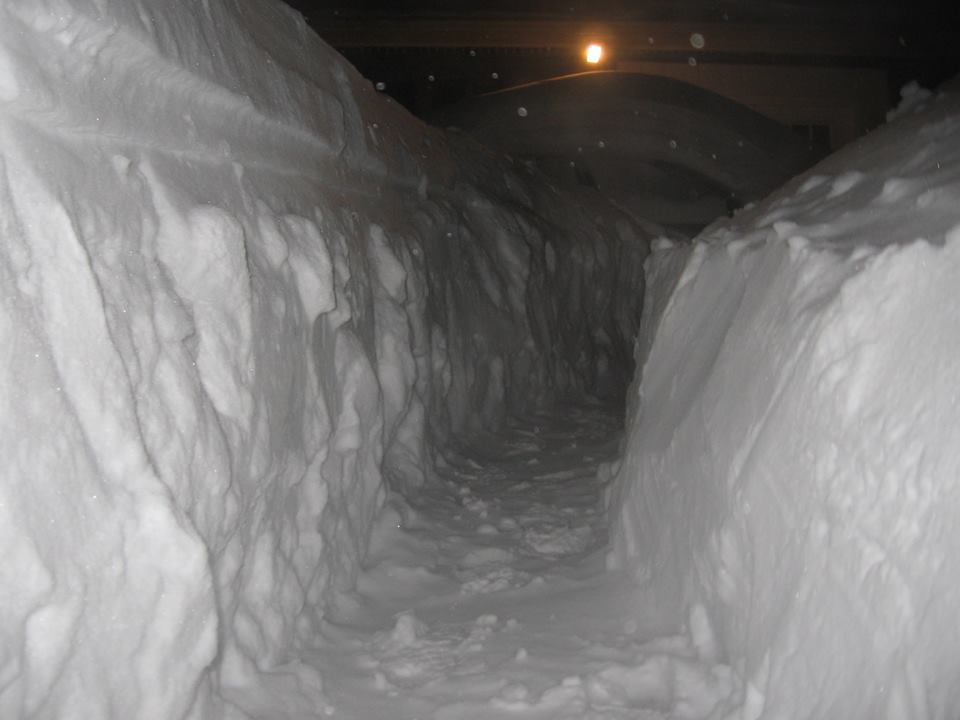
This is the path I was shoveling through our driveway.

This is the path I was shoveling through our driveway.

So I’d been reading The Irrational Season while the snow fell and the afternoon deepened into evening, and then I went out to shovel while there was still some daylight left. And as I began to plow my way through the drifts, almost weeping with how much had to be done, I prayed. I didn’t pray about the snow and the shoveling. I called out to Jesus and begged, again, for him to be in my life and my heart; for him to be the center and purpose of my life, as he once had been. Just saying the prayer made me feel a tiny bit stronger, and I tried to focus on moving each shovelful, on the very small, specific task that lay in front of me: Not the whole driveway but that one shovelful of snow. Each one. And then the next. Still, it was freezing out, and still snowing, and the wind whipped the snow painfully into my cheeks.

I made it about 2/3 of the way down the driveway that way, one shovelful at a time, but my shoulder and wrists were really starting to hurt. Then our neighbor James came riding up on a white horse (I may be embellishing that part) and offered to do the rest of the driveway with his snow blower. I can’t describe how grateful I felt. I think I would have been crying except that the muscles in my face were too frozen. James plowed through the rest of the driveway in minutes, and I moved on to my car. After a few minutes of lugging the heavy snow that the plows had wedged against my car James came by again and said, “Let me do that for you.” While he was working on my car I starting in on the sidewalks, and James came along and waved me off and did those, too.

I made a joke on my Facebook page about marrying James: “’It is a truth universally acknowledged, that a single man in possession of a good snow blower, must be in want of a wife.’ ~Jane Austen, had she lived in Boston in January/February 2015″ But the humor was covering up profound feelings of gratitude and my continuing struggle to re-find faith. Later that night, as I was getting ready for bed, more of Jesus’ words from the Sermon on the Mount came to me: “But seek first his kingdom and his righteousness, and all these things will be given to you as well.

Well, I thought. So. I had begun the work by seeking the kingdom, seeking God, and the other thing — help with shoveling — that I had not prayed for and had not expected, that had been given to me as well.

Here is the full passage, to which the New International Version gives the bold, encouraging header: Do Not Worry.

“Therefore I tell you, do not worry about your life, what you will eat or drink; or about your body, what you will wear. Is not life more than food, and the body more than clothes? Look at the birds of the air; they do not sow or reap or store away in barns, and yet your heavenly Father feeds them. Are you not much more valuable than they? Can any one of you by worrying add a single hour to your life?

“And why do you worry about clothes? See how the flowers of the field grow. They do not labor or spin. Yet I tell you that not even Solomon in all his splendor was dressed like one of these. If that is how God clothes the grass of the field, which is here today and tomorrow is thrown into the fire, will he not much more clothe you—you of little faith? So do not worry, saying, ‘What shall we eat?’ or ‘What shall we drink?’ or ‘What shall we wear?’ For the pagans run after all these things, and your heavenly Father knows that you need them. But seek first his kingdom and his righteousness, and all these things will be given to you as well. Therefore do not worry about tomorrow, for tomorrow will worry about itself. Each day has enough trouble of its own.”

My heavenly Father knows what I need. He knows the needs of the robins, too, and of the old lady and the child on the bus. And even though the words still sting as much as they heal, I will continue to turn back to them. Even though I thought I found the kingdom, and now feel like it is lost, still, I will continue to seek.



Self-talk

Sisyphus by Titian

Sisyphus by Titian, and how I feel about this winter

Snow, snow, and more snow. I am about to head out to my nanny job and it is 8 degrees out, -16 with the wind. For the past week I have had a refrain running through my head, almost subconsciously: “I can’t handle this, it’s too much, it’s too much.” This winter is hitting me hard all of a sudden.

But while it’s true that I feel overwhelmed and exhausted by the winter and all it entails (see my last post, Boston in January), I want to be aware of that inner dialogue and take control of it. That *is* how I feel, but it’s not helpful to let it become my narrative. So I am trying, every time I notice myself thinking, “I can’t take it,” to replace it with a truth that strengthens rather than weakens.

“I am strong.” “I have made it through worse than this.” “I can’t handle the whole winter, but I can handle the work right in front of me today, and that is all I have to do right now.” Those are the inner truths that strengthen me, and what it’s helpful to focus on.

And, also, these: “We are closer to April than November.” “Sunset tonight is 5:01 pm,” (after two months of 4-something sunsets) “The average historical temperature in Boston is one degree warmer than it was two weeks ago.” “Spring is coming, it really is.” “Hang in there.”

Do you have “negative self-talk” swirling through your mind? What is it? What are some truths you can replace it with today?

Dancing with the tigers

seusstigersIt’s been a while since I posted a wrestling the tigers post. For those who are new to my blog, the tigers are a word I use to describe chronic migraines and other health issues. Wrestling them means different things on different days. This past week it was mostly getting up and going to work, smiling at the adorable 1 1/2 year old I nanny, focusing on loving her and caring for her while drinking coffee and ice water and popping ketaprofin to get myself through the day, and then getting to bed early so I could at least be well rested for the next day.

But in the bigger sense wrestling them means struggling with how to live my life with the limitations the tigers bring. The reason I had a headache all this week is that last Saturday I went for a bike ride and then babysat in the evening. Adding four hours of work to my thirty hour work week, and two hours of moderate exercise in the sun and fresh air does not sound unreasonable. I even rested all day Sunday. But that was not good enough. The migraine had set in, and once I hit the work week there’s not much opportunity to placate it. I just have to push through till I can rest again. So this weekend I am going to try to focus on resting. Even though I really want to go to the gym. I really want to call my friend who is back in the states after two years away. I want to look into the local library’s program of teaching English as a second language in the evenings. I want to look into the program of spending time with children whose families are homeless. I want to DO something with my life.

In many ways the limitations have been good teachers. I really do consider it a blessing to have been forced to learn centering prayer (when other kinds of prayer stopped “working”), to have learned to sit still and breathe deep, to have discovered yoga when my feet and back made running impractical. To let go of all the various forms of ministry I’d been involved in — even to let go of Sunday morning church, at least for now — and to allow space to listen for God’s direction instead of chasing after what I thought it might be.

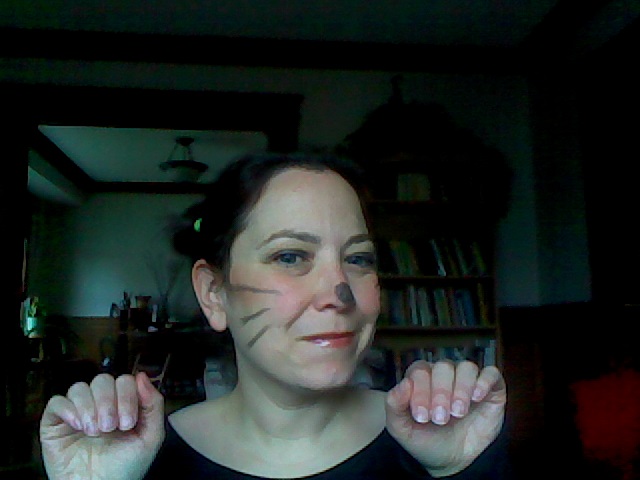
141031-135509But, still, it’s really frustrating sometimes not to be able to just go out and do things. Yesterday I got dressed up as a cat to do school pick-ups for the kids I watch on Fridays. Jamaica Plain turns into a giant party Halloween evening. And there was something so energizing about being a part of a community, wearing the sign of belonging on my face, the kids and parents smiling at me and I at them. I wanted the day to continue into evening, to walk around and smile at more people, to enjoy the fun. But when the parents let me go early so they could take their kids trick or treating, the headache bore down on me and it was all I could do to limp home, stopping briefly at a place near my house to pick up dinner.

Waiting at the restaurant for my order to be ready I felt a little sad and discouraged. I still wore my costume but it felt like a waste. The person who took my order didn’t smile at me. He was a little rude, actually. I felt far away from the party. Then two little girls came in with their mom. The girls saw me and their faces lit up. I smiled at them. Somehow that felt like a blessing. Two more smiles before I had to head home. Somehow that felt like enough for the day.

Today is Saturday and I am resting. This is another kind of wrestling. The tiger is here, resting next to me, on top of me, pinning me down. But I made it through the week. And rest is also a blessing. So I will change the metaphor a little. I will embrace the tiger, even as we struggle. I will see if I can turn the wrestling match into a kind of a dance.

Be still

migrainedepression

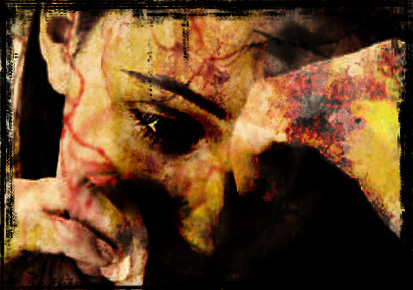
My migraines manifest in many different ways: Nausea, dizziness, derealization, light or sound sensitivity, neck and shoulder cramps, a throbbing ache in the back or front of my head, or a sharp pain on the side. Yesterday and today it has been one of the more “typical” migraine manifestations, the sharp, pulsing pain on one side of the head that gave migraine — Greek ἡμικρανία, hemicrania or “half head” — its name. I came across this painting several years ago on a website called deviantArt. It’s actually titled Depression, but to me it’s exactly how this type of migraine feels.

The other kinds I can mostly muddle through, but this type I need to just give in to, lie down in the dark and whimper till it’s over. Yesterday I didn’t give in — went for a walk and then to a babysitting gig, and the punishment was brutal. Driving home was the worst — I had to fight the urge to close my eyes against the pain, especially at intersections where there were lights. I learned this lesson years ago, but apparently have to keep relearning it: I can’t keep pushing myself. One of the weirdest psychological aspects of migraines, for me, though, is that I blame myself for them, and I feel that I’m being lazy by giving in to them.

Yesterday’s bad migraine was probably triggered by me pushing myself through a yoga video the night before, even though my body was telling me that I was too tired and needed to rest. My friend asked me why I pushed and I said that I just hated to not finish something once I’d started. It’s true. I want to be a finisher, to be strong, to be able to push through pain and laziness. This wouldn’t be a bad quality, I think, if it weren’t for the migraines. It would get me far in life, I think. But the migraines limit me and force me toward wisdom rather than strength. Toward quiet rather than striving. It’s frustrating, but I think it also gets to a deeper truth. We are not all-powerful. Even if I didn’t have migraines, even if I could push my body further, be leaner, run marathons, whatever the apex of physical strength is…Wouldn’t that just obscure the fact of my mortality, my ultimate frailty?

And, too, wouldn’t it make it harder to hear the still small voice calling me to be still? Are the migraines ultimately the voice of God, speaking, in a different way, the words of Psalm 46?

Be still and know that I am God.

Be still and know that I am.

Be still and know.

Be still.

Be.

In the pain of the migraine, there can be no striving, no accomplishing. All I can do is lie still and wait.