The world wants me to write about it today

“Pay attention. As a summation of all that I have had to say as a writer, I would settle for that.”
~ Frederick Buechner

“Instructions for living a life.
Pay attention.
Be astonished.
Tell about it.”
~ Mary Oliver

The world wants me to write about it today. It’s been throwing itself at me, quite shamelessly. It will do anything, it seems, for a bit part in one of my stories. From the moment I left my house the water sparkled at me like some reverse paparazzi, wanting its flash bulbs to be the news on page six. At Starbucks I tried to write my blog post about finances, but an apologetic woman sat across from me, asking in a soft, Germanic accent if there was room for her and her friend, while the Chinese family at the other end of the table nodded and gestured to her, making the word “okay” seem like both a full sentence and a solemn ceremony.

A few minutes later I glanced up to see the Chinese man holding his hands in front of him, empty palms open like a book, staring silently and intently at their pages, and the man on my other side answered his phone with a click of his earpiece and earthy Russian syllables rolled out of his mouth. I paused to take a selfie for Facebook — the intrepid writer hard at work — and when I cropped it I saw I had also captured a woman behind me wearing a head covering, hard at work on her own laptop, a novel buried in the soft furrow of her brow.

“Slow down!” I cried, “Let me choose — I write slowly.” And I fled to the library, hiding in a study carrel with just enough room for me. Safe, I thought. But I glanced over and caught the eye of the man in the carrel next to me, just as he was glancing over at me, and his brown skin, shoes kicked off and tie slung over his shoulder called out to be described. What color tie? Purple, with green stripes, and the shoes looked like loafers–

“Wait! Stop!” I called again to the flamboyant world. “That’s not my job right now!” I glued my eyes to to my computer, trying to write the post, copying and pasting. But the library turned out to be a dangerous choice as a myriad of childhood memories ran up and demanded to play on my page. How many times had I ridden my bike the two miles to the local library and spent the afternoon exploring the worlds within that sacred world? What was the name of the street? What was that smell that drifted out of the Italian restaurant as I biked by? “Tell about it,” the memories insisted. “Tell our story.”

So I ran to the park, a pond surrounded by trees, benches, fields. I grabbed my notebook — there was work to be done! But just within the gates a Korean wedding party gathered for a picnic, laughing loudly as I scurried by, dodging inspiration. (How would I describe the smell of kimchi? Sour? Vinegary?) Then I ran straight into a group of women dressed head to toe in black hijabs, making me suddenly aware of my broad, naked face, my bare hair flowing in the breeze (chestnut, with shiny wisps of grey). But I was restored to modesty as I rounded the corner by a scene from the cover of a romance novel — a young Hispanic woman dressed in a sleeveless, backless, flowing pink gown, with two muscular men holding out swaths of the fabric as a crew of four photographed them. Coming closer I saw the plot twist — the woman was pregnant, and cradled her belly proudly, shaping the dress around it. “Now there is a story,” the world said, pulling out all the stops: “Write it!”

Full to bursting I rushed up the hillside to sit in the crook of a fallen tree that would take me half an hour to describe. But I can’t, I don’t have time, because even as I write this a man has kicked a soccer ball near the pond and his shoe is flying into the air with it — he is hopping on one foot, laughing and shouting in Arabic. He is hopping right now, I tell you — he is bending down in the wet grass to retrieve his shoe. Did I mention the color of the grass? Did I tell you about the ragged feel of the trees after a long winter and a blustery early spring? Did I describe the slow perambulation of an elderly couple, leaning on each others’ arms for support? Did I write about the woman sitting in the crook of a fallen tree, writing furiously in a notebook as if the world were tugging at her sleeves? Did I get it all?

Bake for them two

One year ago today I wrote an essay. It was a little sermon, really, using all the skills and knowledge I’d learned at seminary: exegesis (digging into the historical, Biblical, cultural, and literary background of a Bible passage), “big idea” sermon writing, and application. It represents decades of thought, prayer and Bible study, not just of this passage, but the whole Bible, Old Testament and New. This is what I have to offer. After the recent “religious liberty” rulings in North Carolina and Mississippi, I think it’s even more important to ask ourselves what is more Christian? To insist on our rights at the expense of others’ rights? Or to serve, sacrificially, even if it costs us something? We don’t have to wonder, Jesus addressed this issue in the Sermon on the Mount. Christians, our Jesus said “Go with them two.”

Jessica Kantrowitz's avatarTen Thousand Places

canstockphoto9505469In Jesus’ time, the nation of Israel was under Roman rule. The Israelites were allowed to live there and practice their faith for the most part, but they had to pay taxes to Caesar and obey the Roman laws.

To the Israelites, the Romans were evil and ungodly. They had no place ruling over God’s chosen people in God’s chosen nation. That land had been promised to Moses and his descendants when God brought them out of Egypt. Their very presence in the land was blasphemous.

One of the Roman laws stated that any man could be required to drop what he was doing and carry a Roman soldier’s equipment for him for up to a mile. In the Sermon on the Mount, with his followers gathered around him, Jesus referenced that law and told his followers what they should do in that case:

“If anyone forces you to go…

View original post 987 more words

We choose you

My valentine card for all who have felt unloved and unchosen. Please consider it accompanied by those little candy hearts. ❤ I choose you. We choose you.

Jessica Kantrowitz's avatarTen Thousand Places

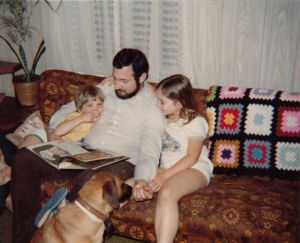
Me with my dad, little brother David, and our dog, Hector. Me with my dad, little brother David, and our dog, Hector.

When I was about eight or nine years old we read at church the story of Abraham preparing to sacrifice his son, Isaac because God called him to. Later, at home, I asked my dad, “Dad, what would you do if God told you to sacrifice me?” I don’t know if he realized what an important question it was for me. I loved God, and our church, and the stories we read in the Bible. When I was three I had prayed for Jesus to come into my heart. But this story scared me. I knew God had provided Abraham with a ram so he didn’t have to sacrifice his son. I don’t remember if I understood at the time that it was an analogy to Jesus, to God the Father providing us with His only son as a…

View original post 1,400 more words

Three / ten thousand places

I

As kingfishers catch fire, dragonflies draw flame;
As tumbled over rim in roundy wells
Stones ring; like each tucked string tells, each hung bell’s
Bow swung finds tongue to fling out broad its name;

I saw a great horned owl at the Arboretum last weekend. I bundled up and set out for a walk on the last day before the temperatures were forecast to settle below freezing, where they are now. I walked briskly over Peter’s Hill and to my favorite section, Conifer Path, where the color palette changes to ocean blue and dark green with subtle reds here and there, and the noise of the nearby street and of your own footsteps is softened by the layers of pine needles. I wish I had a better camera but I will try to describe to you how lovely it is there, in all seasons, but especially whatever the current season is: now, winter, with patches of snow adding even more visual interest and softness. White is beautiful in itself, but it also highlights the beauty of the colors around it; it is a neutral color, a team player, clashing with nothing, strong enough to cover everything but delicate enough to surrender quickly to the yellow of dogs’ urine and the brown-ish red of the autumn leaves that are stirred from under the snow by the wind and my fellow hikers.

For some reason, when I first heard the owl calls I assumed it was a human making them. I think I wanted so much for them to be real that I forced myself to doubt them. I even grew annoyed, as the calls went on, wishing whoever was making them would stop trying to trick me and let me enjoy the woods in peace. I crossed over from Connifer Path to Oak Path, skirting Bussey Hill because I didn’t want to push myself too hard and get a migraine, but when I came to Chinese Path I couldn’t resist and hiked uphill past Explorer’s Garden, almost to the top of the hill, then followed the road back down and retraced my steps through the conifers. S30A07641

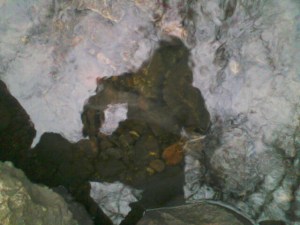
I was almost back to the main road when I was distracted by a stream, and started wandering along it, crunching the damp, half-frozen ground underfoot and taking pictures with my cheap camera phone. Here’s the only one that came out okay, a picture of my own reflection in the stream. I love how the moving water looks like an abstract painting, and how you can see the rocks at the bottom of the stream where my reflection blocks the sun. I love photography. One of these days I’m going to get a nice camera.

As I was wandering along the stream I heard the owls again, the iconic hoo followed by three shorter hoos. The first owl would do the call, then another would repeat, but in a lower pitch. Suddenly it occurred to me that there were real owls in the Arboretum, and a second later, that I might be able to see them. I set off slowly across the slope that led back to Conifer Path, pausing to adjust my direction every time the owls called out. I soon honed in on a group of some of the tallest trees in the area, Giant Sequoia, maybe, or Japanese Cryptomeria. They created a cathedral-like space, darker and quieter than the outside world, and I found I was one of four people tiptoeing into that church, looking up to try to catch a glimpse of the birds. The others were two women and a girl of about nine or ten. We glanced at each other and smiled a greeting, raising our eyebrows in wonder, wordlessly agreed to a vow of silence so as not to scare away our avian hosts.

Then, one of the owls soared from the top of one tree to another, and we saw it, for a moment. My heart rate quickened and I caught the eye of one of the other women and mouthed, “WOW.” We continued to look and listen, but the owls didn’t reappear. A few minutes later another woman tromped into the piney cathedral, speaking loudly, and calling to her dog, and the spell was broken. The owls wisely turned quiet as we humans talked, sharing what we knew about the owls. One woman said a male great-horned owl had been killed last year, and people wondered what the two or three females were going to do. We agreed that this pair sounded like a male and female, and I confirmed that later on the website All About Birds:

“Great Horned Owls advertise their territories with deep, soft hoots with a stuttering rhythm: hoo-h’HOO-hoo-hoo. The male and female of a breeding pair may perform a duet of alternating calls, with the female’s voice recognizably higher in pitch than the male’s.” The others said good bye and dispersed and I found a comfortable tree root and sat quietly for a few minutes, hoping to hear the owl’s conversation start up again. But after a while I grew too cold, and realized the sunset was coming, so I waved good bye and headed back down the path, over the stream, and back home.

II

Each mortal thing does one thing and the same:
Deals out that being indoors each one dwells;
Selves — goes itself; myself it speaks and spells,
Crying Whát I dó is me: for that I came.

On my way back from the Arboretum, there is one of those Tiny Free Libraries; an adorable little yellow one in the shape of a house. You are encouraged to take a book or leave a book, whichever you prefer. I noticed that the owner of the library was very hands-on in rotating the selection, so that almost every time I walk past there are new options to choose from.

The tiny free library

The tiny free library

I noticed this about the rotating selection, but for the first two years I walked by I failed to notice something else about this TFL, the most fun thing: It’s a model of the house behind it.

IMG_0444

The house

This makes me more happy than I can express. But the best part so far, I am so excited to tell you, was that last December, when a large Christmas tree appeared on the covered porch of the main house, a tiny Christmas tree also appeared on the covered porch of the library. I can’t help but feel that anyone with such imagination and dedication to this project must be enjoying life very much.

III

I say móre: the just man justices;
Keeps grace: thát keeps all his goings graces;
Acts in God’s eye what in God’s eye he is —
Chríst — for Christ plays in ten thousand places,
Lovely in limbs, and lovely in eyes not his
To the Father through the features of men’s faces.
~Gerard Manley Hopkins

I love children, and I love being outside, and possibly my favorite thing in the world is being outside with kids. It is the best part of April through November, and occasionally we still make it outside in the winter, too. One afternoon in December I stopped at Lars Anderson park on the way back from picking up the 9yr old and 5yr old from school, and wrote this note afterwards:

I was going to write about how I wished I had a better camera, how these pictures from my cheap phone couldn’t convey the exquisite joy of running up a sunset-streaked hill with two boys, the little one full of pride and purpose because I said to his big brother, “N’s in charge of the expedition!” finding a giant, spiky bush that had overgrown a glacier-dropped rock on the hillside, crawling inside and clambering around until we realized that the rock was the entrance to a troll’s lair and the troll was coming, running out and away to one of our favorite climbing trees, climbing for a while as the sun dipped closer to the horizon and the air became colder, and then making our way back down the hill to the car, I walking and the boys rolling down faster than I thought was possible for the human body to roll, then running back up and rolling down again.

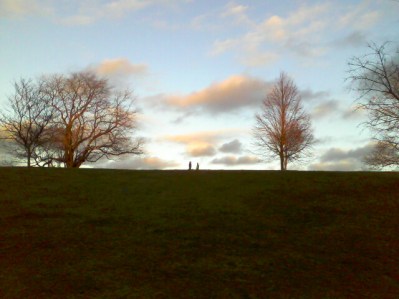
S30A07221I took a few pictures but I was planning on using them mainly to say “it was like this but a thousand times more gorgeous.” But then I saw this one, and I think it actually conveys the moment quite well. This is when the boys ran back up the hill to roll down for a second time, while I waited for them at the bottom. A bit blurry, but I love the composition with the boys silhouetted against the eastern sky almost exactly at the center of the photo. That’s our climbing tree to the left.

Such beauty all around. Sometimes even a cheap camera phone can’t help but capture it.

*****

More about the Hopkins poem, and why I named my blog after it can be found here: Ten Thousand Places

Are you following me on Facebook? Come hang out!


On jealousy and the need to be special

greendragoneye I had a relapse yesterday. It wasn’t depression or cancer, I didn’t get drunk after months of sobriety, but those are pretty good analogies to the way jealousy tries to take over and destroy. What happened was, well, two things. First, my family is getting together this weekend for our Thanksgiving celebration, and since I’ve had a really busy work schedule this month I decided to stay home alone Thanksgiving day to rest and get in some much needed introvert recharging time. So I chose to spend that day alone, because I like being alone.
But despite that very good logic, something happened when I looked on Facebook and saw all the pictures of friends and families gathering for meals. One picture in particular, of a group of friends of mine eating together, sent such a feeling of grief through me that I had to do a breathing exercise to recover. I knew those friends loved me, and I knew I would have been welcome at the table, and I knew that the very good reason that they hadn’t invited me was because I live several states away, but still it triggered that deep feeling of being left out, that feeling that has not only plagued me since I was a kid, but somehow defined me.

The other thing that happened was that Sarah Bessey commented on the post I wrote for her synchroblog, and instead of feeling excited and happy that she had read it and like it, I felt sad that she had read and commented on all 133 submissions. How can I be special if everyone else is special, too?? If you could somehow scan my brain, you would find that question etched into the deepest parts of it. If everyone is special, how can I be special? That’s not even what the word means, right? Just like something can’t be very unique, as I learned from the West Wing:

But the thing is, I believe exactly that. I believe we are all special, all unique, and all deeply loved. And I believe my own specialness, my own calling, does not lie in convincing others that I am more special, more unique, and more deserving of love, but in noticing and affirming the ways that others are unique, special, and loved. I believe the ways I am different from others are not as important as what I have in common with others.

A little while after Sarah commented on my blog she posted a few of her favourites (with a u because she’s Canadian 🙂 ) on her blog. Mine was not among them. And I had to have a little chat with myself. Listen, self, I said. You do not have to be told you are special all the time. And the times that you are told that — when a blog post goes viral, or your friends share and compliment a post, or you win a contest — those are not the things that define you and your writing. Those are nice things, those affirmations, but it’s not why you write. You write to bring the deep, scary things to light, to express as well you can your own struggles and perspective, not to show off how deep you are or how clever or how good a writer, but to know you are not alone, and to tell others that they are not alone. If you were so unique and special that no one could relate to your experiences, then no one would want to read what you wrote.

It has taken 41 years to get to the point where I believe that. And I mostly did, yesterday, after the breathing exercises and the firm but gentle self-talk. But there was still a part of me that felt left out and lonely, over-looked and unimportant. And then this morning Sarah posted the winning submission, the entry in the synchroblog that had most stuck with her, that she most wanted to share with her readers. It is an essay by Rachel Roth Tapling about her struggle with faith, with the Bible, with church and leadership, and it is gorgeous. It spoke to me; in fact, it did what great writing does, what I aim to do with my writing, it described my own experience in a way that helped me understand it better. It made me say, “Oh my gosh, me too!” It was healing. And as I read it and found healing in it, I also found the final piece of healing for yesterday’s relapse into jealousy. Because I realized Sarah had chosen this essay because it needed to be read — because I needed to read it. I realized that Sarah’s end goal, that Rachel’s end goal, and, ultimately, my own, is not to choose who is special and who is not, but to help us all to find healing, to find our way through the struggle and doubt and trauma back to Christ. And I absolutely agree with Sarah — Rachel did that best. You can read her wonderful essay here.

Friend, you are special. You are unique. You are loved. Just like me, just like everyone else. If you don’t believe me, here’s one of the only people I ever believe when he says it. If you want to, if you’re ready, listen to him singing this song and imagine it’s God singing it to you.

Love,
Jessica

On sin and repentance

outofsortsbookSarah Bessey’s wonderful book, Out of Sorts: Making Peace with an Evolving Faith released this week. Do you have your copy yet? To go along with the book launch, Sarah is running a good old-fashioned synchro-blog, with the prompt, “I used to think___, but now I think___.” It was a project for her launch team, but Sarah just opened it up to everyone, so if you have something you’d like to write about, check it out!

I have been thinking about what I wanted to write about for weeks. I have things I want to say about spoken and unspoken gender roles in Christian community, and about spoken and unspoken roles for singles vs married people. I haven’t much changed my mind on those things — I’ve been a feminist and egalitarian since before I knew what those words meant — but I’ve been willing to work with complimentarians in the past, and even put myself in positions where they had authority over me, and I didn’t realize until much later how damaging those experiences had been. But I don’t think I’m quite ready to write about that yet.

Then of course there’s the obvious issue of LGBTQ inclusion. That is probably the shiniest thing that I’ve changed my perspective on. But I don’t think that’s what I want to share for the synchroblog. (If you’re interested, you can read this post about how I changed my mind.)

Here, though, I think I’d like to share a little about how my perspective on sin has shifted. So I’ve adapted an essay I wrote this summer:

Savasana: On finding the uncluttered space

The first time I went to a yoga class I struggled through, watching the clock the whole time. I knew the class was an hour and fifteen minutes, so it was with a sense of surprised blessing that I realized, with twenty minutes still to go, that we were winding down. The poses became slower and easier, and then the teacher told us to lie on our backs and make ourselves comfortable. She suggested putting our socks back on and pulling blankets over ourselves. She dimmed the lights, put on soft, meditative music, and I suddenly realized that it was nap time! Just like in kindergarten, we all lay together on our mats and rested. It felt funny lying in such an intimate, vulnerable pose in a roomful of people, eyes closed as the teacher led us through a relaxation exercise. But I soon forgot about the others and reveled in the peace and quiet as my sore muscles came to rest and my mind settled, my body becoming chilly as the sweat cooled.

Savasana is the word both for the pose — on your back with your arms out at a slight angle — and the process of lying in that pose and going through the relaxation exercise. It happens at the end of every yoga class, and is a way of allowing the poses you have just done to settle into your mind and muscles. It is also a body meditation, similar to centering prayer and bio-feedback, two things I stumbled upon a few years ago in my quest for spiritual and physical health. Like centering prayer and bio-feedback, you are encouraged to take a passive attitude to your thoughts, to allow them without trying to change them, but without latching on to them, or identifying with them.

One analogy used in centering prayer is to see your thoughts as clouds going overhead: You notice them but they don’t affect you down where you are, and they blow past with the wind. For someone who has struggled with anxiety, this is incredibly powerful: I don’t have to try to STOP thinking the anxious thoughts, or to change them or replace them with positive thoughts — exercises which left me exhausted and twice as stressed out — but I don’t have to define myself by them, either. I can nod at them, even greet them with friendly acknowledgement, but then not concern myself with them. I sometimes picture them as clouds, and sometimes as an object beside me: there, but not a part of me. Observe your thoughts, my teacher says, acknowledge them without trying to change them. So I notice: I am angry at my housemate for something stupid, I am worried about money, my back hurts. It’s okay. I don’t have to try to stop being angry right now, or stop worrying, or get my back to stop hurting. That’s just how I feel. It’s not me. My true self is deeper than those thoughts and feelings, is at peace.

I think that growing up and coming of age as a Christian, there were a lot of things I thought were sins that were just feelings, just me struggling to figure myself out, and figure others out, and find my place in the world. Repenting and trying to change those thoughts and feelings was a difficult, and unproductive process. I believe in sin, and in repentance, the Hebrew word shuv that means turning away from bad choices and back towards good, turning away from the wrong path and back to the right one, turning back to God. But I wish that I had known about savasana, too. I wish I could have given myself that space and gentleness, to not immediately identify my feelings as sins, and identify myself with them. Repenting of anger never helped me let go of that anger so much as gently acknowledging it, setting it next to me, and quieting my body and my mind. I can let it go. It isn’t me. I think if I had known how to do that it would have helped me to understand what the real sins were, what things were really pointing me away from God, which direction I needed to turn to go back towards God.

I remember as a child going to church and coming to the confession, week after week, the moment in the service where we read the prayer confessing that we had sinned, “In what I have done, and in what I have left undone.” I thought the second part was so profound — It’s not just our bad actions that are sins, but also our failure to act when we could have done something good. But I remember wondering, and asking my parents: Why do we have to pray that every week? If we’re asking God to help us not to sin next week, shouldn’t he help us? But we pray it automatically — no one stops to ask, “Did anyone succeed in not sinning this week? Great!” Everyone just assumes that we all messed up again. And if failure is built into the system, what’s the point of trying so hard every week?

My poor parents. Those were the kind of questions they had to field on a Sunday morning. But even as a kid the logic confused me.

Then I remember in college, struggling with the same things week after week. I wanted to be patient and kind, to love other people without judging them, and to care about others and take care of them. Those are still my goals, now that I think about it. But every week I found myself frustrated and impatient, judging others and thinking mean thoughts towards them, and frankly caring more about myself than them. That was mixed in with a lot of genuine caring and loving and even good works. But it was so frustrating to me that those thoughts were there. And the harder I tried, the more I repented and asked God for help, the more it seemed the bad thoughts loomed in and took control. And then there were the things that I now think weren’t even sins at all: Anxiety, depression, insecurity, jealousy, loneliness. Some of it was probably clinical and I could’ve used more help than I was getting. But some of it, I think, was just a normal part of being human, of being 19 and trying to figure out who I was, of being someone who thought deeply and took everything in and tried to figure everything out. I tried so hard, and I was so hard on myself for not figuring it out faster and better.

I sometimes think of that strange passage in Matthew 12:45-47, where Jesus speaks of an impure spirit that is driven out of a person, and then comes back to find the place swept clean, and takes up residence again, this time with “seven other spirits more wicked than itself.” And it reminds me of a lyric from a Ray LaMontagne song, Empty, which is about his struggle with depression:

Well I looked my demons in the eye
Bared my chest said do your best to try to destroy me
You know I’ve been through hell and back so many times
I must admit you kind of bore me

I heard that song during a very dark time in my life and I could so relate to the weariness of driving out demons only to have them return and return. Maybe I could just let them be, let them float overhead like clouds while I met with God down below. Maybe if I stopped casting them out they’d grow bored, too, and not want to play anymore.

One evening this August, after a long day at work, I came home and made my way to my yoga mat. During the savasana I opened my eyes and looked up at the ceiling. And I noticed something I never had before. Above, the white textured ceiling was bordered by dark wood paneling that matched the wood on the walls, and it created a framed rectangle the exact size of my living room. My living room is the place I spend more time than any other room (if you don’t count time asleep); it’s where I work on my computer, play on my computer, read, entertain guests, and do yoga. I sit on the front porch sometimes, and hang out in my bed at night, but the living room is the space most full of me, my activities and my presence. And tonight I noticed that there is a space the exact same size and shape above it, with soft, white, textured paint and a dark wood border. It is my living room, but it is emptied of furniture, rugs, house plants, computers, tissues, candles — all the things that clutter the floor below. It is a framed, empty canvas, in the shape of my life, my living, my room.

I realized that this space perfectly represents the place I go to when I do centering prayer, or savasana. In this case the clutter is down below, and that beautiful, white, uncluttered space is above — exactly the shape of me, but empty of all of the thoughts and anxieties, habits and coping mechanisms, that make up my daily life. It is a blank canvas, where I can meet God and we can create something together. God is the paint, and I am the brush, or I am the brush and God is the artist, or I am the canvas only and God is all the rest: the blended colors of the full spectrum, the rocky pigment sparkling in the paint, the sharp edge of the palette knife, the rough horse-hair of the brush, and the Artist Himself, waiting for his materials to settle down, to move all that clutter off of the canvas so He can finally begin.