Of Monsters and Men

MonsterWell,my attempts to change my inner self talk to positive statements are failing laughably. How are yours going? For every, “I’m strong!” and “I can do this!” several dozen, “I can’t take it”s and “It’s too much”es creep in.

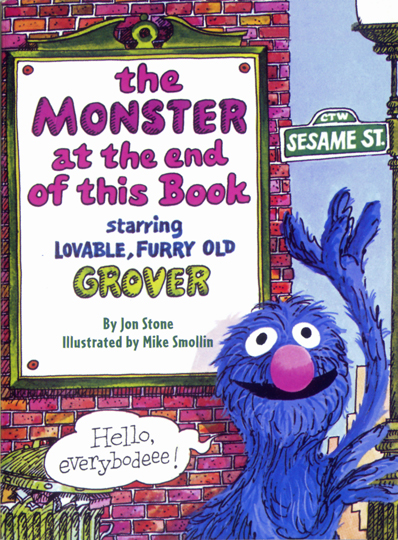
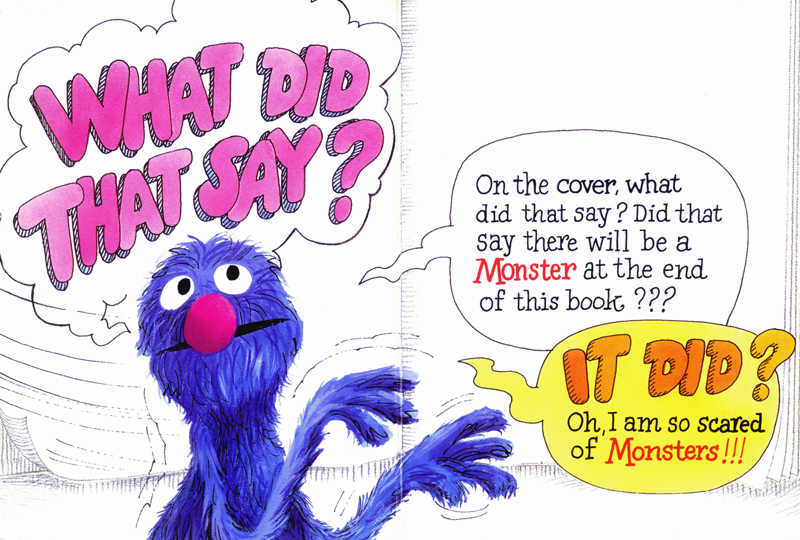
We had a book when I was five or six called The Monster at the end of this book. On the first pages, Grover reads the title of the book and gets scared. He doesn’t want to see the monster! So he comes up with the plan that we — he and the reader — just won’t turn the pages. If we don’t turn them, we’ll never get to the monster, and we’ll be safe. Of course you, the reader, keep turning the pages, and Grover gets more and more frustrated with you, and more and more panicky as you get closer to the end. It’s hilarious.

When my mom started to read it to me, *I* got scared. I was firmly in Grover’s camp. DON’T TURN THE PAGES MOMMY! I remember crying hysterically until she hid the book safely away in the top of a closet. It wasn’t until we moved when I was almost eight that we remembered the book was there, and found out that *SPOILER ALERT* — GROVER was the monster at the end of the book all along! “I, loveable, furry old Grover am the monster at the end of the book. And you were so SCARED.” Well, yes, Grover, I was.

Back to the almost present, three days ago, when the snow piles and consequent traffic was so ridiculous that I decided to take the bus to work instead of drive. The bus was right on time, I thought, till a fellow passenger told me that it was actually the one that was supposed to come an hour ago — she knew because she’d been waiting that long. Once I got on the heated bus I shed my hat and gloves and unknowingly dropped my sunglasses on the floor. A kind, middle-aged, gentleman tapped me on the shoulder and handed them to me, sparking a train of thought about the goodness of most people and how we still help each other out even when we are stressed. Then the same man suddenly yelled out the window,

“F**K YOU, MONSTER STORM!!”

before lapsing back into a meditative silence. The rest of the passengers looked over in brief surprise, and then went back to their own thoughts and lives.
I am so scared of monsters

Yesterday I drove again because I had to take the little girl I nanny to school. The roads were — are — still awful. Many two-way streets are reduced to one narrow lane with walls of snow on either side. Tempers are running short all around. The three mile drive to the girl’s school took almost half an hour. I thought I was handling the stress pretty well, but looked down after a particularly stressful incident involving a taxi and saw that I had chewed my thumbnail down till my finger bled.

Then, amidst all the honking and close calls, a woman tried to merge in front of a man behind me and he got angry. He jumped out of his car, leaving it sitting empty on a busy, four lane street, and started yelling and swearing at the woman — and then pulling on her door handle! It was terrifying. I opened my door to try to help — talk him down, or call the police, or take a picture of his license plate or something — but realized I couldn’t leave the little girl alone. I had my phone out to call the police, but before I could the man jumped back in his car and drove off.
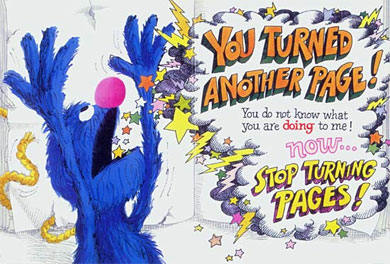
Page from TheMonster at the end of this Book, by Jon StoneThere has been more snow in the past two weeks than Boston’s average for the entire winter. And another foot or more is coming this weekend. I feel like shouting, like Grover, “STOP TURNING THE PAGES!” Or maybe borrowing the exclamation of the gentleman on the bus. If we could stop turning the pages, maybe we could stop the snow from falling, and maybe that would stop the monster from coming. But, in the end, if it turns out that the monster was only ourselves all along, would that be any better? I already bit my own hand — what damage will I do if the snow keeps coming? And the man who leaped, roaring, out of his car — what will his monster do if we get to the end of the book? I am scared to find out.


Boston in January


wickedbigstormLate January — This is the time of year that winter always starts to feel too much for me. I thought I was making it through pretty unscathed this year: We’d had almost no snow so far here in Boston, which meant no shoveling, no scrabbling for precious, hard-dug-out parking spaces, no arguing with neighbors about the proper way to pile up the snow. But all that changed — and changed dramatically — this week with what one meteorologist said was the sixth biggest snowstorm in Boston in recorded history. Before it even came it caused tension in my house over an unregistered car that our subletter had been storing for months, without permission, in the driveway. Our landlords, my housemate, and the downstairs tenants who share the driveway all wanted it moved and the snowstorm brought the issue to a head. I felt that if it wasn’t moved before the snowstorm it was going to be stuck there till March or April. The subletter couldn’t find the title and was apologetic but refused to move it before he got it registered. I pushed the issue more than I would have if it weren’t for the coming storm, and emotions were high all around.
I shared with my writer’s group that it had been a hard day, and one of them said, “If a tough life is a good story, then maybe… a tough day is a good blog post?” I replied, “Yeah, it may be a good blog post some day. Right now if I wrote about it it would be too much Why I Am Right And The Other Guy Is An Idiot. I *am* and he *is* 😉 but I’ve got to wait till I get to a deeper truth than that.

Then the storm came and things just kept getting worse. We had more disagreements with our subletter over how to shovel, because there is just so little room to put all that snow. Our neighbor once again expressed disapproval about how we were shoveling. Another neighbor’s van took up one and a half parking spaces, so I couldn’t use the spot I’d dug out. And I heard from my mom that she’d fell and hurt herself, and was taking longer than expected to recover. Now it is snowing again, and more coming on Monday. We haven’t come to a consensus with our subletter about the shoveling, and the snow piles keep getting higher. I came up to my parents’ to help them out and take my mom to her chiropractor’s appointment but we had to cancel the appointment because the roads are so bad. I re-injured my knee — not in the snow, but still. And the headlight on my car went out.

It just keeps piling up, literally and figuratively. Roads are narrower, driving anywhere takes twice as long, and parking is next to impossible, even if you have put a chair in the street to save your spot. People are just tense. This is a hard time of year.

So what is the deeper truth in all of this? I’m not sure, but I think a couple of things are true. The first, I think, is the same lesson I keep coming back to: Conflict is just part of the human condition. People are going to disagree and get frustrated at each other no matter what. There is no perfect amount of action or inaction, passivity or assertion, speaking or keeping quiet that can avoid this. There is no perfect thing to do or say that will avert all conflict. I question whether I should have pushed our subletter so much, but at the same time I feel like I had genuine concerns that it was okay for me to express. In any case, it’s time to let it go and move on. The endless post-game , play by play analysis is too exhausting.

And, second, I think that none of us should be judged by how we behave in New England in late January. We are worn out and weary and not at our best. So I will take a deep breath and forgive myself, and then try to extend that grace to others. And I will try to find things to laugh at. Like this:

dunkin donuts boston

If Dunkin’ Donuts is closing, you know it’s serious.


Driving west

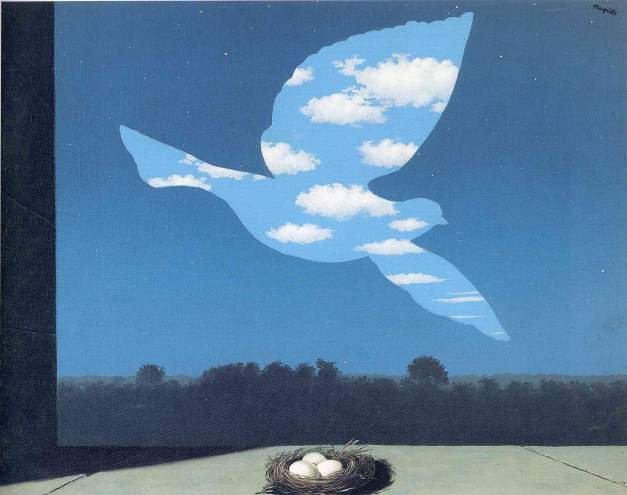
The Infinite Recognition by René Magritte

The Infinite Recognition by René Magritte

My friend and I were driving from Boston to Connecticut late one afternoon, and the sun was bright in the western sky. It was my car, but he was driving. He usually scorned sunglasses, this friend, but I had an old pair in the glove compartment that I offered him, and, after squinting into the sun for a while, he put them on. They were the kind that somehow make things look brighter and more defined.

As we drove on, the clouds were gathered in one of those spectacular pre-sunset displays, cirrus, stratus, and cumulus layered on top of each other with sunlight streaming through them.

“Those clouds are beautiful,” my friend said, and I agreed.

A few minutes later he said, “Those clouds are really gorgeous! I mean, look at the layers! I’ve never seen clouds like this before!”

“It’s really lovely,” I agreed. And it was. He was excited and happy, and I enjoyed his happiness. He struggles with depression as well as other serious health issues, and it is nice to see a tiny bit of joy break through. And the only thing better than watching the unfolding of a gorgeous sunset is watching it with a friend who is enjoying it as much as you.

I think he had forgotten he had the sunglasses on. I decided not to tell him that the clouds were the regular, everyday miracles, that the sunglasses were just helping him to see them better.

I just finished Madeleine L’Engle’s book The Summer of the Great Grandmother. It was written during the last months of her mother’s life, when she was suffering from what sounds like Altzeimer’s disease. Madeleine describes her teenage thoughts about what heaven must be like. She imagines a planet where the sentient beings do not have eyes, and cannot imagine what vision is, what it would be like to see. Then she imagines that when we die, “we might go to another planet, and there we might have a new sense, one just as important as sight, or even more important, but which we couldn’t conceive of now any more than we could conceive of sight if we didn’t know about it.”

Perhaps that’s what Paul meant when he wrote, “For now we see through a glass, darkly.” Not another planet, maybe, but new eyes to see the one we already have. New eyes, or new hearts, or something we can’t even imagine yet. Maybe whatever it is will help us make sense of all the pain and darkness here on earth, the depression, disease, and death. In the meantime we see glimpses of it in the glory of the clouds at sunset, through our human, fallible eyes, through our contact lenses and glasses and sunglasses.

Accept, let go

CandleI was having a tough time this morning — not enough sleep, a cranky two year old that was making me feel like a bad nanny, and a difficult email conversation — and feeling anxious and like I needed to do something to make myself feel better. I ran through all the things that I could do and they mostly involved trying to get other people to make me feel better. I am totally in favor of the phone a friend option, but somehow this didn’t feel right to me today. If I hadn’t been with the little one I might have considered chemical options (only the legal ones, don’t worry!) Then I remembered one of the biggest lessons from yoga and life: Observe your feelings without judging them. I took a deep breath (another of yoga’s big lessons) and said, This is how I feel, and it’s okay. Suddenly my heart rate slowed, the anxiety lifted, and I had my perspective back. Those stressful things were still happening, but they didn’t control or define my day anymore.

I started a practice a year or so ago, when I was struggling with some difficult memories, of breathing in deeply, and my in-breath represented full acceptance of myself and everyone else involved in the memories. As I breathed in I acknowledged that I had done my best, despite my mistakes and weaknesses, and everybody else had probably done their best too. The air expanded my lungs and made room to allow me to be who I was, and others in my past to be who they were. Then I exhaled, and that represented letting go of the pain and hurt, that had been done to me, and that I had done to others. Breathe in — accept. Breathe out — let go.

I try, also, to do the same thing with stress, anxiety, or feelings that are just too much. Breathe in — observe and accept. Breathe out — let go. I think this is similar to what Glennon Doyle Melton is expressing when she says, “Everything beautiful comes from our ability to sit still with our discomfort.” If we are brave enough to be quiet and not try to fix our feelings, or distract ourselves from them, or chase them away with a glass of wine or a pill, we might discover that they won’t actually destroy us. They probably will even have something to teach us.

Esther Ekhart has a wonderful explanation non-attachment. I’m not sure if you have to be a subscriber to watch the video, here is the link to it anyway. She says that true non-attachment doesn’t remove you from the world around you, but rather frees you up to fully engage with it.

The two year old is napping now, and will hopefully wake up less cranky. I’ll probably feel kind of crummy later since I’m not napping, but that’s okay. As long as I remember to breathe in and out I’ll be okay.

Things I’ve been wrong about for most of my life, part two

Bewitched Park by Leonid Afremov

Bewitched Park by Leonid Afremov

Ever since I was very young I’ve felt this strange tension between feeling smart, creative, special and, at the same time weird, awkward, and out of place. The first thing made me feel happy and proud; the last three incredibly sad and even bitter. But all of them made me feel different. I moved through life pretty well, more or less, did well in school, went on to college and grad school, was in leadership roles in most areas of life. But I always felt like my true self, my real thoughts and feelings, were too weird and scary to share. I felt out of place all the time, even among friends, even when I was the leader or organizer of a group. I created a secret world inside myself and hid parts of myself there — the parts that I thought made me too strange and different, and kept me from fitting in.

But, somewhere, at some point, I started getting glimpses of a larger truth. I can’t remember when the first glimpse came — in high school or college, maybe? At some point I heard this quote by the Roman playwright Terence: “I am human, and nothing human is alien to me.” I wrote that in my journal and thought, yes. Nothing human is alien to me, and if that is true then maybe nothing in me is alien to my fellow humans. Maybe I am just human after all. No better or worse than the rest of the humans.

And I started noticing that I wasn’t the only one who felt different and alone. I began to think that maybe, actually, more people felt out of place than in. And if that were true, then maybe none of us were actually weird and different. Or maybe we were all weird and different, actually. Maybe I was weird and different, just like a lot of other people. And maybe that meant none of us needed to be alone.

I have so much more to say about this, but the sun is rising and I have to get ready for my day job soon. But today I wanted to tell you this: When I wrote the first part of this series, Things I’ve been wrong about my whole life, part one, I shared something from that secret part of myself. I had never felt more alone or more on the outside than during the time I wrote about in that essay. And something wild happened when I got brave and wrote about it and posted it on my little blog with my few dozen readers. People read it and said, “Me, too.” My friend Glennon Doyle Melton of Momastery read it and said, “Me, too,” and shared it with her followers on Facebook. And then, suddenly, hundreds and thousands of people came and read it, and said, “Me, too,” and shared it with their friends who said, “Me, too,” too.

When I felt most alone, when my thoughts and feelings seemed too intense and strange and even crazy — there were literally thousands of others feeling just like me. My deepest fears and struggles, the ones that made me feel so alone, turned out to be what I most had in common with my fellow humans. Maybe the same is true for you?

*****

Come find me on Facebook and let’s be weird and different together!


Blunders and Absurdities

Her Shame by Dena Cardwell

Her Shame by Dena Cardwell

A couple of months ago I wrote an essay called, “Things I’ve been Wrong About Most of My Life, Part 1.” It was about learning to stop judging and critiquing myself all the time, to let go of the untrue criticism of others, to apologize when I really did do something wrong, and forgive myself. I included this quote from Ralph Waldo Emerson:

“Finish each day and be done with it. You have done what you could. Some blunders and absurdities no doubt crept in; forget them as soon as you can. Tomorrow is a new day. You shall begin it serenely and with too high a spirit to be encumbered with your old nonsense.”

The essay seemed to strike a chord in some who read it. A couple of women commented that they were haunted with guilt for past “blunders and absurdities.” And I thought about what that meant, in my life and in others’. There are certainly things that I’ve done wrong, people I’ve hurt, ugly feelings that I’ve acted on — things I might call “sins.” But blunders and absurdities — those are something else. Those are the things that were awkward, ridiculous, weird, that exposed my otherness, that made me feel like I didn’t belong in society, that I didn’t belong among friends. Those are the things that are decades old but still make me flinch every time I think of them. And as I thought about them I got mad. I thought, what right do these b’s and a’s have to kick me in the gut, over and over again, so many years later? What right have they to suggest that they represent the real me, the secret me that if people knew about they would run? And what right do they have to haunt my friends with guilt? No, I thought, enough. We should be free of these. Of course, this is easier said than done. Easier preached than practiced. But one thing I do know, is that secrets, and fears, and secret fears shrivel up when they are exposed to the light.

So today I’m writing about — and publishing — the three blunders and absurdities that plague me the most. Some are silly. One is genuinely awful. For some I do owe an apology — though it’s not clear to whom it should be addressed. This, then, is my confession and my apology. But it is also my declaration of freedom. I am bringing them out of the dark corners of my heart and into the light of day. I am putting them, finally, to rest. And maybe if I share my own secret pangs of guilt it will help other people to feel less alone. I know we all have them, these blunders and absurdities.

The first happened at a friend’s wedding, about eighteen years ago. I didn’t know most of the guests at the reception, so I was wandering around, nibbling snacks and making small talk. The time came for the bride to throw the bouquet, and I gathered with the other single women. Among us was the widowed grandmother of either the bride or the groom — I can’t remember which. I heard some of the women joking about letting her catch it but I wasn’t really paying attention. The bride turned around and tossed it, I stepped forward, raised my hand…and caught it! For a second I was excited and happy, but then I looked around me and saw that I was the only one who had stepped forward — and I had stepped right in front of the grandmother. I don’t remember if there was silence or feeble applause. I don’t specifically remember a surprised look on the bride’s face, or the grandmother smiling graciously. I can’t say for sure that the other women glared at me or whispered behind my back. I don’t even remember if I took the bouquet home. But I vividly remember that moment of realization after I caught the bouquet and looked around, and I feel that jab of shame again every time I think of it. Blunders and absurdities.

About ten years ago I was traveling in Morocco, and I stayed with a family in a small village there. I’d been with them a few days when Friday came along — the day that the men went to the mosque and the women spent the morning cooking a big couscous meal. I was used to the box of couscous that takes five minutes to make, but in Morocco it took the whole morning and was a special Friday tradition — they didn’t eat couscous any other day. I spent the morning in the kitchen with the women. By the time the men came back from prayer we had a giant plate of couscous covered in meat and vegetables. It was beautiful, and I couldn’t wait to dig in. We all sat around the table, with our own spoons but a common plate in the middle. As the guest I was asked to take the first bite, and I carefully loaded my spoon with a yummy looking piece of zucchini and some couscous. As soon as I put it in my mouth I realized it was too hot. Of course I couldn’t spit it out, so I tried to subtly inhale over the food in my mouth to cool it off. Unfortunately, couscous is made up of tiny pieces of pasta, and my inhale sent several of them straight into my lungs. My first cough came so quickly that I didn’t have time to cover my mouth, and more couscous shot out onto the table. The rest of the coughing fit was hardly less embarrassing, as tears came to my eyes and I tried to apologize while my lungs desperately tried to empty themselves of the sacred food. The whole family stared at me until it was over, and then the meal went on in silence. Blunders and absurdities.

Couscous-morocco

Are you ready? This last one is the worst. I had a friend at school who I’ll call Elise. She and I had a rocky relationship, and at the time this incident took place I was feeling frustrated with her. I felt like she was dramatic and controlling, like she always needed to be the center of attention. (How much of that was jealousy that *I* couldn’t be the center of attention and control things, I wonder?) She and some other friends lived in a small house on campus, and I would visit them sometimes. Typically for me, I didn’t feel like I really belonged in the group, but I wanted to. One day, Elise was upstairs, and a few of us were downstairs, talking. I don’t remember what we were talking about, but I remember it was a good conversation, and I felt like I was really getting to know the other women. It felt rare and special to me. And then, all of a sudden, Elise started swearing, loudly, upstairs, and I knew the moment was over. The other women looked up, concerned, but I said, kind of under my breath, “Don’t take it out on us.” I don’t know if anyone heard me or not. But one or two of them ran upstairs to see what was wrong. I don’t know what I thought it was — that she’d cut herself shaving or something like that. But it turned out that a good friend of hers had been shot and killed in a robbery. Someone had just called to tell her. Oh how I wished that my selfish little grumble had been a silent one. Nobody ever said anything to me about it, but every time I remember it I get that same sick feeling. Blunders and absurdities.

Well. So. There are more, but those are the top three. “Finish each day and be done with it. You have done what you could. Some blunders and absurdities no doubt crept in; forget them as soon as you can. Tomorrow is a new day. You shall begin it serenely and with too high a spirit to be encumbered with your old nonsense.” Thank you, Ralph. I have done what I could. I will forget them as soon as I can — though in this case “soon” means ten and twenty years. But today is a new day, and I choose to be done with the old nonsense. Who’s with me?