What I will be doing in twelve days…

bagshot-row-2.jpg

Sans the attic, Tyler and David… 😦 But avec Graeme, Ashlee, Riley, Jacquie, Jordon and Aaron. Hopefully Aaron. I’m not sure whether R2D2 will be there.

“Bagshot Row is an artistic community which seeks to apply the values and lessons of true, good, and beautiful art to both the spiritual and practical elements of life. Originating in Dubuque, IA and founded by Graeme Pitman, David Kern, Tyler Smith, Justin Phelan, and Riley Miller, Bagshot Row is a mixture of faith, literature, word (both in essay/blog/musing and poetry), photography, prayer, design, music all bound up in the belief that our very lives can be worship. We meet infrequently on Thursday nights at 9pm to discuss things we have written or read or sometimes just to hang out in an attic.”

String theory may be the unifying link Einstein was looking for.

Today I finally figured out how to watch The Elegant Universe online at http://www.pbs.org.

In other news, I am up to about the middle of season three in LOST, up to book VI in The Brothers Karamazov, have forgotten at least half of the Greek I learned in seminary but followed along fairly well to my CD of John 1 read aloud, created my own version of Cuban black bean soup (I substituted lime juice for lemon juice and added carrots and potatoes), and used all my tiles in my Scrabulous game with Riley. All in all a good day, though you may notice a conspicuous lack of fund raising. In my defense, my printer is out of black ink and I am getting over the flu.

How was your day?

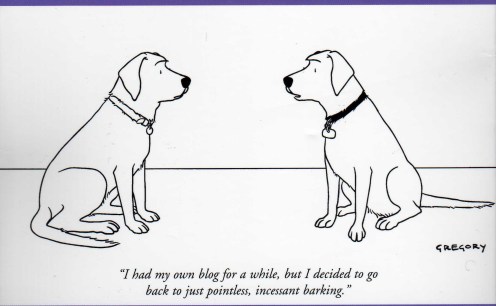
dogblog.jpg

He who has had a bath needs only to wash his feet.

The past two days I have been emerging from an intense bout with the flu feeling a renewed burst of energy that I almost don’t know what to do with.  Besides finally doing my laundry and paying my student loan bill (sorry Gordon-Conwell) I have been making phone calls and emails for fund raising (up to 51% and rising), plotting a letter writing campaign to David Kern’s Children’s Literature professor (how hard would it be to let the boy take his exam early so he can go to his friend’s wedding and see all of us who love him?), trying to reintroduce my stomach to its former role of digesting (it seems to still be adverse to this “eating” thing: I think a week and a half of nothing but Sprite has it out of practice), and picking up books that have laid neglected.

The first book I re-picked up was The Inner Voice of Love, by Henri Nouwen.  My housemate Mark gave me this book (technically I bought it myself, but he truly gave me the gift of it) a few months ago and it has been like a direct lifeline between me and God.  It is the private journal of Nouwen, written when he was undergoing an intense personal despair, and it resonates with me as few other books have.  Yes, I have gone fully Bostonian/politically correct/touchy feely, etc. and started using phrases like “resonates with me.”  We all knew it was coming.

The second book I re-picked up was The Brothers Karamazov.  I have been planning on rereading this for eleven years, but saving it as a rare and beautiful treat.  It bowled me over when I read it in my senior Russian Literature course, and I am very excited to be into it again.  It turns out that some friends — Graeme, Aaron and Karen — are reading it as well, so I look forward to good discussions.

The third book — sad that it was not the first, I guess, but that’s what it is — is the Bible, specifically my two favorite passages, Matthew 5-7 and John 13-18.  I have been trying for years to memorize these pieces, but my memory has the habit of lasting only so long as I am daily practicing them.  Still, there is something powerful about reading a passage that you have at least attempted to memorize.  The words are a part of you, so that you feel you are reading not only the Word of God, but your own Word as well.  I love the feel in Matthew that the God of Abraham, Issaac and Jacob, the creator of the universe and the terrifying presence on the mountain with Moses is sitting among his people, speaking his words of love and grace for the first time clearly, without intermediary.  Blessed indeed are those who hear.  And in John I love the raw pain and confusion of the disciples as they struggle to understand where Jesus is going and what he is telling them.  Today I wept again as I read Peter’s plea, “Then, Lord, not only my feet but my hands and my head as well!”  Jesus’ response was a reassurance to me, as well, as I emerge coughing and exhausted from fighting the flu: “He who has had a bath needs only to wash his feet.”  I am not starting from scratch, though it feels like it.  I am on a continuing journey, and it is overseen by One who knows both its beginning and its end.

And so I wash my feet in the Word, and in Nouwen and Dostoevsky, and jump back into the business of life.  Right now my business is fundraising, getting to 70% as quickly as possible so I can get onto campus and start the work I feel called to do.  My business, also, is relationships.  I feel this calling as strongly as any career path.  My old friends, the Greenhaus community, the International students from church, Bagshot Row — these are all my “job” to me as much as InterVarsity.

May the Lord be with you in your business as well.

Belief and unbelief.

There are some doubters even in the western villages. One woman told me last Christmas that she did not believe either in hell or in ghosts. Hell she thought was merely an invention got up by the priest to keep people good; and ghosts would not be permitted, she held, to go ‘traipsin about the earth’ at their own free will; ‘but there are faeries,’ she added, ‘and little leprechauns, and water-horses, and fallen angels.’ I have met also a man with a mohawk tattoed upon his arm, who held exactly similar beliefs and unbeliefs. No matter what one doubts one never doubts the faeries, for, as the man with the mohawk on his arm said to me, ‘they stand to reason.’

~W.B. Yeats, from The Celtic Twilight

A list! A list!

Inspired by the blogs of my literary (and movie-ary) friends, I’ve put together my own list. I was sad to realize that I haven’t read anything all that impactful lately, and the things that have been were mostly recommendations from friends’ blogs. So I’ve decided to list my top twenty five novels of all time. Okay, some of them aren’t novels: There are a couple of trilogies and a couple of short story collections. But they’re the books that rocked my world. Some I couldn’t bear to leave, and flipped over and read again without getting up to pee (or, while peeing). Others were so earth-shattering that I haven’t touched them since, but I’m haunted by their echos to this day. If you’re talking to me and I’m not listening, odds are I’m probably lost in the memory of one of these books. The numbers in parenthesis are my best guess at my age when I first read them.

1)The Brothers Karamazov, Fydor Dostoevsky (21)
This novel not only captured me entirely, it opened up new worlds for me of narrative. Dostoevsky is so brilliantly artless in the way he explains his characters every thought and emotion. I fell in love with the pious Alyosha, tortured by the thought of his unsaved brothers and father. And Dmitri’s dream of the baby…. Oh, my soul.

2) Gaudy Night, Dorothy Sayers (28)
This was one I read three or four times the week I discovered it, and still pick up regularly. Sayers deserves her association with the Inklings, though she wasn’t a regular. It is a beautiful study of two truly independent, intelligent people trying to learn how to be healed of the pain of the past and love each for who they are. The theme of redemption and God’s love rings out through the whole book, though it’s not at all “religious.” It’s the third in her books about Peter and Harriet, and the ninth or so in the Lord Peter Wimsey mysteries, but it was the first one I picked up and I’m glad.

3) Watership Down, Richard Adams (11)
Yes, it’s about rabbits but it’s brilliant. You’re just going to have to trust me on this.

4) The Chosen, Chaim Potok (20)
I learned more about Judaism from this book than from studying abroad in Israel. And the friendship between the two boys! Beautiful.

5) Franny and Zooey, J.D. Salinger (27)
This one, too, was doubly influential to me both as a reader and as a writer. If you took out all the descriptions of people lighting their cigarettes, shaking the match, snuffing out their cigarettes, gazing pensively out the window, etc. the book would be about 20 pages long. But those cigarettes! Those pensive gazes! They convey so much.

6) The Place of the Lion, Charles Williams (19)
The Platonic Archtypes are come to earth, drawing all their reflections back to them!

7) Cry, The Beloved Country, Alan Paton (16)
So sad I haven’t opened it since. Ah, South Africa.

12) A Tale of Two Cities, Charles Dickens (15)
“‘Tis a far better thing I do now than I have ever done. ‘Tis a far better death I go to…”

13) The Secret Life of Bees, Sue Monk Kidd (28)
The only book from the 21st century that made it on my list. She creates a beautiful world of half fantasy and half bitter reality. Her next book, though, The Mermaid’s Chair, was a let down.

14) To Kill a Mockingbird, Harper Lee (16)
The scene where Scout breaks up the mob with just her presence… Ah.

15) The Once and Future King, T.H White (11, 22)
Not nearly as cutesy as the movie. I love almost anything related to the Arthurian legand. I read the first half of the book many times as a child, but couldn’t get past the part where they slaughter the unicorn until I was older.

16) The Earthsea Trilogy, Ursula LeGuin (14)
The kind of perfect fantasy that speaks more about real life than any non-fiction. Sad and beautiful.

17) The Last Unicorn, Peter S. Beagle (12)
Not just a kids book, really. The way that Shmendrick learns to be a real magician is such a wonderful allegory to the work of the Holy Spirit, though I don’t think Beagle meant it to be.

>18) The Sherlock Holmes stories, Arthur Conan Doyle (11)
The game is afoot!

19) The Father Brown stories, G.K. Chesterton (26)
A mild, round faced little man, but he goes straight to the heart of a criminal with the speed and accuracy of an arrow — or the Spirit. Father Brown converted his author to Catholocism.

20) A Winter’s Tale, Mark Helprin (18)
Gorgeous writing.

21) Pride and Prejudice, Jane Austen (21)
Yes, I am a girl.

22) The Princess Bride, William Goldman (16)
So much richer than the movie! (Though I love the movie, too.)

23) A Separate Peace, John Knowles (15)
The first time I fell enviously in love with the friendship between men.

24) The Lord of the Rings trilogy, J.R.R. Tolkien (16,20,28)
It took me years to get into these books, but now I love them.

25) The Dragonriders of Pern, Anne McCaffery (10)
I’m a little embarrased about this one but, come on! You can talk to dragons!!

Please add your critique and your own favorites. Or if you remember me carrying another book around for weeks and pressing it to my breast, please remind me!

Addendum:

A couple of months ago I posted a list of my top 25 novels (with a couple of short story collections in there). I have to add three. One that I forgot is The Book of the Dun Cow by Walter Wangerin, Jr. It’s an amazing allegory about the difficulty of living out the sin and redemption of the world. It was also an excellent primer for me on the daily liturgy. Please, please read it.

And there are two that I have read recently that make the list, though I’m not sure which books get bumped off. Maybe it’s just a top 28 list now.

First, Jayber Crow, by Wendell Berry, for which I am forever indebted to David Kern for recommending. This is the mature masterpiece of a prolific writer, and spans the life of Jayber in a slow, building beauty.

And second, I am proud to announce that after years of trying I have broken through to some measure of understanding of Flannery O’Connor. For this I have to thank Tyler, Susi, Jeremy, Jason, Mike, my mother and Flannery herself for her essays and other writings in Mystery and Manners. The novel that’s making the list is The Violent Bear it Away. The plot rolls in with the slow back and forth motion of the tide, and breaks your heart with glimpses of truth and love among the madness and desperation of the characters.

For Bagshot Row

Some writers on writing.

“It is Red Smith who is reported to have said that it’s really very easy to be a writer — all you have to do is sit down at the type-writer and open a vein. Typewriters are few and far between these days, and vein-openers have never grown on trees. Good writers, serious writers — by which I mean the writers we remember, the ones who have opened our eyes, maybe even our hearts, to things we might never have known without them — all put much of themselves into their books the way Charles Dickens put his horror at the Poor Law of 1834 into Oliver Twist, for instance, or Virginia Woolf her complex feelings about her parents into To the Lighthouse, or, less overtly, Flannery O’Connor her religious faith into virtually everything she ever wrote. But opening a vein, I think, points to something beyond that.

“Vein opening writers are putting not just themselves into their books, but themselves at their nakedest and most vulnerable. They are putting their pain and their passion into their books the way Jonathan Swift did in Gulliver’s Travels and Dostoyevsky in The Brothers Karamazov, the way Arthur Miller did in Death of a Salesman, and William Maxwell in They Came Like Swallows. Not all writers do it all the time — even the blood bank recognizes we have only so much blood to give — and many good writers never do it at all either because for one reason or another they don’t chose to or they don’t quite know how to; it takes a certain kind of unguardedness, for one thing, a willingness to run risks, including the risk of making a fool of yourself.”

~Frederick Buechner, from the introduction to “Speak What We Feel (Not What We Ought to Say)

“You ask whether your verses are good. You ask me. You have asked others before. You send them to magazines. You compare them with other poems, and you are disturbed when certain editors reject your efforts. Now (since you have allowed me to advise you) I beg you to give up all that. You are looking outward, and that above all you should not do now. Nobody can counsel and help you, nobody. There is only one single way. Go into yourself. Search for the reason that bids you write; find out whether it is spreading out its roots in the deepest places of you heart, acknowledge to yourself whether you would have to die if it were denied you to write. This above all — ask yourself in the stillest hour of your night: must I write? Delve into yourself for a deep answer. And if this should be affirmative, if you may meet this earnest question with a strong and simple “I must,” then build your life according to this necessity; your life even into its most indifferent and slightest hour must be a sign of this urge and a testimony to it.”

~Rainer Marie Rilke, Letters to a Young Poet