Victories
Who has two thumbs and just ran around Jamaica Pond for the first time ever?
This girl!!
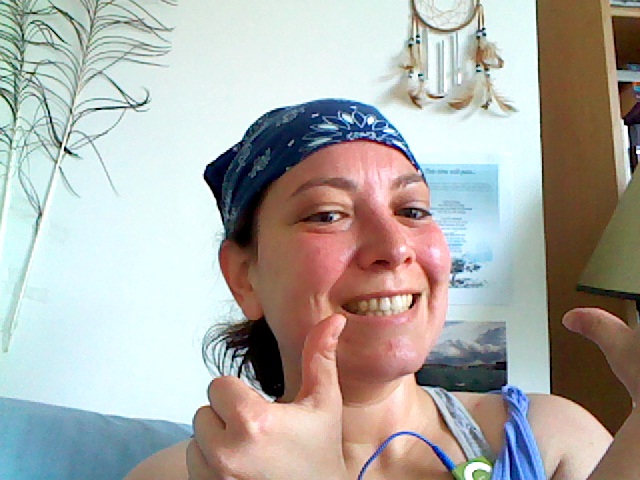
Who fought her way through a migrainey, med-hangovery miasma and not an insignificant amount of depression, discouragement, sadness, and even despair to get outside and run today? That’s right, it’s the aforementioned two-thumbed girl.
And who has fought her way through all that crap to go to the gym 100+ times since September, and run 64 miles since February? That’s right, it’s the girl above taking her picture with her elbow!
I think I am very brave.
What a beautiful day! We’re not scared.
 Gorgeous day in Boston today! Yesterday was my birthday, and it was a good one. Some highlights:
Z, the four year old I babysit for drew me a picture of a “birthday tornado storm,” with lots of wind, smoke and lightning. Love it.
I went with Z and his 15mo old brother, N, to the Boston Nature Center, where we saw lots of birds, including wild turkeys, hawks, robins, I think an osprey, and my favorite, red-winged blackbirds. They are so beautiful, with the flash of red against the shiny black. I took them as a personal birthday present. And just seeing the kids running around and loving the outdoors was wonderful.
Pushed myself at the gym for a new personal record: 2 mile run at 5mph. I started running in February, and it took me weeks to even run a mile at all; weeks more to run one at 5mph. Yesterday I did two!
And one of my favorite writers/bloggers, Glennon, posted a wonderful quote by Amma that made my day:
“The essence of motherhood is not restricted to women who have given birth; it is inherent in both men and women. It is an attitude of the mind. It is love, and love is the very breath of life.” Amma (not mine, the hugging saint of India)
We Are All Mothers.
Oh, and the title of this post is from one of Z and my favorite books, We’re Going on a Bear Hunt, by Michael Rosen and Helen Oxenbury.
We’re going on a bear hunt
We’re going to catch a big one.
What a beautiful day!
We’re not scared.
Whenever I say to Z, “What a beautiful day!” He replies, “We’re not scared!” What a wonderful affirmation, don’t you think? Let’s go!
Running
I’ve kind of been cheating lately, posting other people’s poems and quotes without even my own thoughts about them. So here are a few thoughts, quick, before I forget what they are.
Community is hard, but I will grudgingly say worth it. Right now is one of the hard times, but it is a different kind of hard than when there is disagreement or conflict. Right now is when we are all suffering because two of us are suffering. As a community we can be there for them in a way that neighbors or even a church family cannot: We are right here, sharing a backyard and kitchens, steps away if they need to talk. I am happy for that. But when I heard their bad news, it hurt me in a way that a neighbor’s news would not, that the news of most church-family members would not. The worth it part of community is that we can be there for them, and that they and others have been here for me when I needed it. The bad part is the pain. And the disagreement and conflict, and personality conflicts, etc. There is a good part to that, too. But that is another story.
I have not updated you on the sunset times lately, but I am trusting my (mostly imaginary) readers to have noticed that it is getting later and later. Here in Boston the sun set tonight at 7:37 p.m. The muscles in my shoulders that were tensed all winter to cope with the long dark evenings have relaxed.
News about my literary career: I wrote a haiku last month. Let’s see if that little poem can snowball into a productive year for 2011. By which I mean it would be nice to write a story or two again.
But my big news is that I have started running and, more significantly, continued running. It has been 13 years since I have run more than a mile, but I now regularly run 1.5, 2, or 2.5 on the treadmill. I want to transition to outdoor running, but it’s harder for me: It’s so much easier to stop running when all you have to do is, well, stop, than when the treadmill is moving steadily under you and to stop you have to a) make the decision to stop, b) press the down arrow about ten times to get to a walking pace, and c) stop running. Just that little extra effort gives me the time to decide that I am, after all, going to keep running, whereas if I’m outside I will stop before I think about it. Does that make any sense?
Anyway, I have been running for over two months now, and according to MapMyRun I have logged 50 miles! Yay me! I am posting this under Wrestling the Tigers because this is a great victory against the migraines, both in that exercise is good long-term for them (against them) and that I often am running with some kind of migraine or other, or get one after running, but I persevere. Take that, tigers!

The moon is low
Dropping Keys
The small man
Builds cages for everyone
He
Knows.
While the sage,
Who has to duck his head
When the moon is low,
Keeps dropping keys all night long
For the
Beautiful
Rowdy
Prisoners.
A story by G. K. Chesterton
Homesick at Home
By G.K. Chesterton
One, seeming to be a traveller, came to me and said, “What is the shortest journey from one place to the same place?”
The sun was behind his head, so that his face was illegible.
“Surely,” I said, “to stand still.”
“That is no journey at all,” he replied. “The shortest journey from one place to the same place is round the world.” And he was gone.
White Wynd had been born, brought up, married and made the father of a family in the White Farmhouse by the river. The river enclosed it on three sides like a castle: on the fourth side there were stables and beyond that a kitchen-garden and beyond that an orchard and beyond that a low wall and beyond that a road and beyond that a pinewood and beyond that a cornfield and beyond that slopes meeting the sky, and beyond that – but we must not catalogue the whole earth, though it is a great temptation. White Wynd had known no other home but this. Its walls were the world to him and its roof the sky.
This is what makes his action so strange.
In his later years he hardly ever went outside the door. And as he grew lazy he grew restless: angry with himself and everyone. He found himself in some strange way weary of every moment and hungry for the next.
His heart had grown stale and bitter towards the wife and children whom he saw every day, though they were five of the good faces of the earth. He remembered, in glimpses, the days of his toil and strife for bread, when, as he came home in the evening, the thatch of his home burned with gold as though angels were standing there. But he remembered it as one remembers a dream.
Now he seemed to be able to see other homes, but not his own. That was merely a house. Prose had got hold of him: the sealing of the eyes and the closing of the ears.
At last something occurred in his heart: a volcano; an earthquake; an eclipse; a daybreak; a deluge; an apocalypse. We might pile up colossal words, but we should never reach it. Eight hundred times the white daylight had broken across the bare kitchen as the little family sat at breakfast. And the eight hundred and first time the father paused with the cup he was passing in his hand.
“That green cornfield through the window,” he said dreamily, “shining in the sun. Somehow, somehow it reminds me of a field outside my own home.”
“Your own home?” cried his wife. “This is your home.”
White Wynd rose to his feet, seeming to fill the room. He stretched forth his hand and took a staff. He stretched it forth again and took a hat. The dust came in clouds from both of them.
“Father,” cried one child. “Where are you going?”
“Home,” he replied.
“What can you mean? This is your home. What home are you going to?”
“To the White Farmhouse by the river.”
“This is it.”
He was looking at them very tranquilly when his eldest daughter caught sight of his face.
“Oh, he is mad!” she screamed, and buried her face in her hands.
He spoke calmly. “You are a little like my eldest daughter,” he said. “But you haven’t got the look, no, not the look which is a welcome after work.”
“Madam,” he said, turning to his thunderstruck wife with a stately courtesy. “I thank you for your hospitality, but indeed I fear I have trespassed on it too long. And my home–”
“Father, father, answer me! Is not this your home?”
The old man waved his stick.
“The rafters are cobwebbed, the walls are rain-stained. The doors bind me, the rafters crush me. There are littlenesses and bickerings and heartburnings here behind the dusty lattices where I have dozed too long. But the fire roars and the door stands open. There is bread and raiment, fire and water and all the crafts and mysteries of love. There is rest for heavy feet on the matted floor, and for starved heart in the pure faces, far away at the end of the world, in the house were I was born.”
“Where, where?”
“In the White Farmhouse by the river.”
And he passed out of the front door, the sun shining on his face.
And the other inhabitants of the White Farmhouse stood staring at each other.
White Wynd was standing on the timber bridge across the river, with the world at his feet. And a great wind came flying from the opposite edge of the sky (a land of marvellous pale golds) and met him. Some may know that that first wind outside the door is to a man. To this man it seemed that God had bent back his head by the hair and kissed him on the forehead.
He had been weary with resting, without knowing that the whole remedy lay in sun and wind and his own body. Now he half believed that he wore the seven-leagued boots.
He was going home. The White Farmhouse was behind every wood and beyond every mountain wall. He looked for it as we all look for fairyland, at every turn of the road. Only in one direction he never looked for it, and that was where, only a thousand yards behind him, the White Farmhouse stood up, gleaming with thatch and whitewash against the gusty blue of morning.
He looked at the dandelions and crickets and realised that he was gigantic. We are too fond of reckoning always by mountains. Every object is infinitely vast as well as infinitely small. He stretched himself like one crucified in an uncontainable greatness.
“Oh God, who has made me and all things, hear four songs of praise. One for my feet that Thou hast made strong and light upon Thy daisies. One for my head, which Thou hast lifted and crowned above the four corners of Thy heaven. One for my heart, which Thou hast made a heaven of angels singing Thy glory. And one for that pearl-tinted cloudlet far away above the stone pines on the hill.”
He felt like Adam newly created. He had suddenly inherited all things, even this suns and stars.
Have you ever been out for a walk?
* * * * *
The story of the journey of White Wynd would be an epic. He was swallowed up in huge cities and forgotten: yet he came out on the other side. He worked in quarries, and in docks in country after country. Like a transmigrating soul, he lived a series of existences: a knot of vagabonds, a colony of workmen, a crew of sailors, a group of fishermen, each counted him a final fact in their lives, the great spare man with eyes like two stars, the stars of ancient purpose.
But he never diverged from the line that girdles the globe.
On a mellow summer evening, however, he came upon the strangest thing in all his travels. He was plodding up a great dim down, that hid everything, like the dome of the earth itself. Suddenly, a strange feeling came over him. He glanced back at the waste of turf to see if there was any trace or boundary, for he felt like one who has just crossed the border of elfland. With his head a belfry of new passions, assailed with confounding memories, he toiled on the brow of the slope.
The setting sun was raying out a universal glory. Between him and it, lying low on the fields, there was what seemed to his swimming eyes a white cloud. No, it was a marble palace. No, it was the White Farmhouse by the river.
He had come to the end of the world. Every spot on earth is either the beginning or the end, according to the heart of man. That is the advantage of living on an oblate spheroid.
It was evening. The whole swell of turf on which he stood was turned to gold. He seemed standing in fire instead of grass. He stood so still that the birds settled on his staff.
All the earth and the glory of it seemed to rejoice around the madman’s homecoming. The birds on their way to their nests knew him, Nature herself was in his secret, the man who had gone from place to the same place.
But he leaned wearily on his staff. Then he raised his voice once more.
“O God, who hast made me and all things, hear four songs of praise. One for my feet, because they are sore and slow, now that they draw near the door. One for my head, because it is bowed and hoary, now that Thou crownest it with the sun. One for my heart, because Thou hast taught it in sorrow and hope deferred that it is the road that makes the home. And one for that daisy at my feet.”
He came down over the hillside and into the pinewood. Through the trees he could see the red and gold sunset settling down among the white farm-buildings and the green apple-branches. It was his home now. But it could not be his home till he had gone out from it and returned to it. Now he was the Prodigal Son.
He came out of the pinewood and across the road. He surmounted the low wall and tramped through the orchard, through the kitchen garden, past the cattle-sheds. And in the stony courtyard he saw his wife drawing water.
 Ten Thousand Places