Things I’ve been wrong about for most of my life, part two

Bewitched Park by Leonid Afremov

Bewitched Park by Leonid Afremov

Ever since I was very young I’ve felt this strange tension between feeling smart, creative, special and, at the same time weird, awkward, and out of place. The first thing made me feel happy and proud; the last three incredibly sad and even bitter. But all of them made me feel different. I moved through life pretty well, more or less, did well in school, went on to college and grad school, was in leadership roles in most areas of life. But I always felt like my true self, my real thoughts and feelings, were too weird and scary to share. I felt out of place all the time, even among friends, even when I was the leader or organizer of a group. I created a secret world inside myself and hid parts of myself there — the parts that I thought made me too strange and different, and kept me from fitting in.

But, somewhere, at some point, I started getting glimpses of a larger truth. I can’t remember when the first glimpse came — in high school or college, maybe? At some point I heard this quote by the Roman playwright Terence: “I am human, and nothing human is alien to me.” I wrote that in my journal and thought, yes. Nothing human is alien to me, and if that is true then maybe nothing in me is alien to my fellow humans. Maybe I am just human after all. No better or worse than the rest of the humans.

And I started noticing that I wasn’t the only one who felt different and alone. I began to think that maybe, actually, more people felt out of place than in. And if that were true, then maybe none of us were actually weird and different. Or maybe we were all weird and different, actually. Maybe I was weird and different, just like a lot of other people. And maybe that meant none of us needed to be alone.

I have so much more to say about this, but the sun is rising and I have to get ready for my day job soon. But today I wanted to tell you this: When I wrote the first part of this series, Things I’ve been wrong about my whole life, part one, I shared something from that secret part of myself. I had never felt more alone or more on the outside than during the time I wrote about in that essay. And something wild happened when I got brave and wrote about it and posted it on my little blog with my few dozen readers. People read it and said, “Me, too.” My friend Glennon Doyle Melton of Momastery read it and said, “Me, too,” and shared it with her followers on Facebook. And then, suddenly, hundreds and thousands of people came and read it, and said, “Me, too,” and shared it with their friends who said, “Me, too,” too.

When I felt most alone, when my thoughts and feelings seemed too intense and strange and even crazy — there were literally thousands of others feeling just like me. My deepest fears and struggles, the ones that made me feel so alone, turned out to be what I most had in common with my fellow humans. Maybe the same is true for you?

*****

Come find me on Facebook and let’s be weird and different together!


Blunders and Absurdities

Her Shame by Dena Cardwell

Her Shame by Dena Cardwell

A couple of months ago I wrote an essay called, “Things I’ve been Wrong About Most of My Life, Part 1.” It was about learning to stop judging and critiquing myself all the time, to let go of the untrue criticism of others, to apologize when I really did do something wrong, and forgive myself. I included this quote from Ralph Waldo Emerson:

“Finish each day and be done with it. You have done what you could. Some blunders and absurdities no doubt crept in; forget them as soon as you can. Tomorrow is a new day. You shall begin it serenely and with too high a spirit to be encumbered with your old nonsense.”

The essay seemed to strike a chord in some who read it. A couple of women commented that they were haunted with guilt for past “blunders and absurdities.” And I thought about what that meant, in my life and in others’. There are certainly things that I’ve done wrong, people I’ve hurt, ugly feelings that I’ve acted on — things I might call “sins.” But blunders and absurdities — those are something else. Those are the things that were awkward, ridiculous, weird, that exposed my otherness, that made me feel like I didn’t belong in society, that I didn’t belong among friends. Those are the things that are decades old but still make me flinch every time I think of them. And as I thought about them I got mad. I thought, what right do these b’s and a’s have to kick me in the gut, over and over again, so many years later? What right have they to suggest that they represent the real me, the secret me that if people knew about they would run? And what right do they have to haunt my friends with guilt? No, I thought, enough. We should be free of these. Of course, this is easier said than done. Easier preached than practiced. But one thing I do know, is that secrets, and fears, and secret fears shrivel up when they are exposed to the light.

So today I’m writing about — and publishing — the three blunders and absurdities that plague me the most. Some are silly. One is genuinely awful. For some I do owe an apology — though it’s not clear to whom it should be addressed. This, then, is my confession and my apology. But it is also my declaration of freedom. I am bringing them out of the dark corners of my heart and into the light of day. I am putting them, finally, to rest. And maybe if I share my own secret pangs of guilt it will help other people to feel less alone. I know we all have them, these blunders and absurdities.

The first happened at a friend’s wedding, about eighteen years ago. I didn’t know most of the guests at the reception, so I was wandering around, nibbling snacks and making small talk. The time came for the bride to throw the bouquet, and I gathered with the other single women. Among us was the widowed grandmother of either the bride or the groom — I can’t remember which. I heard some of the women joking about letting her catch it but I wasn’t really paying attention. The bride turned around and tossed it, I stepped forward, raised my hand…and caught it! For a second I was excited and happy, but then I looked around me and saw that I was the only one who had stepped forward — and I had stepped right in front of the grandmother. I don’t remember if there was silence or feeble applause. I don’t specifically remember a surprised look on the bride’s face, or the grandmother smiling graciously. I can’t say for sure that the other women glared at me or whispered behind my back. I don’t even remember if I took the bouquet home. But I vividly remember that moment of realization after I caught the bouquet and looked around, and I feel that jab of shame again every time I think of it. Blunders and absurdities.

About ten years ago I was traveling in Morocco, and I stayed with a family in a small village there. I’d been with them a few days when Friday came along — the day that the men went to the mosque and the women spent the morning cooking a big couscous meal. I was used to the box of couscous that takes five minutes to make, but in Morocco it took the whole morning and was a special Friday tradition — they didn’t eat couscous any other day. I spent the morning in the kitchen with the women. By the time the men came back from prayer we had a giant plate of couscous covered in meat and vegetables. It was beautiful, and I couldn’t wait to dig in. We all sat around the table, with our own spoons but a common plate in the middle. As the guest I was asked to take the first bite, and I carefully loaded my spoon with a yummy looking piece of zucchini and some couscous. As soon as I put it in my mouth I realized it was too hot. Of course I couldn’t spit it out, so I tried to subtly inhale over the food in my mouth to cool it off. Unfortunately, couscous is made up of tiny pieces of pasta, and my inhale sent several of them straight into my lungs. My first cough came so quickly that I didn’t have time to cover my mouth, and more couscous shot out onto the table. The rest of the coughing fit was hardly less embarrassing, as tears came to my eyes and I tried to apologize while my lungs desperately tried to empty themselves of the sacred food. The whole family stared at me until it was over, and then the meal went on in silence. Blunders and absurdities.

Couscous-morocco

Are you ready? This last one is the worst. I had a friend at school who I’ll call Elise. She and I had a rocky relationship, and at the time this incident took place I was feeling frustrated with her. I felt like she was dramatic and controlling, like she always needed to be the center of attention. (How much of that was jealousy that *I* couldn’t be the center of attention and control things, I wonder?) She and some other friends lived in a small house on campus, and I would visit them sometimes. Typically for me, I didn’t feel like I really belonged in the group, but I wanted to. One day, Elise was upstairs, and a few of us were downstairs, talking. I don’t remember what we were talking about, but I remember it was a good conversation, and I felt like I was really getting to know the other women. It felt rare and special to me. And then, all of a sudden, Elise started swearing, loudly, upstairs, and I knew the moment was over. The other women looked up, concerned, but I said, kind of under my breath, “Don’t take it out on us.” I don’t know if anyone heard me or not. But one or two of them ran upstairs to see what was wrong. I don’t know what I thought it was — that she’d cut herself shaving or something like that. But it turned out that a good friend of hers had been shot and killed in a robbery. Someone had just called to tell her. Oh how I wished that my selfish little grumble had been a silent one. Nobody ever said anything to me about it, but every time I remember it I get that same sick feeling. Blunders and absurdities.

Well. So. There are more, but those are the top three. “Finish each day and be done with it. You have done what you could. Some blunders and absurdities no doubt crept in; forget them as soon as you can. Tomorrow is a new day. You shall begin it serenely and with too high a spirit to be encumbered with your old nonsense.” Thank you, Ralph. I have done what I could. I will forget them as soon as I can — though in this case “soon” means ten and twenty years. But today is a new day, and I choose to be done with the old nonsense. Who’s with me?

New Year’s resolutions

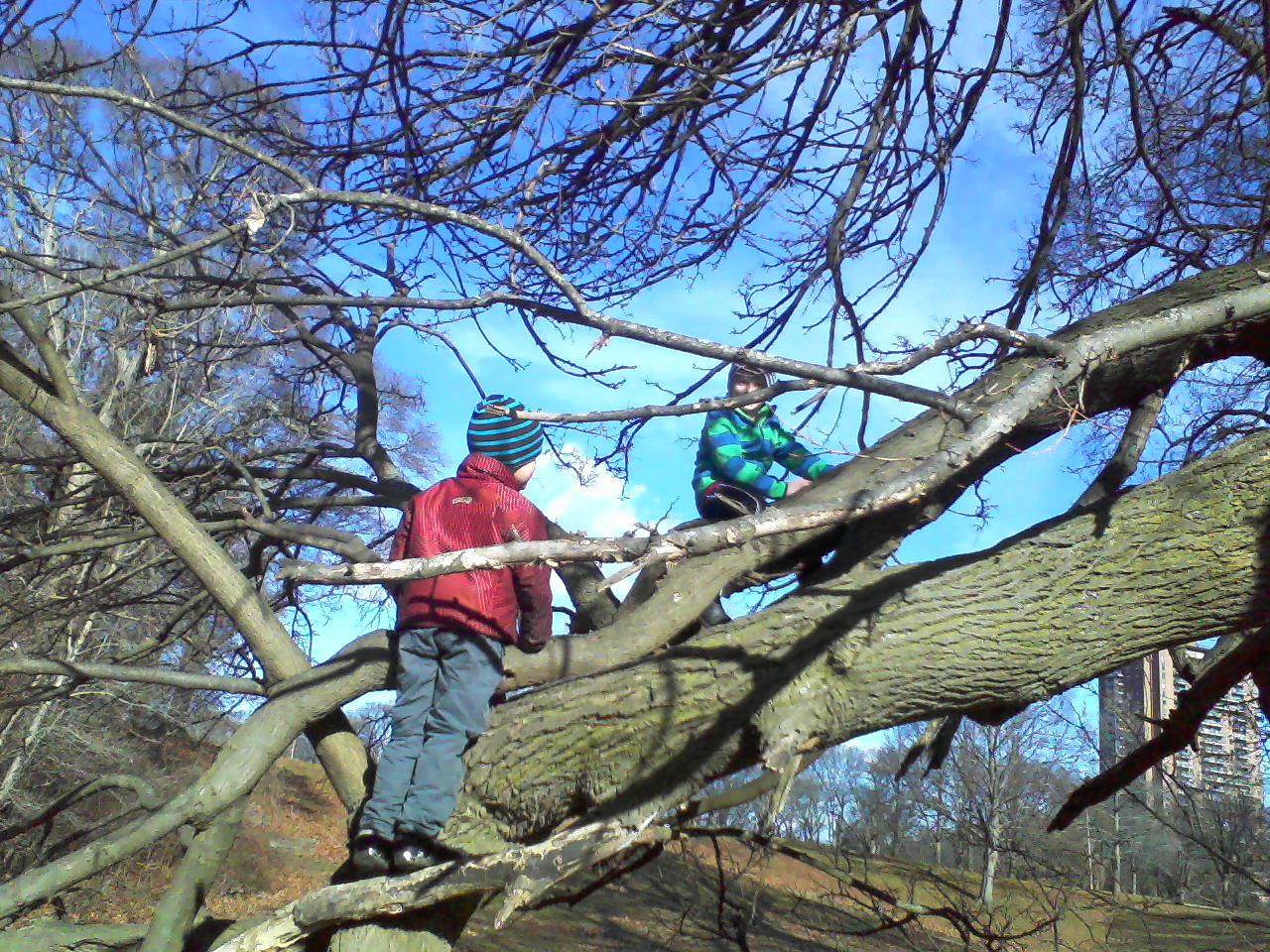
Tree climbing at Jamaica Pond

Tree climbing at Jamaica Pond

My new year’s resolution this year is to mostly keep doing what I’ve been doing, because I think I’m on the right track. I will not be dieting because diets make you fatter, and I will not be hitting the gym — though I would love to, actually — because I have a bunch of little chronic injuries at the moment. The one big thing I want to do next I’ve already signed up for: A writer’s workshop through The Frederick Buechner Center at Princeton Seminary. I am really excited about it. It’s the first time I’ve spent money on my writing, the first time I’ve been to a conference in seven years, and the first time I’ve been to a seminary in nine years. Don’t tell Gordon-Conwell that I’m cheating on them with Princeton.

But the things that I want to focus on next year are the same things that I’ve been focusing on this year. Nothing new or particularly ambitious. But they work for me.

1) Be the best nanny and editor I can — focus on being present and paying attention.
2) Write weekly (I can’t swing daily right now, but I’m getting good at weekl
y).
3) Do yoga and bike when I can.
4) Keep seeing friends and family in person as well as connecting online.
5) Eat mostly healthy food and resist equally the temptations to eat too much and too little.
6) Look for ways to connect with God, and don’t be discouraged when I can’t find Him in the same places I used to.

Do you have New Year’s resolutions? Do they represent big changes, small tweaks, or staying the course?

On living and dying

024A couple of years ago my dad was diagnosed with Parkinson’s. I was going through a really difficult time with the community where I’d lived for seven years and was soon to leave, and I processed the news mostly as the dull toll of a deep-voiced bell, tolling softly but continuously under everything, audible mostly at night when there were no other sounds to block it out. For two years, while the bell was rolling out its note, I found myself in a strange mixture of avoidance and hyper-preparedness. I didn’t want to think about Parkinson’s, didn’t want to know even if it was fatal or just degenerative, didn’t want to talk about it with anyone, really. A woman I was seeing at the time for spiritual direction gave me an article on Parkinson’s and I tucked it away in a notebook and flinched the couple of times I happened to see it there. I scrolled quickly past Facebook posts where people were sharing about their loved ones’ struggles with cancer and other illnesses. I started two books I really wanted to read — The Summer of the Great Grandmother and Two-Part Invention, both by Madeleine L’Engle — but set them aside because they both dealt with illness and death and I couldn’t take it.  At the same time, several times a week, I would suddenly think: I have to be ready! and begin to walk myself through my father’s illness and death in my imagination, trying to experience the emotions ahead of time so they wouldn’t undo me when they came for real.

Of course, as I’d learned long ago, this kind of imagining doesn’t really help. It just causes anxiety now, and I’m sure won’t make things any easier when the time really does come. I know for a fact that what makes things easier, or at least better, is to live fully in the moment and do what you can Today. I learned this lesson when my grandparents died, and somehow more deeply two years ago when the nanny job I’d been doing for six years was to end because the youngest was starting school. They told me at the end of the summer that he would start school in January, and I was devastated. I had bonded with those two boys in a way that I hadn’t with other children I’d cared for, and the time I spent with the little one was the most stabilizing, peaceful thing in my life at the time. I felt as if I’d been told my own children were being taken away from me.

But I knew enough by then to know that it was going to be okay. And so I did the only thing I could, and tried to be as present as possible for every moment I had left with them. I looked at them, listened to them, touched their hair and their hands, and told myself: “You are here right now. This is not a memory or a fantasy, the past or the future. This is all there is. Pay attention.” I noticed the sky and the trees and the birds. I looked around, 360 degrees and up and down, every time we went outside. I breathed deeply. And then, when the little one started school in January, I let go. And I could say, “I couldn’t have done more, or been there more.” I only had what I was given, and I took it with open arms.

MeltingLarsAnderson

Of course, with my parents, that was harder. They only live an hour and fifteen minutes away, but they are busy and I am busy, and my energy levels are not that high. It hasn’t been as pure an experience as it was with the boys. It’s not as easy to know which weekends to go up. And it’s not as easy to just take them outside and watch them play with wildflowers. Parents don’t do that, usually. At least, not as often as two year olds. They also don’t seem to get as genuinely happy and excited every time a helicopter goes by, even though I always point it out. In all fairness, the little boy who is four now is not a excited about them as he used to be when he was two. As for me, I don’t think I will ever take the appearance of a helicopter lightly again.

I am telling you all this now because I just came across another Facebook post by someone’s loved one who is dying. Her name is Kara Thewlies Tippetts. And I read it. For the first time in two years I didn’t look away, but I looked into her eyes (in her picture) and read her story. And, oh. I didn’t need to read that article my spiritual director gave me. I didn’t need to google Parkinson’s, or read about Madeleine L’Engle’s grandmother dying of Alzheimer’s or her husband’s illness and death. But I needed to read this. And perhaps you do, too. So here it is. The link has crashed because it is getting too much traffic, (here it is, anyway) but some kind person copied and pasted it onto Momastery’s Facebook page. You can read it below.

Look around. Look at what is in front of you and all around you. This is not a memory or fantasy. You are here right now. Pay attention.

And I have to tell you something else. I didn’t see those boys much for almost two years. I babysat for them once or twice, but their parents didn’t really need a sitter. I went to their soccer games here and there, but I wasn’t really a part of their lives. And I missed them. But it was okay. But just this fall their parents asked if I would be available to pick them up from school one day a week. And I was. So now I see them every week again.
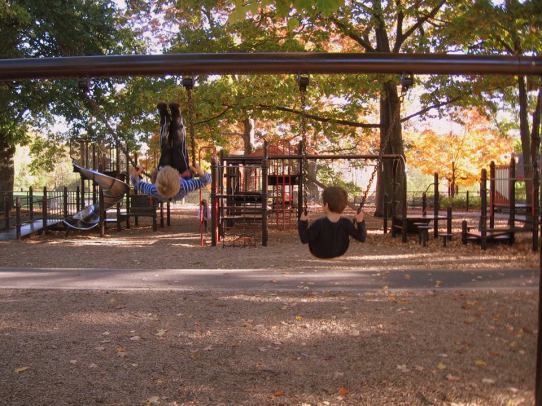
swings

And my dad saw a Parkinson’s specialist this month who said that it’s not actually Parkinson’s, but something else that they are still trying to figure out. It’s good news, probably, we think, but we still don’t know. Sometimes things are taken away, and sometimes they are given back. I wonder how much the taking away is part of the gift. Could it even be that the losing is the greater gift? I think this is something that will be clear only later. Except that I think Kara understands it, now, already. Here are her words:

“I woke slowly this morning. From my vantage point in bed, I was able to see the sunrise. My baby was curled in the stretch of my back and I could hear the crackle the fire my guy had built downstairs. I didn’t have the strength to travel to his side, but I loved the comfort of hearing him- knowing he was using the quiet to speak with Jesus about our now, our story, our hearts, and our children. Their is a constant pulse of an IV the doctor sent me home with Friday. The horizon outside my window was mostly gray, soft- a snow promised in the days forecast. Then for a moment, a beautiful pink filled the horizon- then it suddenly faded back to gray. It felt like a gift to watch and see this simple moment. No fanfare simple beauty- then the return of ordinary gray. As I grieved the passing beauty, I realized there is something astounding of the soft tones that aren’t showy as well.

“I am thinking a lot about the living we do lately. We live by degrees and now I’m learning how we also die by degrees, and in it all their is beauty. I have spent so much time thinking on big love and wondering how we press past our own limitations we place on ourselves and love beyond our limits. How do we move beyond our comfort and into a realm greater than our understanding. We find a comfort near to Jesus, knowing His love, and begin to overflow from the bounty he has provided in our lives. It takes courage. It causes heartache at times, but there is always a return. Loving big in new corners always grows a spirit in strength- perhaps not tangible strength, but a strength that would cause the spirit to continue to try. Continue to wonder over love, wonder over extending boundaries.

“And now, now I’m learning what it is to die by degrees. Parts of my body failing, parts of my abilities vanishing, and what then? Yesterday, I kept thinking- I drove for the last time and didn’t realize it was the last time. I don’t remember the last time in the drivers seat or the music we played. I just realized I will likely never again drive. It’s this weird event that marks the fading of a life, and I have no feeling other than wonder over the fact that it’s over. That chapter. All the driving my body can no longer do will now be captured by my community, my loves, my people. And there will be other strengths that will languish, and my people will press into love and provide us the needed strength and support to manage that new edge.

“I listened to my husband make the impossible phone call this morning. He called hospice. He told him that his young wife was dying, but they already knew. My kind-faced oncologist had called and told them. They were gentle and gave us a time they would be here to meet with us. The call you never expect when you are still getting your footing on living and loving and confidence in faith and who you are. But our hands have been pulled wide of our story, and peace enters. Jason walks into the room and said- I did one thing I needed to today. Needed to but never wanted to- he called Hospice because I am dying.

“So, there it is. My little body has grown tired of battle and treatment is no longer helping. But what I see, what I know, what I have is Jesus. He has still given me breath, and with it I pray I would live well and fade well. By degrees doing both, living and dying, as I have moments left to live. I get to draw my people close, kiss them and tenderly speak love over their lives. I get to pray into eternity my hopes and fears for the moments of my loves. I get to laugh and cry and wonder over heaven. I do not feel like I have the courage for this journey, but I have Jesus- and He will provide it. He has given me so much to be grateful for, and that gratitude, that wondering over His love will cover us all. And it will carry us- carry us in ways we cannot comprehend. It will be a new living and trusting for many in my community. Loving with a great big open hand to my story being the good story- even when it feels so broken.

“Will you trust Jesus with us? Love us today by imagining how you can press deeper into love in the place you live. Give away what was never yours to keep. Love us by extending yourself in the corners of your world in a way that shines bright the light on the strength of Jesus and His unwavering love and grace. Love us by not meeting our story in pity, but pray that Jesus would tenderly meet us as we walk these new hard steps together as a community. Will you walk in grace with us to my last breath? Will you commit us to prayer? Will you trust Jesus that He knows the moments, He holds the moments, and He will take me away to the land of no more tears at exactly the right moment- and He will also shepherd and love my people after that last breath.”

Thank you so much, Kara.

Pink and Grey on the Lake by Geoff Childs
Pink and Grey on the Lake by Geoff Childs

Florida, A True Story

camel beachOn Friday night, after a long week of nannying and hanging out at the Momastery Facebook page, I went to bed and had a dream that I was Glennon’s nanny. Saturday I woke up and was thinking about the dream and considering whether I would move to Florida for the job. I’d be far from my family, I thought, but the weather would be a welcome change from Boston. I’d have to leave the deep, spiritual symbolism of the changing seasons, but I just might be up for it. Just as I was thinking this, the phone rang. I picked it up and the caller ID read simply, “Florida.”

(What do you think, readers? Was it Glennon? Did she offer me the job, and did I accept? Am I moving to Florida? Well…)

I rarely answer my phone, and even the motivation of the tropics couldn’t quite make me pick up this time. But a few moments later there was a beep to let me know I had voicemail. I pressed play and a man with a deep voice began speaking in a language I mostly did not understand. I did recognize two words, Saalam Alaikum — “Peace be with you” in Arabic. So I played the message to my housemate, Mark, who is Lebanese and grew up in Saudi Arabia. He said it didn’t sound like Arabic to him; maybe Urdu.

A dream, a thought of traveling, a follow-up phone call from the dream-land, a message from a stranger wishing me peace in a foreign tongue. I can only imagine that I am at the beginning of a great adventure. If you don’t hear from me for a while, I will probably be in Florida, or Pakistan, possibly traveling with the Meltons and a mysterious, deep-voiced, dark-skinned man. If you do see me in Boston, looking pale and tired, shivering in the cold, it may not really be me. I may have left behind a doppelgänger to hold my place until I return, if I ever do.

The Darkest Night of the Year

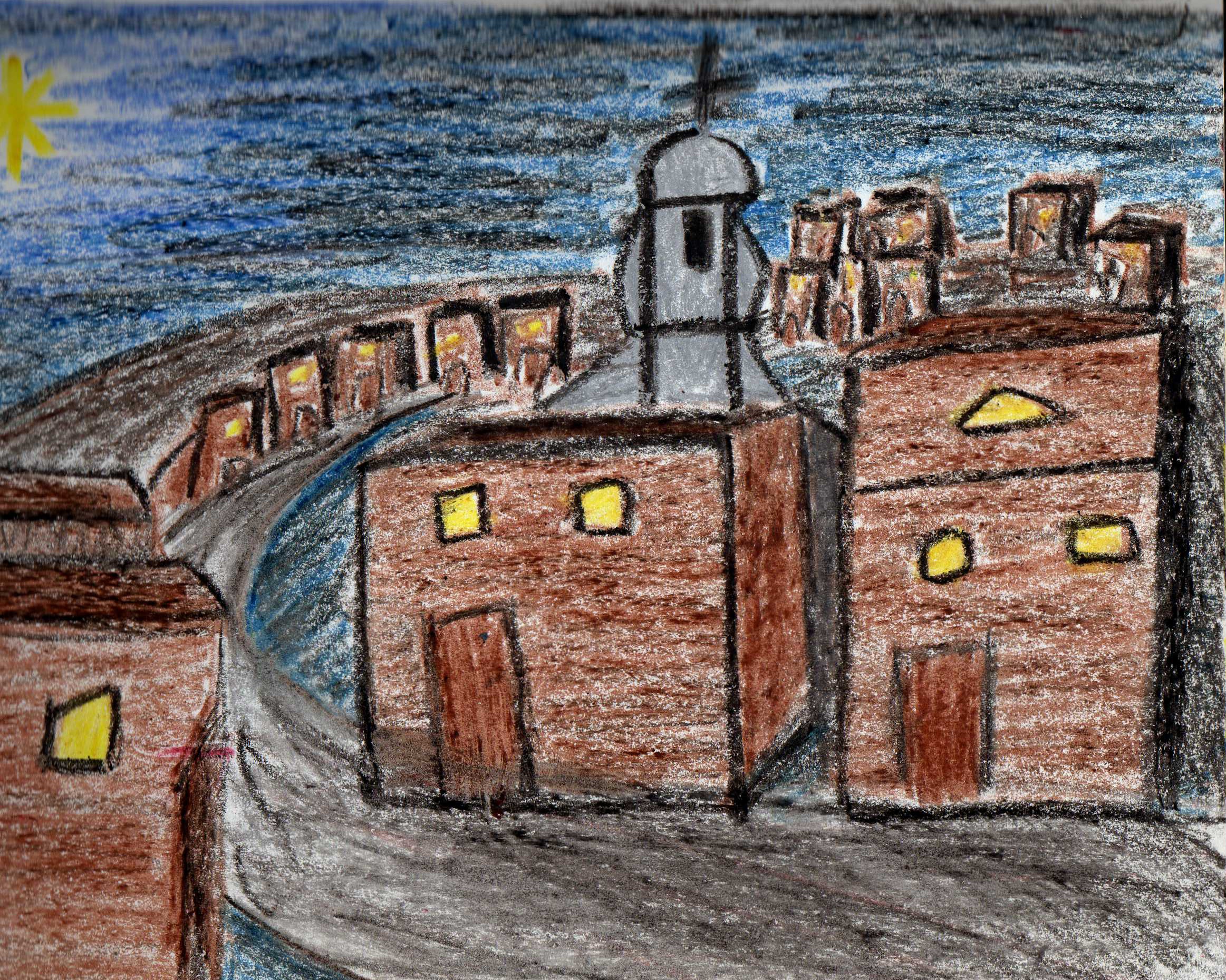
My crayon sketch of Bethlehem at night, Christmas Eve 1994

My crayon sketch of Bethlehem at night, Christmas Eve 1994

Originally published in 2006 as part of the Greenhaus Community’s Advent Calendar

The Winter Solstice and Advent

On December 22nd, in Boston, the sun will rise at 7:11 a.m. and set at 4:15 p.m. It is said that the ancient people watched the nights lengthening, and feared that the sun was dying. Even in our modern times, when we think we understand the movement of the earth and sun, we cannot help but feel oppressed by the encroaching darkness. We have even given this oppression a name: Seasonal Affective Disorder. The ancients offered sacrifices to the sun, we take anti-depressants and buy full spectrum light bulbs. But every year, the sun returns. It rises earlier and sets later each day, even as the winter weather worsens. Somehow, we are saved from the darkness.

The early Christians understood the deep truth behind this salvation. Jesus was probably not born in December – most scholars suggest April as a more likely month. But the Christians understood that there was more to the ancient myths than superstition. The darkening earth reminds us of the darkness of our souls without God. And that is why the shortest days of the year are the perfect time for the season of Advent. Advent means “coming,” – the coming of Christ – and the twenty four days before Christmas are a time of preparation for this coming. As the days shorten, our spirits tell us that without some intervention, we will be lost in the darkness. But that intervention has been given. Christ has come! “Yet in thy dark streets shineth the everlasting light/ The hopes and fears of all the years are met in thee tonight.” ~from O Little Town of Bethlehem

That is why, in the midst of the darkness of Apartheid, Archbishop Desmond Tutu was able to proclaim,

Goodness is stronger than evil,
love is stronger than hate,
light is stronger than darkness,
life is stronger than death,
victory is ours through him who loved us.