Shooting stars

Photo by David Kingham

Photo by David Kingham

Last night my mom and I went out to see if there were any stragglers from the Perseid meteor shower. We had missed the peak days because of work, and illness, and all the other daily reasons why you miss beautiful, special things like meteor showers, but we decided that, by golly, we would go out when we could, and see what we could see, even if, like the bear in the song, all that we could see was the other side of the mountain.

The sky was cooperating more or less — a bit hazy, with some scattered clouds, but already through the car window I could see more stars than I was used to seeing in Boston. We drove around New Hampshire back streets for a while, but there were too many trees. We drove through the campus of Saint Anselm college which was so well-lit it made me think something must have happened to incite the college to plant more and more lamp posts along the paths, lighting up every inch of the grounds until women were safe-ish. I noticed my thoughts, then, and the increase of my heartbeat, and took a deep breath. You don’t have to think about things like that right now. I told myself. It’s okay. Breathe deeply and think about what is actually happening. I looked at my mom’s arm next to me, bare and warm in a tank top, and used it to ground my thoughts in the moment. How easily I move out of time, into thoughts and feelings, both pleasant and unpleasant. You are here, now. Be here.

We drove for maybe a half an hour and then my mom remembered that there was a new section to the cemetery being prepared, a field dug out and planted with grass seed, waiting for new residents. You’re here now. You’re alive. We pulled over and took the blanket out of the emergency pack my brother had made for us for Christmas one year. In the dark the green camouflage pattern looked like greys and blacks, the swoops and swirls mimicking the shadows on the grass and pavement as we made our way carefully around the fence and into the empty field, a single cricket greeting us by the gate.

“I see an animal,” I said, grabbing my mother’s arm. “I think it’s a skunk.” I could clearly see the glint of its eyes, the black and white pattern, and the wobbly movement of its walk as it came toward us. “Where?” my mom asked, and I took the flashlight from her and pointed it towards…a small piece of white wood. No eyes, no movement. Just white next to the black of the night. “Okay,” I said, “I have an overactive imagination.”

We picked our way carefully down the road and onto the field, then spread out the blanket and lay down, waiting for our eyes to adjust to the light. “It doesn’t look black to me yet,” my mom said, “Where it should be black it looks greyish.”

“That’s because of the Bible,” I said, “The psalm says, ‘Even the darkness will not be dark to you.”*

“Very funny,” said my mom.

We lay quietly for awhile, watching the sky. I tried not to think of cars going by, of people, of whether it was entirely safe for us to be out here alone at ten thirty at night. We didn’t know which direction to look in, so we gazed upward and tried to be aware of the periphery of our vision as well. After a few minutes we started to chat, catching up on our lives, talking about God and church and our struggles with finding our place.

Then: “There’s one!” my mom cried, pointing.

“Aw, I didn’t see it.”

And a few minutes later, in unison, “Look, I saw one!” Then a few more, all short and not very bright. We realized they were all towards the north, near the big and little dipper, so we got up and turned our blanket towards Canada. Pine trees rimmed the horizon, and the edge star of the big dipper began to sink below them. I imagined the bowl of the dipper filling up with pine sap.

“None of these are very impressive,” I said to my mom.

“No,” she said.

“Come on, sky!” I exclaimed, “Give us some nice big ones!”

Then I laughed and said, cajolingly,

“Come on, little meteors! Come hang out with us here. The atmosphere is fun, I promise. Nice and warm — it won’t burn you up, really.” We laughed.

“The dew’s out,” I said, a little while later. “The blanket’s damp. And I’m starting to get a little cold and tired.”

“Okay, sky,” my mom said, “We want to see three big ones, and then we’ll go home.”

We chatted a little more, but we didn’t talk much about the hard stuff. Dad just got a walker, but for now he’s still able to go to the jails and do the ministry he loves. Mom’s job is hard, but she needs it for the health insurance. We’re not really sure what will happen next, when they’ll need to move to a place without stairs, how much longer mom can do this job before it gets too hard. There would be time to talk about that tomorrow. For now we talked about poetry and prayer, about our friends, about the constellations and the falling stars.

“Okay, God,” my mom said, “I’m going to count to ten, and if there’s not a really big one we’re going home. One…two…three…” She slowed down as she approached ten, allowing extra time for God’s recalcitrance.

“Ten,” she said, and her voice was so calm and certain that I was a little surprised when nothing happened. We waited for a few more minutes, anyway, and then helped each other up, picking up the damp blanket and walking easily back to the car, now that our eyes had adjusted to the night.

***

*Psalm 139


Tell about it

IMG_0369“Instructions for living a life.
Pay attention.
Be astonished.
Tell about it.”
~Mary Oliver

I’ve been having a little bit of vulnerability fatigue lately. I’ve shared a lot of personal stuff in this space, and I have more I want to share, but I think I need to take a break for a little while. I want to keep blogging, though, and keep writing, definitely. I love that Mary Oliver poem, above. It is the same writing advice that Frederick Buechner gives many times: Pay attention; write what you see. So I am going to spend some time doing just that. The next few posts might not be that deep or insightful, and they might be kind of short. But I think I need to get out of myself, out of my own head, for a while. And maybe my readers could use a break from the inside of my head, as well. Let’s look around, a little, and see what we may see. Here are a couple of my recent Facebook posts, in which I tried to do just that.

***

I swam, hard, for an hour today in a cool, dappled lake. Take that, inner voice that tells me I’m lazy, out of shape, and wasting the summer.

At one end of my laps, on the buoy that held the rope marking the swimming area, a bronze dragonfly sat every time I came back there. Near the end of my swim I paused and looked at him more closely. He looked back at me, flew up a foot or two then circled back to land in the same place. “That’s your spot, huh?” I said to him. He fluttered his wings and gazed back at me. I swear, he did. We had a moment.

Tomorrow and Friday will be ten hour work days, so I won’t have time, probably, to finish a blog post for this week. But I wanted the little bronze dragonfly to be written down. If my job as a writer is to pay attention and write about what I see, then I would be remiss in not mentioning the dragonfly. And the fact that, walking through the woods to the pond, looking around at the young trees that framed the path, I thought to myself: I should change the camera setting — this is too green, it doesn’t look real.

***

I just woke up to thunderstorms, a typical enough occurrence in the summer but somehow, at 6:30 in the morning, it seemed so strange. Dark, dark as a winter morning, with a tinge of pale yellow to the darkness and the rumbling of thunder like the portent of a not-so-distant war. The air was wetter than I’d ever experienced, too — the clothes that I left out on my chair, were damp. And now, as I sit by the window, flashes of lightning crackle as if the audience were ignoring the request of the actors for no flash photography, please, during the performance.

***

An Introvert Complains

People
Are so annoying
And they’re everywhere.

At least, all the places I can get to
before I start feeling ill at ease
too far from home.

People talk to me when I’m
lost in thought, talk
to each other, laugh
in that high-pitched, irritating
way that they have.

People smell, let’s
face it, and their
arm hair accidentally
tickling my own
arm hair is like nails on a
chalkboard or like
the neighbor’s car idling
in the driveway outside my
window, filling the room
with fumes.

Even here, home alone
as I listen to a podcast on
poetry (which you can blame
for the form of this post)
while I watch a video of
ocean waves and
scurrying sandpipers
to keep my mind from
wandering;

Even here,
as I’m lulled by the poetry
and the waves, and the
birds, people intrude — Surfers
splashing into the frame,
bobbing and calling to each
other, scaring away the
sandpipers and wearing
neon green.

And the mood is broken
so much so that I can’t even
focus when the poet, Elizabeth
Alexander, reads her words,

“Poetry
is the human voice,
and are we not of
interest to each other?”

To my white friends: Four things we can do

Sandra BlandYesterday I watched the video of Sandra Bland’s traffic stop. It is terrifying. It would be extremely upsetting just in itself, but knowing that the jail she is being taken to — for changing lanes without signaling and expressing her irritation to the police officer when he asked her if she was irritated — knowing that she will die in that jail is just too horrible. And there are thousands of black women and men trying to tell us that this is not an isolated incident, that they live in this fear every day of their lives. The least we can do is listen. Friends, the very, very least we can do is listen without arguing.

If you do not have people of color in your life to listen to, find people online. Follow Austin Channing Brown​, Osheta Moore​, Bree Newsome, Karen Walrund, and Yolanda Pierce. Listen to them, and read the links they post. Go to Twitter and look up the hashtag #IfIDieInPoliceCustody and read for as long as you can before your tears blind your eyes.

If you can’t do anything else, just listen.

If you can do one thing more, acknowledge their feelings. Say, “I hear you, and I’m sorry.” It helps to have your pain acknowledged, to know that someone hears you. It matters.

If you can do one more thing after that, lament. Go to twitter and look up the hashtag #welament, and add your voice. You don’t need to write a poem or say anything profound. Just say something. Say the names of the victims of the Charleston shootings. Say the names of Sandra Bland, Yvette Smith, and Shelly Frey, say the name of Dajerria Becton. If you don’t have your own words, retweet the words of others. Mourn with those who mourn.

If you start to understand, and want to do one more thing, acknowledge your own complicity. I’ll start:

I, Jessica Kantrowitz, live in a country that was built on slave labor and has deep roots of racism and inequality. Regardless of how kind and inclusive my own thoughts and actions are, I participate in and benefit from the hundreds of small ways that the system is skewed in my favor. As long as I continue to accept those advantages and remain in a place of privilege, I am complicit in imposing disadvantages and inequality on others.

If you don’t believe my confession above, or don’t think it applies to you, please go back to step one. Please go back to listening. And maybe read this post by my friend Jaime Jennet: A Love Letter to Middle Class White Folks. This is a hard one, I know. I understand if it takes a while. Please just keep listening, keep reading, keep trying to understand. Things are not going to change until more white people understand what racism really is — not a personal attitude, not the way you yourself treat people of different races and ethnicities, but the whole history, culture, and societal structure of the country in which you live. And, do you know what? This systemic, institutional racism is hurting us, too. Listen to how lovingly James Baldwin wrote about it in a letter to his nephew [brackets mine]:

“For these innocent [white] people have no other hope. They are, in effect, still trapped in a history which they do not understand; and until they understand it, they cannot be released from it.”

Our own freedom is at stake, here, too, friends.

Listen. Acknowledge the feelings of black women and men. Lament. Acknowledge your own role in institutional racism. These four things can change our hearts. And when our hearts are changed, we can begin to change the tide of history. There is much work to be done, but we can’t get down to work until we really understand what is going on and what our own part in it is.

Thank you for listening, friends.

Much love,

Jessica

Four invitations

Wildflower bouquetMy mind likes to find connections, and to organize things in little groups. I’m the person who pours her M&Ms on the table and sorts them according to color (and then eats them methodically so there are always the same number of each color). So when someone recently shared the Rumi poem below my mind made a neat little bouquet with that poem, Shel Silverstein’s poem-preface to Where The Sidewalk Ends, and five paragraphs that never fail to make me cry from Richard Foster’s preface to his book Prayer. Three invitations. They go nicely together, I think.

Come. Come in. You are welcome to come in.

The fourth invitation, which I’ll share first, is to my new Ten Thousand Places Facebook page. Please head over and “like” it — pull up a chair, and make yourself at home! I’ll post links to new blog posts there, and also shorter thoughts and quotes. I’d love it to be a place that embodies, just a little bit, the spirit of each of the three invitations below. And maybe it can be something of a community, as well. I think you guys would like each other.

Here’s my little bouquet of wildflower-invitations. You might want to put it in water when you get home. If you don’t have a vase, a mason jar or jelly jar will do just as nicely.

***

Come, come, whoever you are.
Wanderer, worshiper, lover of leaving.
It doesn’t matter. Ours is not a caravan of despair.
Come, even if you have broken your vows a thousand times.
Come, yet again , come , come.

~Rumi

***

If you are a dreamer come in,
If you are a dreamer a wisher a liar,
A hoper a pray-er a magic-bean-buyer…
If you’re a pretender come sit by my fire
For we have some flax golden tales to spin.
Come in!
Come in!

~Shel Silverstein

***

Perhaps you have never prayed before except in except in anguish or terror. It may be that the only time the Divine Name has been on your lips has been in angry expletives. Never mind. I am here to tell you that the Father’s heart is open wide — you are welcome to come in.

Perhaps you do not believe in prayer. You may have tried to pray and were profoundly disappointed…and disillusioned. You seem to have little faith, or none. It does not matter. The Father’s heart is open wide — you are welcome to come in.

Perhaps you are bruised and broken by the pressures of life. Others have wronged you, and you feel scarred for life. You have old, painful memories that have never been healed. You avoid prayer because you feel too distant, too unworthy, too defiled. Do not despair. The Father’s heart is open wide — you are welcome to come in.

Perhaps you have prayed for many years, but the words have grown brittle and cold. Little ever happens anymore. God seems remote and inaccessible. Listen to me. The Father’s heart is open wide — you are welcome to come in.

Perhaps prayer is the delight of your life. You have lived in the divine milieu for a long time and can attest to its goodness. But you long for more: more power, more love, more of God in your life. Believe me. The Father’s heart is open wide — you too are welcome to come higher up and deeper in.

~Richard Foster

***

Come. Come in. You are welcome to come in.

Love,Jessica

He suffers with us


When I first started this blog back in the summer of 2007 I was about to fall into one of the darkest times of my life. As I look back at the first several posts, I can see I was still fighting it, still trying to find cheerfulness around me and write about it, even though inside I felt a growing desolation and despair. I had created a category that I called “Wrestling the Tigers” to describe my struggle with migraines, something that I had been dealing with since I was a kid. But a deep depression was settling in as well, and I soon started writing about that under the tigers category. The migraines were to worsen, the depression become debilitating, things in the community get progressively harder, my job as a minister to international students fall apart, and my felt-relationship with God disappear. But in 2007 and 2008 I was still fighting it. I was still trying to find a way to figure out work, to talk through things at the community, to medicate the migraines and the depression, and to re-find the connection I’d had with God.

By the end of 2008 things were falling apart. I moved from one house in the community to another, to try to relieve the strain of one of the difficult relationships, but that triggered more stress and difficulties. I had a scary reaction to a migraine medication and had to miss a work retreat, and when I was scolded and threatened with being put on probation because of it, I finally realized that I was not going to be able to make the job work, and I quit. I tried to rally and choose another career — applied to nursing schools and took a statistics class as a prerequisite. But after a few weeks of struggling to take the two trains to my class every week I realized that going back to school wasn’t feasible. I took a full time nanny job but had to quit after three weeks because I felt so sick. In 2009 I finally gave into the depression and migraines, and collapsed into bed. I stayed there for ten months, getting up only once or twice a day to go downstairs for coffee or food. I hardly left the house or had social interactions beyond a few strained words with my housemates and community-mates. It was next to impossible to chat about normal things when I was in so much pain, both physical and mental, and people soon grew tired of hearing me talk about how bad I was feeling. I don’t blame them. I was sick and tired of talking about it, too. It was easier to be alone.

The worst part about that time, though, was feeling like I’d lost all the ways of connecting with God that used to be so precious to me. Reading the Bible had been as much a part of my day as my morning coffee, but now the words were empty of the power and beauty they used to hold. But it was worse than that: I would read the empty words and remember how much they used to mean, and feel that loss so intensely that I couldn’t bear it. It was too hard. Sometimes I read them anyway, and just cried. Prayer was hard, too. I used to find such solace in prayer, pouring out my heart to my best friend and giving my life to him daily. But now I just felt emptiness. All I could feel was the depression and the constant pain of the migraines.

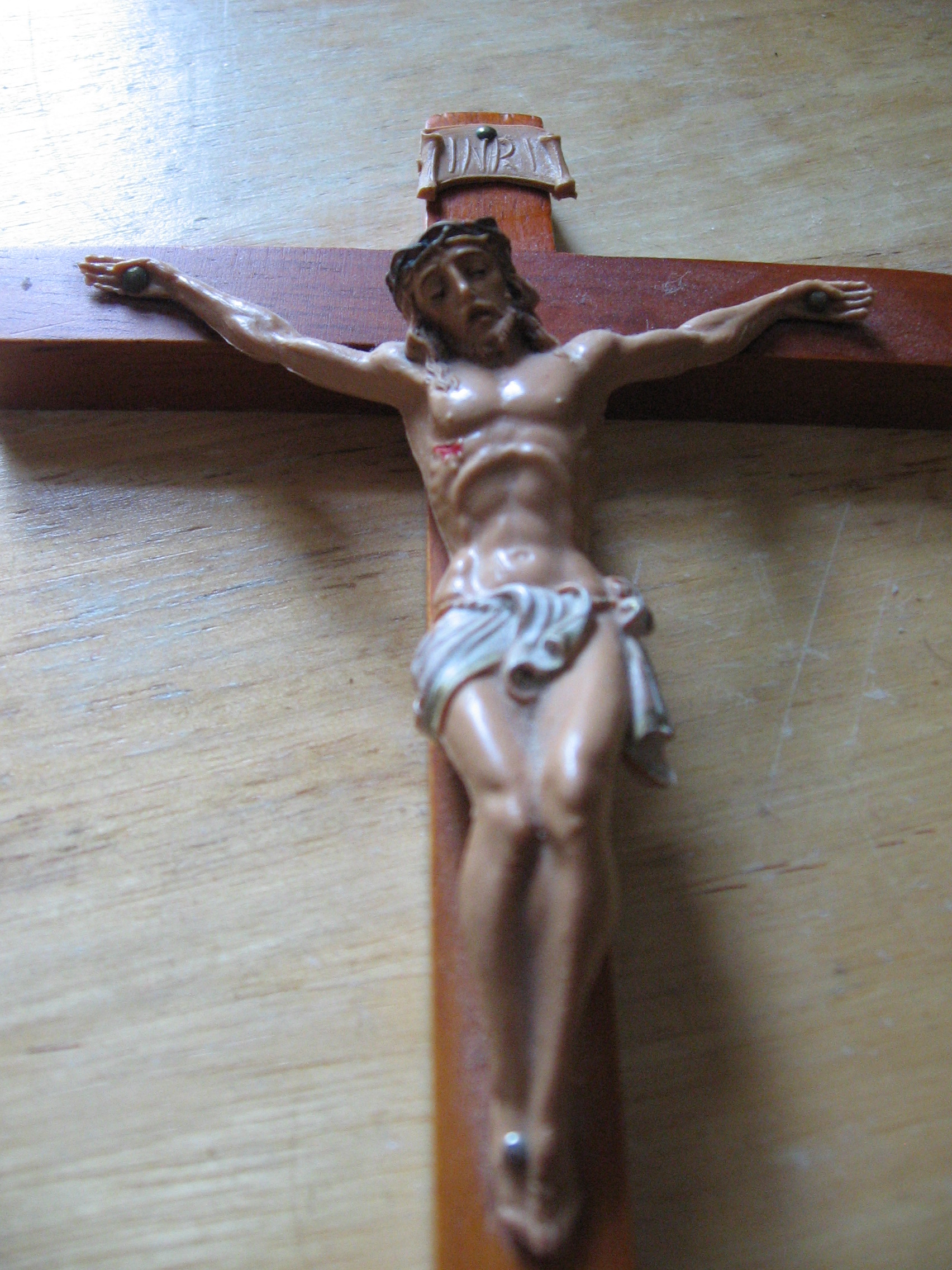
IMG_0347Then, one day on a whim, I bought a little crucifix online. I was raised in the Protestant tradition and remember being told that Catholic theology was wrong because they kept Jesus on the cross, whereas Protestant crosses were empty, representing the resurrection. When the package came, and I took out the little plastic Jesus it seemed so strange — a little Jesus doll when what I wanted was the real man, present in my heart, mind, and spirit, as he used to be. But one day, when the pain was at its worst, I placed my fingers on the nails in his hands, studied his face and his body, and wept with understanding: Jesus was in pain, too. He was suffering, too. I might not understand why it was happening to me, or why he wouldn’t answer my prayers to take it away, but now I knew that He was in it with me. For the days and months to come I lay in bed, clutching the crucifix to me and crying. Here’s what I wrote one night:

This did not go at all as planned, if I ever had a plan.  It had something to do with impressing everybody, but doing it without appearing to, effortlessly, the way I tell jokes,without smiling, looking away afterwards, leaving people to laugh or not, too cool to acknowledge my own cleverness.

But I was broken out of my intellect, my intention, my talent by the brokenness of my body, and though I wanted to relate to Christ in his witty repartee, his compassion, his healing, I now relate most to his twisted form on the cross, eyes shut in pain, not yet dead, not yet resurrected, not yet ascended. My Lord, the suffering, naked, four inch plastic form on the eight inch wooden cross.

I am not making a theology out of this.  Far be it from me. I am telling you what I do not know, not what I know. I am in pain all the time. I am dizzy, nauseous, exhausted, and this is before the side effects from the medications kick in.

Jesus’ features are not twisted in agony. If you didn’t know better you might almost think he looked peaceful. But I think that I recognize the movement inward that a long-suffering spirit makes. It is close to meditation. You have less to do with the world, with what is going on around you. Physical and emotional sensation take over and then, somehow, you sink below that, to a place deeper than that.

The contemplatives teach that at our very center the Spirit is constantly praying; that our act of prayer consists of joining in awareness with that ongoing prayer.  This is the only kind of prayer I can hope for, now.

I place a finger on each nail and press the wooden cross to my heart, the broken body of Christ against my own.

i-came-here-to-kneel

Taken from my bed — my home for many months — a ray of sunlight makes its way in and I reach through it to the cross.

The dark time lasted for six years, all told. Those two years, from the end of 2007 to the end of 2009 were the worst of it; after that I found a better (for me) migraine doctor and better meds, was able to start working a little bit and exercising, and learned what I needed to do to support my mental health. I still have migraines — almost every day, in fact — but they’re not as bad, and I know how to manage them. The depression has gotten slowly but continually better — these days it only visits occasionally, and I know what to do: Slow down, breath, meditate, do yoga and centering prayer. The spiritual stuff took the longest, though. I’ve written about that elsewhere, and I’m writing more. But for today I wanted to share this post about what the crucifix meant to me in that dark time, in case it might be helpful for someone who is in the darkness now. I don’t know why your prayers for healing have not been answered, or if the answer is, “no” or “not yet.” But I know the God that loves you is with you, and knows how you feel. He suffers with you, as he suffered with me back them. You are not alone.

What do you do?

Just a quick post before I head off to work. I love this definition of vocation by Frederick Buechner. Let me tell you something: I was never any good at street evangelism and I hated it with a passion, but I am a top-notch nanny and I find so much joy in it. And I love to write, and I think I am becoming a good writer. Where do you find joy? And where does the world need you?

Vocation

IT COMES FROM the Latin vocare, to call, and means the work a man [or woman] is called to by God. There are all different kinds of voices calling you to all different kinds of work, and the problem is to find out which is the voice of God rather than of Society, say, or the Super-ego, or Self-interest. By and large a good rule for finding out is this. The kind of work God usually calls you to is the kind of work (a) that you need most to do and (b) that the world most needs to have done. If you really get a kick out of your work, you’ve presumably met requirement (a), but if your work is writing TV deodorant commercials, the chances are you’ve missed requirement (b). On the other hand, if your work is being a doctor in a leper colony, you have probably met requirement (b), but if most of the time you’re bored and depressed by it, the chances are you have not only bypassed (a) but probably aren’t helping your patients much either.

Neither the hair shirt nor the soft berth will do. The place God calls you to is the place where your deep gladness and the world’s deep hunger meet.

– Originally published in Wishful Thinking