How to save a life

loveoneanother My heart is heavy for Paris and Beirut today. It has been heavy for Syria and her refugees for a long time. I want to drop everything and fly to Germany and the refugee camps and help people, somehow, I don’t know how. I want to do something. Of course, as I told my friend the other day, I would be next to useless there. I would be overwhelmed and I would have a migraine all the time and just need to lie down. In fact, I did drop everything, sixteen years ago when I was in seminary, and flew to Croatia to help the seminary students who were working with refugees from the Bosnian War. But when I got there, it turned out the students had all left for the summer. I spent a month doing paperwork and cleaning for the seminary instead. I also went to Turkey that summer after the earthquake (though that was unplanned), and five years later to Morocco to try to help out some midwives there who were saving premature babies. I was pretty much useless in both those places, though it was fascinating and humbling to see how people responded to the presence of an American. The Turks, bleeding and shaking in makeshift tents next to the rubble of their homes thanked me for being there, as if America itself had come to their aid. But I had no medical knowledge, no training, nothing really to offer them.

So going over there, to Europe or the Middle East, is not really how I personally can best help. But I believe I can, and each of you reading this can, too. I believe that there are people all around us who have the potential for great works of love or great acts of destruction, and our presence in their lives could make the difference in which of these they choose. And I believe that it’s not necessarily great acts of altruism that make that difference, but the small things we do each day, how we choose to look upon people and respond to them, whether we choose to respond to anger with anger, or to do the hardest thing and offer gentleness in exchange.

What if we looked at every person who gave us an angry look, who cut us off in traffic, who interrupted us in a meeting, who spread rumors about us in the office, as a potential mass shooter, as a potential suicide bomber? And what if our gentle response to their anger made them stop and reconsider? What if the person who honked and yelled at me yesterday because I wasn’t pulling out of the parking space they were waiting for was on the brink of snapping, but if I smiled and rolled down my window and looked him in the eye I could have given him another day of peace, another chance to find hope? Instead, I got stubborn and passive-aggressive, and took another minute to adjust the heat and the radio settings before I pulled out. And even then, driving away, I felt anger washing over me. I wished I had stayed longer, I wished I had turned off the car and kept him waiting, claiming my space and my rights, even though the kids were hungry and tired and needed to get home for lunch and a nap. Driving away, I suddenly felt so angry and such a sense of injustice that tears came to my eyes.

Where does anger like that come from? It usually happens to me in the car. People are just awful to each other in their cars here in Boston. I think it is because we can’t really see each other. We don’t look each other in the eye, we just see a two thousand pound metal vehicle. We don’t have the subtlety of expression, we can’t tell if the other person looks sad or scared, all we have are blinkers and horns to try to communicate our opinions and feelings. We don’t know that the person who just cut us off was up all night with a sick toddler and had to go to a job they hate even though they are also sick. We don’t know that the person tailgating us is getting old and having trouble telling how close she is. All our empathy and compassion is reduced to a single feeling of right and wrong, justice and injustice, getting our way and making sure the other person knows it. I am such a kind person, usually, when I am face to face with people. At least, I remember to try. But in the car it is different.

And so I try to remember, and to love people with my driving. To smile and wave and say thank you when people let me go, even though I know they can’t hear me. To let people go in front of me, even if I technically have the right of way.  That’s the other thing about driving in Boston — the city wasn’t designed by architects, it evolved haphazardly and inconsistently. So while in other cities there is some kind of structure and order, and you turn when the lights tell you to turn, in Boston there are many places where it’s just never your turn to go. If we didn’t stop and let each other go, we’d never get anywhere. And generally you know when you are waiting to turn that someone, eventually, will notice you and let you out. We depend on it, or none of us would ever get anywhere. People are kind to each other here, too.

One morning this past June the kids I nanny hadn’t been napping well but they all fell asleep in the car, so I decided to just drive around for an hour to give them a solid rest. They live near an intersection on the border of Roslindale and West Roxbury, and I drove through that intersection about three or four times in that hour, looping around to find places to drive without getting too far from home in case they woke up. There were a lot of police cars and ambulances there, and I wondered what had happened. It wasn’t until I got home from work that evening and turned on the news that I saw that a potential terrorist had been shot and killed there by the police. It was just fifty yards or so from where the kids and I had passed several times that morning. Half a mile from their house. About a mile from mine.

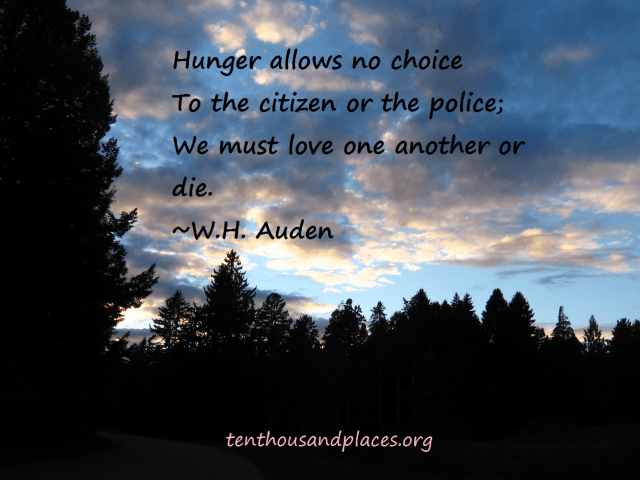
There is not much I can do right now for the Syrian refugees, shivering in tents on concrete floors as the cold weather sets in. There’s not much I can do for the families of the victims of the shootings in Paris and Beirut. But I can smile and wave and let people go ahead of me in traffic. I can humanize the driver in the car that cut me off and extend compassion to him or her. And I can get out of my car, and off of the internet — another closed-in vehicle that keeps me from really seeing the person I am interacting with — and actually get out into the city and interact with people. I can’t help the children drowning in the Mediterranean, but I signed up to lead a playgroup at a local homeless shelter. I can remember that everyone I meet is fighting a great battle, and give them a moment of refreshment and rest, a kind word in a world that has maybe been cruel to them. I can remember that we have no choice, that we must love one another or die.

lamplighthouseladder

Love,
Jessica


On sin and repentance

outofsortsbookSarah Bessey’s wonderful book, Out of Sorts: Making Peace with an Evolving Faith released this week. Do you have your copy yet? To go along with the book launch, Sarah is running a good old-fashioned synchro-blog, with the prompt, “I used to think___, but now I think___.” It was a project for her launch team, but Sarah just opened it up to everyone, so if you have something you’d like to write about, check it out!

I have been thinking about what I wanted to write about for weeks. I have things I want to say about spoken and unspoken gender roles in Christian community, and about spoken and unspoken roles for singles vs married people. I haven’t much changed my mind on those things — I’ve been a feminist and egalitarian since before I knew what those words meant — but I’ve been willing to work with complimentarians in the past, and even put myself in positions where they had authority over me, and I didn’t realize until much later how damaging those experiences had been. But I don’t think I’m quite ready to write about that yet.

Then of course there’s the obvious issue of LGBTQ inclusion. That is probably the shiniest thing that I’ve changed my perspective on. But I don’t think that’s what I want to share for the synchroblog. (If you’re interested, you can read this post about how I changed my mind.)

Here, though, I think I’d like to share a little about how my perspective on sin has shifted. So I’ve adapted an essay I wrote this summer:

Savasana: On finding the uncluttered space

The first time I went to a yoga class I struggled through, watching the clock the whole time. I knew the class was an hour and fifteen minutes, so it was with a sense of surprised blessing that I realized, with twenty minutes still to go, that we were winding down. The poses became slower and easier, and then the teacher told us to lie on our backs and make ourselves comfortable. She suggested putting our socks back on and pulling blankets over ourselves. She dimmed the lights, put on soft, meditative music, and I suddenly realized that it was nap time! Just like in kindergarten, we all lay together on our mats and rested. It felt funny lying in such an intimate, vulnerable pose in a roomful of people, eyes closed as the teacher led us through a relaxation exercise. But I soon forgot about the others and reveled in the peace and quiet as my sore muscles came to rest and my mind settled, my body becoming chilly as the sweat cooled.

Savasana is the word both for the pose — on your back with your arms out at a slight angle — and the process of lying in that pose and going through the relaxation exercise. It happens at the end of every yoga class, and is a way of allowing the poses you have just done to settle into your mind and muscles. It is also a body meditation, similar to centering prayer and bio-feedback, two things I stumbled upon a few years ago in my quest for spiritual and physical health. Like centering prayer and bio-feedback, you are encouraged to take a passive attitude to your thoughts, to allow them without trying to change them, but without latching on to them, or identifying with them.

One analogy used in centering prayer is to see your thoughts as clouds going overhead: You notice them but they don’t affect you down where you are, and they blow past with the wind. For someone who has struggled with anxiety, this is incredibly powerful: I don’t have to try to STOP thinking the anxious thoughts, or to change them or replace them with positive thoughts — exercises which left me exhausted and twice as stressed out — but I don’t have to define myself by them, either. I can nod at them, even greet them with friendly acknowledgement, but then not concern myself with them. I sometimes picture them as clouds, and sometimes as an object beside me: there, but not a part of me. Observe your thoughts, my teacher says, acknowledge them without trying to change them. So I notice: I am angry at my housemate for something stupid, I am worried about money, my back hurts. It’s okay. I don’t have to try to stop being angry right now, or stop worrying, or get my back to stop hurting. That’s just how I feel. It’s not me. My true self is deeper than those thoughts and feelings, is at peace.

I think that growing up and coming of age as a Christian, there were a lot of things I thought were sins that were just feelings, just me struggling to figure myself out, and figure others out, and find my place in the world. Repenting and trying to change those thoughts and feelings was a difficult, and unproductive process. I believe in sin, and in repentance, the Hebrew word shuv that means turning away from bad choices and back towards good, turning away from the wrong path and back to the right one, turning back to God. But I wish that I had known about savasana, too. I wish I could have given myself that space and gentleness, to not immediately identify my feelings as sins, and identify myself with them. Repenting of anger never helped me let go of that anger so much as gently acknowledging it, setting it next to me, and quieting my body and my mind. I can let it go. It isn’t me. I think if I had known how to do that it would have helped me to understand what the real sins were, what things were really pointing me away from God, which direction I needed to turn to go back towards God.

I remember as a child going to church and coming to the confession, week after week, the moment in the service where we read the prayer confessing that we had sinned, “In what I have done, and in what I have left undone.” I thought the second part was so profound — It’s not just our bad actions that are sins, but also our failure to act when we could have done something good. But I remember wondering, and asking my parents: Why do we have to pray that every week? If we’re asking God to help us not to sin next week, shouldn’t he help us? But we pray it automatically — no one stops to ask, “Did anyone succeed in not sinning this week? Great!” Everyone just assumes that we all messed up again. And if failure is built into the system, what’s the point of trying so hard every week?

My poor parents. Those were the kind of questions they had to field on a Sunday morning. But even as a kid the logic confused me.

Then I remember in college, struggling with the same things week after week. I wanted to be patient and kind, to love other people without judging them, and to care about others and take care of them. Those are still my goals, now that I think about it. But every week I found myself frustrated and impatient, judging others and thinking mean thoughts towards them, and frankly caring more about myself than them. That was mixed in with a lot of genuine caring and loving and even good works. But it was so frustrating to me that those thoughts were there. And the harder I tried, the more I repented and asked God for help, the more it seemed the bad thoughts loomed in and took control. And then there were the things that I now think weren’t even sins at all: Anxiety, depression, insecurity, jealousy, loneliness. Some of it was probably clinical and I could’ve used more help than I was getting. But some of it, I think, was just a normal part of being human, of being 19 and trying to figure out who I was, of being someone who thought deeply and took everything in and tried to figure everything out. I tried so hard, and I was so hard on myself for not figuring it out faster and better.

I sometimes think of that strange passage in Matthew 12:45-47, where Jesus speaks of an impure spirit that is driven out of a person, and then comes back to find the place swept clean, and takes up residence again, this time with “seven other spirits more wicked than itself.” And it reminds me of a lyric from a Ray LaMontagne song, Empty, which is about his struggle with depression:

Well I looked my demons in the eye
Bared my chest said do your best to try to destroy me
You know I’ve been through hell and back so many times
I must admit you kind of bore me

I heard that song during a very dark time in my life and I could so relate to the weariness of driving out demons only to have them return and return. Maybe I could just let them be, let them float overhead like clouds while I met with God down below. Maybe if I stopped casting them out they’d grow bored, too, and not want to play anymore.

One evening this August, after a long day at work, I came home and made my way to my yoga mat. During the savasana I opened my eyes and looked up at the ceiling. And I noticed something I never had before. Above, the white textured ceiling was bordered by dark wood paneling that matched the wood on the walls, and it created a framed rectangle the exact size of my living room. My living room is the place I spend more time than any other room (if you don’t count time asleep); it’s where I work on my computer, play on my computer, read, entertain guests, and do yoga. I sit on the front porch sometimes, and hang out in my bed at night, but the living room is the space most full of me, my activities and my presence. And tonight I noticed that there is a space the exact same size and shape above it, with soft, white, textured paint and a dark wood border. It is my living room, but it is emptied of furniture, rugs, house plants, computers, tissues, candles — all the things that clutter the floor below. It is a framed, empty canvas, in the shape of my life, my living, my room.

I realized that this space perfectly represents the place I go to when I do centering prayer, or savasana. In this case the clutter is down below, and that beautiful, white, uncluttered space is above — exactly the shape of me, but empty of all of the thoughts and anxieties, habits and coping mechanisms, that make up my daily life. It is a blank canvas, where I can meet God and we can create something together. God is the paint, and I am the brush, or I am the brush and God is the artist, or I am the canvas only and God is all the rest: the blended colors of the full spectrum, the rocky pigment sparkling in the paint, the sharp edge of the palette knife, the rough horse-hair of the brush, and the Artist Himself, waiting for his materials to settle down, to move all that clutter off of the canvas so He can finally begin.


How to write a blog post

Great blue heron

Discovering the Water’s Edge by Mark Slawson

“There are no unsacred places;
there are only sacred places
and desecrated places.”
~from How to Write a Poem by Wendell Berry

I’ve been feeling discouraged lately. I have some foot problems and a knee problem that have been keeping me from going for walks and doing yoga, and I need that exercise as much for emotional health as for physical. I also need it for my work. I do two marathon days of 10 hours each with three kids, and I need to be strong to make it through.

I also had an argument with a friend the other day, where we were crossing wires and each hurting the other. We talked about it and we’re fine now, but it left me feeling familiarly frustrated with how easy it is to say something stupid or hurtful — how in fact it seems like the harder I try the more blunders and absurdities I end up adding to the list of things that haunt me at night when I can’t sleep. And then I drive in Boston and people are so mean to each other sometimes, and so angry.

I don’t get outside much in my current jobs. The little kids go from activity to nap to activity, and the big ones have to go straight home from school to do their homework. The boy I watch on Fridays is just a (very cute) homebody, and if we get out it’s usually just for a walk around the block. So I was surprised and excited when he agreed to a walk around Jamaica Pond this afternoon.

I wish my phone took better pictures, but believe me, it was lovely at Jamaica Pond today. Still, I was feeling low and just kind of dull, and the autumn colors weren’t stirring as much joy in me this year as they usually do. Also, the first thing we saw when we stepped out of the car was writing scrawled on the curb — a variation of the “call Sally for a good time” except with explicit details about what the good time would entail, and what I assume was the poor girl’s actual phone number. And I thought — people suck. I suck. Why can’t we all get it together?

Still, I was at a gorgeous pond with an adorable four year old, so I settled myself into my job description as a writer (via Frederick Buechner): “Pay attention.”

The water level at the pond was much lower than it had been the last time I was there. J and I walked on a little beachy area below the landscaped stones that usually mark the edge of the pond. We threw stones into the water, and then sticks. We examined fallen branches and played walking games that J invented. I told him there was a really cool tree I wanted to show him, and he put the hood up on his sweatshirt and put his little hands in his pockets as we walked. We acted on suggestions from both parties: “Let’s climb that tree!” “Let’s go up those steps and see what’s on top.” “I’ll take one step then you take one step then I take two then you take two.” “Let’s go see where the old mansion used to be.”

My feet hurt a little bit, but the red and orange maples and the slope of the hills were beginning to get through my malaise. We traced the outline of the old mansion up on Pinebank Promontory and read the little plaques with its history and the history of the pond. Then we looped back down towards where the car was parked. We still had 20 minutes till we had to leave to pick up his big sister, so I tried to think of something to do.

“Do you want to throw rocks into the water again?”

“Okay.”

We went back down on the drought-created beach, and started walking but suddenly there was a large flapping and a great blue heron moved away from us a few feet, startled by our proximity. We quickly went back up onto the path and sat down to watch it. I’ve lived in this area for nine years, and this is the first year I’ve ever seen a blue heron at the Pond. It seemed a little precarious. I’m used to seeing them in more secluded places. Jamaica Pond gets hundreds of visitors a day, lots with dogs. J and I watched as it resumed its slow stalk for fish, its long, S-shaped neck moving in concert with its feet. I explained that it was walking slowly like that so the fish wouldn’t notice it, and that when it saw one it would jab its long beak underwater and snap it up. Funnily enough, the heron’s walk looked a lot like one of the walking games we’d just been playing. J told me a joke:

“Why did the pelican get in trouble at the restaurant? Because he couldn’t pay his big bill!”

Suddenly the heron’s head jerked forward, there was a splash, and it came back up with a perfect little rainbow trout in its beak. It was exciting and dramatic and beautiful, and in that moment joy broke through to me again, celebrating the heron’s catch with a little boy on the path by Jamaica Pond. We watched for a while longer, chatting with others who had stopped to watch, and I exulted in their happiness, too. The heron caught one more fish while we were there, and missed one. People took pictures and smiled at each other, and laughed at J’s cute and wise comments.

It was a sacred place we’d stumbled onto, just yards away from the desecrated curb where we’d started. But there are no unsacred places, Berry said, and it’s true. It’s just that I needed the heron, and the maple trees, and J to help me remember.

What kind of month has it been?

stepsI have a bunch of ideas for blog posts but life has been so busy the past few weeks that I haven’t had a chance to sit down and flesh them out. So I thought I’d tell you about what has been keeping me busy.

The most exciting thing was the Love Flash Mob over at Momastery. In 24 hours we raised over $475,000 dollars to build a new wing for the Heartline Maternity Center in Port au Prince, Haiti, and to buy warm clothes for mothers and babies from Syria who are still living outside in Berlin, even as the cold weather has set in. These Love Flash Mobs are my favorite times of the year because we take the power of community and turn it into concrete, practical action to love and care for each other. The maximum donation is $25 — the average for this one was $21. That means my $25 counts just as much as that of the millionaire or billionaire or anyone else. 21,000 of us got together and gave, and countless lives will be saved because of it. You just can’t get efficiency and joy like that anywhere else on the interwebs. Check it out here. And don’t be sad if you missed this one, just follow Momastery on Facebook and/or my Facebook page and we will be sure to tell you when the next one is happening.  I even stepped way out of my comfort zone for the flash mob to create and video tape myself doing a touchdown dance for every flash mob update. Enjoy!

I’ve also been busy with the launch team for Sarah Bessey’s upcoming book Out of Sorts: Making Peace With an Evolving Faith. The book is amazing — You are going to want to read it, trust me. I’ll have a review up soon, but for now you can preorder it on Amazon.com or Barnes and Noble, or support your local small bookstore by buying it there. The release date is November 3rd.

The launch team has been an incredible experience, not only discussing Sarah’s book with her and the others, but getting to know the other team members as well. I have two new favorite blogs through the launch team: Esther Emery’s Church in the Canyon and Tanya Marlow’s Thorns and Gold. Esther is a homesteader, deep thinker, and a brilliant writer. She crafts sentences like this, which I read several times over: “And even here I see God revealed — refracted, bent, and shattered — shining out the cracks of crooked people.” Tanya Marlow writes about struggling to find God and God’s will in her life while suffering from debilitating chronic illness, something which you know is dear to my heart. And it was also through the launch team that I found this beautiful, moving letter from a 19 year old girl with Asperger’s to her ten year old self. (The rest of Debby’s blog is well worth checking out, too.)

AAI_WritingContestAnother project I’ve been a part of is the Almost an Inkling flash fiction contest happening over at Mythgard. It’s a six week contest with a different prompt and guidelines every week. We’re in week five now, which is poetry. I just tried my hand at a Clerihew and a Triolet, two forms which were new to me. I actually won the literary prize for week three, the “Minute Mystery” which was very exciting for my twelve year old self, who didn’t dream of writing viral essays about gay weddings, but about writing stories. (She doesn’t really get blogging, even though I’ve tried to explain it to her. She just wants to know why we aren’t writing more stories about cats and unicorns.) My story for week two, with the prompt “Here Be Dragons” was dedicated to Say it Survivor, my friends’ Laura and Mary’s organization dedicated to helping women and men who have survived childhood sexual abuse tell their stories. They have workshops and talks coming up in Massachusetts and beyond — check it out on their website. The challenge for the story was to surprise the reader with an unexpected perspective on the dragon. My heart was full of Laura and Mary and the other brave survivors that week, so this is what I wrote:

She first saw the dragon the same night her uncle first came into her room. She was very young. After he left she lay there, choking back tears – he had warned her not to cry – and wondering, for the first time in her life, if there was something wrong with her. Then, suddenly the dragon was there, hovering over her bed, its green eyes shining in the darkness. It had brown-red scales, like muddied flame, and its wings spanned the room and, somehow, beyond.

She caught her breath and stopped crying, terror of the dragon greater than the pain. She waited for it to pounce, but it never moved, other than the slow beating of its wings and the whirl of its eyes, locked on hers. Time passed, minutes or hours. Then, despite her uncle and despite the dragon, her eyes began to droop and her small body fell into sleep. It was very late, and she was very young.

From then on, whenever her uncle came into her room, after he left the dragon would appear. Soon she found that she would wait for it, lying in the dark, holding her breath and blinking until its unblinking eyes appeared above her. She never really stopped being afraid of the dragon, but she was comforted, too, by its presence, its strong, sinewy legs and sharp claws, its tireless wings that beat the air, swirling it into a gentle breeze. Even though the worst had happened, even though she was so, so far from safe, she felt something her young mind did not have words for yet. Something like hope, something like confidence.

She only spoke to the dragon once, a year or so after the dual visits had started. One night she took a deep breath, lifted her small chin and said,

“Just go ahead and eat me, dragon. Do it.”

And the dragon lifted its own chin, and opened its jaw, and a blast of fire came out, heating the air above her head, but she was not harmed. She understood its answer: Yes, the dragon had said, I could fry you and swallow you whole, but I will not. And she cried harder that night than she ever had before.

The last time the dragon appeared to her was years later. She was older now, not young anymore, not at all young anymore, and the dragon came to her late one night. And she looked in its eyes and noticed something she never had before: They were the same color as her own green eyes, with the same brown flecks. And she saw that the mud-red scales were the same color as her own auburn hair, which shone in the sunlight.

Then she flexed her arms and legs and she felt the sinewy strength of a dragon flow through them. She felt the movement between her shoulders of powerful wings. And she stretched out her wings and she flew.

The Almost an Inkling contest is still going on if you would like to try your hand at a poem this week, or next week’s prompt which will be “Speculate and Subcreate.” Also at this link you can read the winning entries from the first three weeks, and vote on the poems from week five. The winning entries will be published in a special-edition ebook by Oloris Press and we’ll be reading our work aloud during a webinar at the end of the contest on Halloween.

restwellWhew, well, there’s more I could tell you about — what a busy month it’s been! — but I’ll stop there and give you a chance to check out the links I’ve included. I hope you’ve all had a good October so far! What have you been up to? Let me know in the comments. And if you haven’t been doing that much, that’s okay, too. The resting is part of the doing.

Love,

Jessica

On resting well

restwell
Yesterday, after a Saturday spent in a familiar struggle, I wrote a letter to myself in my journal. I thought I’d share it here, in case some of you could relate.

Jessica,

Here are some things you’ll need to remember: When you’ve been pushing hard and are really tired, you’ll need to rest. You’ll be looking forward to that rest. But when it comes you probably won’t be able to enjoy it very much. It won’t feel nice and peaceful. You’ll feel bored and lonely. You’ll have a migraine and you’ll feel resentful that the migraines are keeping you from leading a normal life. You’ll wish you could be outside taking advantage of the beautiful weather, or at least at the gym exercising. You’ll wish you could be with friends and you’ll start to feel like you don’t have any friends. You’ll think you should be working more and you’ll worry about money. You’ll feel the depression edging in and you’ll start to worry that if you don’t do something it will come to stay. You’ll worry about eating too much or too little, and that if you spend the day lying around you’ll get fat. You’ll question every hour, and if you should be doing something other than what you’re doing.

All of that will happen, as it always does. And you’ll try to reinvent the wheel and reexamine your life and your game plan, every time. The problem is, that’s not restful. So here are the three things you need to know:

  1. You need the rest.
  2. You’re doing your best.
  3. You can trust God to do what you can’t.

Here are some other things to remember:

You used to eat a lot more. Remember those big bowls of popcorn with butter and Parmesan cheese, those variety packs of candy? The salt and sugar from those binges produced dopamine. Eating + watching TV lulled you and allowed your mind to rest. Without the food you’re more squirrely. It’s okay. It was a coping strategy when the migraines and depression were so bad, but it was bad for you. It’s good that your eating is healthier now. But it makes sense that it would take some time to re-learn rest without that coping strategy. Remember the lesson from centering prayer and savasana: Observe your feelings without judging them. And trust that the good habits you’re learning will continue to fill in the gaps left by the bad ones.

Also, don’t compare your life and schedule now to when you were running and exercising hard four or more times a week. You were only working three easy days then, and now you’re working four and two of them are quite hard (three small kids for ten hours). Plus, you get home later, and need to go to bed earlier to wake up earlier. You’re not going to be able to replicate 2011’s schedule of coming home from work and going straight to the gym for two hours. That’s okay. Do a little yoga. Maybe go for a walk — but it’s okay if you’re not even up for that. Your two ten hour work days are like a marathon, and the other nanny days take energy as well. Just listen to your body and do what you can.

And — You’re living well at work! You pay attention, take in the beauty of the days and the children. You have good relationships with the kids and their parents. You use your mind and your body. You laugh and make other people laugh. You exercise — lifting the kids, pushing the stroller, cleaning up after them. You get outside. You do fun things. It’s not a typical social life, but it’s a good life. So it’s okay not to do a lot on your days off — Your days on are packed!

Last thing: You actually do a lot outside of work, too. Just this summer you went to a writer’s conference, went to two of Glennon’s talks in Boston, and went to a Shakespeare play on Boston common. You spent time with Laura, Suzy, David, Megan, Gina, and the Lundquists. You went to Walden Pond, to Crane’s Beach, to Hale Reservation; you swam and kayaked. You went to the library and to the Arboretum, to Lars Anderson park, to Jamaica Pond. You went to church three whole times! You write a blog and are doing a flash fiction contest, you’re on Sarah Bessey’s launch team (#outofsortsbook), you’re in a writer’s group. You keep in good touch with your friends, you visit your parents often and you went to Connecticut to see your brother. You try to be a good friend to Mark and a good housemate to Jill, you offer support and encouragement to commenters on your blog, on Momastery, and on Facebook. You make soup. You do yoga. You keep your house clean and keep more than a dozen houseplants alive. You put out sugar water for hummingbirds and seeds for the other birds.

You read books, albeit slowly. You read articles and blogs. You think deeply about things. You sometimes pray.

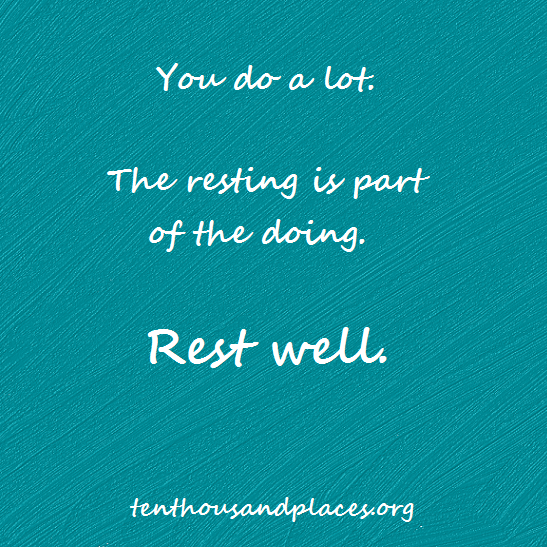
You do a lot.

The resting is a part of the doing.

Rest well.

Love,

Jessica

Dear shooter: I will not learn your name

Candle

Dear shooter,

I will not learn your name.
I will not read about your vision or your passion
or your manifesto; the views, the hatred
that led you to this act.

I will not share your image on social media
Or comment on the news reports that do.
I will do my best to not even think of you, to unmake your
memory, to forget that such a person ever lived.

You did not win either my admiration or my horror.

But if you had come to me before and said,
“I am angry,” “I am terrified,” “I am alone,”
“I am filled with hatred, for you, for everyone.”
I would have looked you in the eyes as best I could.

I would have spoken your name out loud.
I would have told you the truth, as I know it,
That you are beloved, that you are not alone.
That Love has not passed you over — even you.

And the way I know this is that Love loves me, too —
Even me. I would have looked on you with compassion
And said a prayer for you. I would have called heaven to your aid.
But I will not give you notice now.

I will not learn your name.