On Charleston, Hillary Clinton, and black forgiveness

Painting for Mother Emmanuel by Ty Poe

Painting for Mother Emmanuel by Ty Poe

“They dress the wound of my people
as though it were not serious.
‘Peace, peace,’ they say,
when there is no peace.”
~ Jeremiah 6:14

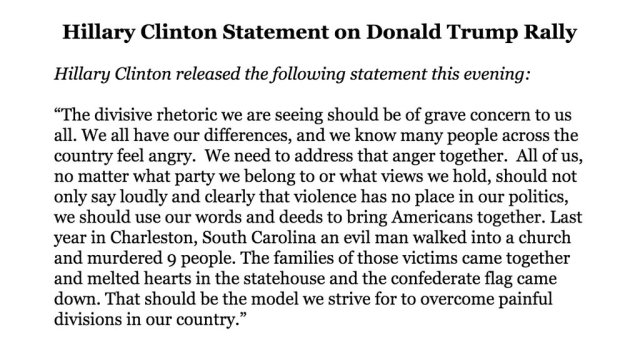
I am deeply concerned at Hillary Clinton’s response to the events in Chicago. It is the height of ignorance and, yes, racism, to call for black forgiveness for continued violence against them. Until we as white people have acted vigorously to dismantle racism in America we have no right to call for people of color to continue to absorb its blows.

This is Clinton’s statement:

Rally
Many people of color are speaking out against Clinton’s statement, and I want to join my voice with theirs.


I would like to repeat, fervently, what I wrote last June after the murders in Charleston. There is no justice in platitudes. There is no justice in crying, “Peace, peace,” when there is no peace. Justice cannot be found in silencing the voices of the oppressed. It can only be found in truly hearing their voices, in calling out with them and for them, and in DOING THE WORK.

On the murders in Charleston

If you only have something nice to say,
Be quiet.

Now is not the time for niceties,
For crying, “Peace, peace”
When there is no peace.

If you have a voice
HOWL

If you have a soul
LAMENT

If you have a prayer, fine.
Say it softly to yourself.

But if you want God to hear you
SHOUT

If you want to pray for peace
WAIL

Rend your garments
Fall to the ground

And stay there until God answers you.
And then get up and do the work.

~ Jessica Kantrowitz

Save

Social Justice for the Socially Inept: The New Jim Crow

Social justice for the socially inept(10)

I feel I have to start a lot of my stories this way, but, this really happened, I swear.

One day last fall, after a second cup of coffee, I was pushing the double stroller to toddler tumble time and brainstorming ideas for my blog, and I came up with “Social justice Sundays.” I was thinking of all the cool guest bloggers I’d have, issues I would help us to learn about, and suggestions I’d make for my readers to make the world a better place. Then, no joke, I accidentally pushed the stroller onto the heel of a handicapped, African-American man in front of me, causing his shoe to come off. I apologized profusely and tried to help him, but he ignored me. So I went on my way, chagrined, but still daydreaming about my blog series. Then it came to me — the perfect title and the perfect description of what I wanted to write about: “Social justice for the socially inept!”

Throughout my life I have tried in various ways to be an activist, a missionary, a helper, a world-changer, but most of my attempts have fallen short, often in almost tragically comical ways. I’ve gone to Turkey, Morocco, and Croatia, I’ve been to the sites of earthquakes and wars, I’ve been to church basements and homeless shelters, I did an independent study on Christian social justice organizations at seminary. I’ve awkwardly bought coffee and sandwiches for people on the streets, some who said thank you and some who swore at me. I called 911 when I found a man passed out late at night in a subway stop. I derailed a trip to the Boston Calling music festival with some friends in college because there was a homeless man passed out on the street on the way, and I was like, “What about the story of the good Samaritan? What would Jesus do?!” But all these attempts have felt bumbling and mostly useless.  I have chronic migraines, which limit my physical involvement in many things. I am very introverted and get overwhelmed quickly in social situations. I have high emotions and tend towards high anxiety, though I’m working on that. But for me, showing up at a civil rights march would be the opposite of helpful. I’d probably get claustrophobic and panicky, start crying, and need the medics to come give me oxygen.

But there are things I can do, things I am good at. I can read. I can listen carefully and think deeply about what I hear. I can write in a way that lets others know they are not alone. So I thought that instead of flying overseas to have panic attacks at refugee camps I’d try to share a little bit of what I’ve been listening to, and start a discussion about it. If you feel similarly frustrated, wanting to do something but not knowing where to start, please join me and fumble along with me. Here at SJSI, all are welcome, grace is given freely, and there are no stupid questions.

Two of my goals this year are to educate myself about race-related issues and to encourage my white friends to come on the journey with me. Incidentally, the white folks I know (myself included) are horrified at what America is coming to and will come to if Donald Trump is elected, but the people of color I know are saying that this is where America already is, and has been.

BGiM1

This thought has been making me nauseous for the past several days. Our nightmare is their reality. It’s tempting for me to want to close my eyes and go back to not knowing this. But yesterday’s primaries are making that impossible. And I don’t want to live in peaceful ignorance while others are suffering. I want to learn more, and to figure out what my part can be in changing things.

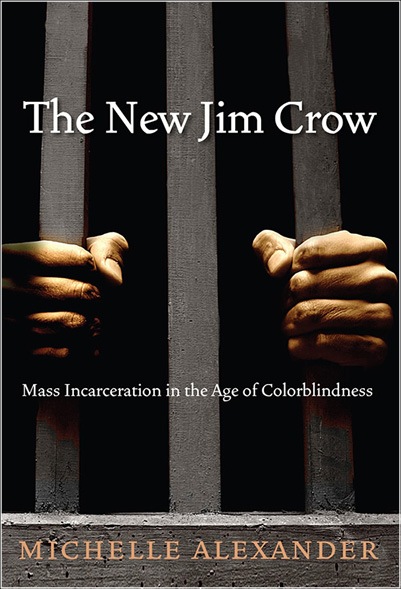
JimCrowSo I thought I’d start off Social Justice for the Socially Inept with a book, The New Jim Crow: Mass Incarceration in the Age of Colorblindness, by Michelle Alexander. I’ve heard this book is pretty brutal to read, which makes sense if you’re used to believing in the Matrix-generated world of a more or less safe and fair USA. A few weeks ago on Facebook I asked if any of my white friends would commit to reading this with me and several did. My copy arrived in the mail yesterday, solid and heavy in my hands.

Will anyone else join us? Will we take the blue pill and wake up safe and sound in our ignorance? Or take the red pill and find out just how deep this rabbit hole goes?

“The New Jim Crow is a grand wake-up call in the midst of a long slumber of indifference to the poor and vulnerable.” —Cornel West

Yours in the journey,
Jessica

Dear February: A break-up letter

brokenheart

Dear February,

Hey, babe. We need to talk.

I don’t think we should see each other anymore.

It’s not you, it’s me. Okay, well, if I’m honest, it’s a little you. I mean, I don’t know if anyone’s ever told you this before, but you’re kind of high maintenance. I don’t mind putting work into a relationship, but when it’s always you throwing tons (literally) of snow at me, and I have to spend every weekend shoveling out my house and car, it gets to the point that I just can’t cope. When was the last time we did something fun on the weekend? Maybe these blizzards *are* fun for you, I don’t know. But for me, I think I need a month with a little more warmth, the occasional sunny day I can just cuddle with and be myself. You know?

And, listen, I’m sure there are girls out there who can appreciate you more than I can. People who ski, for example, or who hate being able to feel their fingers and toes. You should hold out for someone who likes you for who you really are.

I can tell you were really trying this year, and I want to give you credit for that. Those days where the sun broke through and your temperatures got up into the 50s were just lovely. But, to be honest, they just made the cold, snowy days that much harder. I know you did the best you could, February, but I think we just have to admit that we’re not right for each other.

What’s that? Who told you that? Well, yes, it’s true, I have met someone else. His name is March. He actually reminds me of you a little, in a funny way. He and I have plans tomorrow and — guess what? — he might have a snowstorm. On our first date, I know. He’s a bit of a fixer-upper. But I really think he’s open to change. He’s working on himself, you know? I told him how hard your dark, lonely evenings were, and he promised me that within a couple of weeks he’d have sunset moved to six thirty, and even seven. I know you like to stay in at night, February, but I’m the kind of girl who likes a nice walk in the evenings, with the sun on my back.

Still, I think March might just be a rebound relationship. There’s this other month I met online who says he always brings his girls flowers. Flowers, can you imagine? Did you ever think of doing that, February? Or is that too much of  a cliche for you?

Oh. Well, this is awkward — I forgot it was a leap year. I guess we have one more day together after all. So…what do you want to do? Come on, February, don’t be like that. Let’s end on a good note. What do you say — want to go shovel some snow, for old time’s sake?

Your friend,
Jessica

On banishing shame, or how I found and ate three day old rice under my covers and woke up the next day free

Photo by OzRocky

Photo by OzRocky

Sometimes I eat a late night snack in my bed. I used to have much bigger binges late at night, sometimes eating the equivalent of an additional one or two meals. The best thing for my body, for my sleep rhythms, for my emotional well-being, is not to snack after 9pm. I sleep better when I don’t, and I wake up feeling somehow clearer, less foggy, not retaining water from the salt of last night’s snack. Sometimes I manage not to late-night-snack, but often I don’t. I have gotten really good at not keeping things in the house that lend themselves to mindless snacking — chips, candy, salty things, big bags of things. So when the urge does come I can only eat what I have — an apple or a single-serving yogurt. That’s all well and good, but when I’m tired and medicated (I take my migraine meds a couple of hours before bed) sometimes I still manage to overeat. Even bread can be a temptation. I crave something I can put in my mouth, bite after bite. I crave the dopamine stimulation of salt, the busy-ness of my hand going back and forth from the bag to my mouth.

Some nights I still eat too much. But as I’ve written before, it’s not overeating that perpetuates eating disorders. It’s shame. Do you remember my three rules of eating? Eat when you’re hungry, stop when you’re full, forgive yourself when you don’t? That last one, forgive yourself when you don’t, is the absolute most important. If you forgive yourself, that day is over, that binge is over, and you get to wake up a normal human being on a normal day. You can feed yourself a healthy breakfast, plan a healthy lunch and dinner, enjoy the taste of the food, the nice full feeling in your stomach, and the energy the food gives you. That night you might overeat, or you might just eat an apple, or even just go to bed with no snack at all.

If you don’t forgive yourself you wake up, not just foggy and bloated, but angry and in caloric debt. You try to force yourself to eat smaller meals, you punish yourself with bitter thoughts; you furrow your brow at your reflection in the mirror. You don’t feed yourself lovingly throughout the day, so when you get to the night you are hungry. You dislike yourself. Guess what makes you feel better while at the same time validating your self-castigation? Half a loaf of that raisin bread you were saving for breakfast. Shame begets shame. Forgiveness begets healing.

I have gotten really good at forgiving myself. I think that is the only reason that the 50+ pounds I lost a few years ago has stayed off. Sure, I could probably lose another 30 by breaking my rules, by not eating when I’m hungry, by turning my shame into the fuel to beat my body into submission. I’ve done that before, and it works, for a little while. But then the weight comes back, and, like the demon in Jesus’ obscure parable in Matthew 12, it brings back seven of its friends with it. Better to welcome the one demon you have, gently allow it space in your life without giving it control over anything. And maybe you will find that that demon was just you all along — wonderful, imperfect, adorable, multi-faceted, dearly loved you.

Something funny happened this past weekend, that showed me just how far I’ve come and just how good at forgiving myself. I went away for the weekend, and got back Monday afternoon. I didn’t have the energy to cook dinner, but I remembered that I had some leftover rice and planned to eat that with frozen veggies. But when dinner time came, I couldn’t find the rice anywhere. It wasn’t on my shelf in the fridge, or my housemates’ shelves. I asked Mark twice if he had eaten it, and he denied it. Then I remembered that Friday night I’d had the late night snacking urge. Nervously I pulled back the covers of my bed, and found it there: A Pyrex container of rice. It had been in my bed the whole weekend.

>Five years ago I would have felt that sick feeling of shame in my gut. I would have immediately begun spiraling into hateful thoughts towards myself. I would have thought that the rice represented a deep, secret, fatal flaw, that it confirmed that I was abnormal and broken. What kind of person loses rice in their bed? What was wrong with me? In an effort to purge and punish myself I would have thrown the rice into the garbage disposal and eaten only veggies for dinner. Three hours later, hungry and full of shame, I would probably have overeaten again, salt and sugar, something bad for me.

Do you know what I did this time? I laughed. I told Mark where I’d found it, thereby depriving the shame of oxygen and snuffing it out. Secrecy is oxygen to shame, did you know that? And I checked that the rice was still good (it was!) and heated it up with veggies and I ate it. I was hungry, so I ate good, healthy food, and I ate until I was full. I forgave myself, and I fed myself.

Friends, forgive yourselves. Feed yourselves. You are good and whole and loved. Yesterday is over, it does not get to make demands on us today. Go to sleep forgiven and whole, wake up to a new day, and feed yourself.

*****

Follow me on Facebook and on Twitter for more exciting stories about rice and other metaphors. And join in the conversation! I’d love to hear your stories, too.

atomsstories

Love,
Jessica

God will make clear to you: On disagreements and doctrine


This weekend I’ve been thinking again about how often the question, “What do you believe about X?” is used to determine whether or not someone is truly a Christian — X being any number of things such as homosexuality, abortion, heaven and hell, universal heath care, which political party is more “Christian”, and on and on. It is a question that goes all the way back to the Anabaptists and whether baptism should be given in infancy or at the age of understanding and profession of faith, and back before that to the split between the Roman Catholic church and the Eastern Orthodox church over whether the Spirit proceeds from the Father and Son or just from the Son, and back even further than that to the early church over whether non-Jewish Christians had to be circumcised. When I share a perspective that challenges my readers, they often respond with a doctrinal question aimed at clarifying whether or not I am a “true” Christian. The idea is that if I answer the question correctly, they will consider what I’ve said, but if I answer incorrectly, they will dismiss me as a false Christian, and gladly dismiss the uncomfortable feeling that there might be something to what I have said.

I love these readers, actually. They are some of my favorite people, because even in asking the question they are taking a step outside their comfort zone. I get a lot of commenters lecturing me, scolding me, and scoffing at me, but the ones who ask questions, even if the question is aimed at discrediting me or putting me in a doctrinal box, show an openness to a response. A question opens up the possibility of a conversation, and a conversation opens up the possibility of a relationship, and a relationship opens up the possibility of finding common ground, not necessarily in doctrine and beliefs, but in our spiritual orientation, the direction in which we are facing and the person towards whom we are moving. For Christians, the common denominator is not our stance on heaven and hell, or our views on baptism, or the way we vote. Our common denominator is Jesus, “Jesus Christ and him crucified,” as Paul says in 1 Corinthians 2:2.

So when one of my readers asks me, “What do you believe about X,” I first of all thank them. I am genuinely grateful that they have read my words, and thought about them, and taken the time to respond. And then I tell them this:

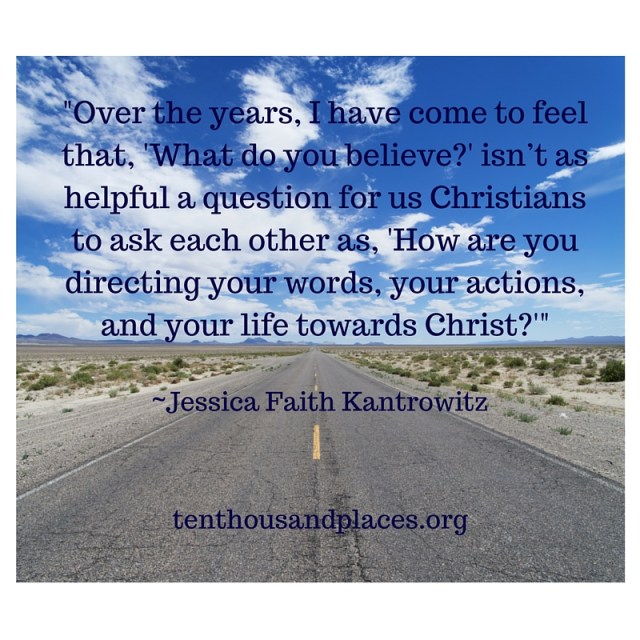
I am a professed Christian, and have read the Bible many times. The thoughts in this post and in all my writing reflect a deep, life-long meditation on God’s word and a continual seeking to conform my life to my Savior’s. Over the years, I have come to feel that, “What do you believe?” isn’t as helpful a question for us Christians to ask each other as, “How are you directing your words, your actions, and your life towards Christ?” You and I have different interpretations of some parts of scripture, and have come to different conclusions about X, but we are both seeking to know, love, and serve God through Jesus Christ. So we have the most important thing in common! I cling to the promise of Philippians 3:15, that, “…if on some point you think differently, that too God will make clear to you.” If we both keep our hearts and our feet turned towards Jesus, our steps will move us nearer and nearer to him. And even if we are in very different places doctrinally, if we are both moving towards Christ then we will somehow, mysteriously, be moving closer to each other, too.

Love,
Jessica

We choose you

My valentine card for all who have felt unloved and unchosen. Please consider it accompanied by those little candy hearts. ❤ I choose you. We choose you.

Jessica Kantrowitz's avatarTen Thousand Places

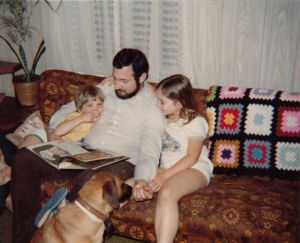
Me with my dad, little brother David, and our dog, Hector. Me with my dad, little brother David, and our dog, Hector.

When I was about eight or nine years old we read at church the story of Abraham preparing to sacrifice his son, Isaac because God called him to. Later, at home, I asked my dad, “Dad, what would you do if God told you to sacrifice me?” I don’t know if he realized what an important question it was for me. I loved God, and our church, and the stories we read in the Bible. When I was three I had prayed for Jesus to come into my heart. But this story scared me. I knew God had provided Abraham with a ram so he didn’t have to sacrifice his son. I don’t remember if I understood at the time that it was an analogy to Jesus, to God the Father providing us with His only son as a…

View original post 1,400 more words