The world wants me to write about it today

“Pay attention. As a summation of all that I have had to say as a writer, I would settle for that.”
~ Frederick Buechner

“Instructions for living a life.
Pay attention.
Be astonished.
Tell about it.”
~ Mary Oliver

The world wants me to write about it today. It’s been throwing itself at me, quite shamelessly. It will do anything, it seems, for a bit part in one of my stories. From the moment I left my house the water sparkled at me like some reverse paparazzi, wanting its flash bulbs to be the news on page six. At Starbucks I tried to write my blog post about finances, but an apologetic woman sat across from me, asking in a soft, Germanic accent if there was room for her and her friend, while the Chinese family at the other end of the table nodded and gestured to her, making the word “okay” seem like both a full sentence and a solemn ceremony.

A few minutes later I glanced up to see the Chinese man holding his hands in front of him, empty palms open like a book, staring silently and intently at their pages, and the man on my other side answered his phone with a click of his earpiece and earthy Russian syllables rolled out of his mouth. I paused to take a selfie for Facebook — the intrepid writer hard at work — and when I cropped it I saw I had also captured a woman behind me wearing a head covering, hard at work on her own laptop, a novel buried in the soft furrow of her brow.

“Slow down!” I cried, “Let me choose — I write slowly.” And I fled to the library, hiding in a study carrel with just enough room for me. Safe, I thought. But I glanced over and caught the eye of the man in the carrel next to me, just as he was glancing over at me, and his brown skin, shoes kicked off and tie slung over his shoulder called out to be described. What color tie? Purple, with green stripes, and the shoes looked like loafers–

“Wait! Stop!” I called again to the flamboyant world. “That’s not my job right now!” I glued my eyes to to my computer, trying to write the post, copying and pasting. But the library turned out to be a dangerous choice as a myriad of childhood memories ran up and demanded to play on my page. How many times had I ridden my bike the two miles to the local library and spent the afternoon exploring the worlds within that sacred world? What was the name of the street? What was that smell that drifted out of the Italian restaurant as I biked by? “Tell about it,” the memories insisted. “Tell our story.”

So I ran to the park, a pond surrounded by trees, benches, fields. I grabbed my notebook — there was work to be done! But just within the gates a Korean wedding party gathered for a picnic, laughing loudly as I scurried by, dodging inspiration. (How would I describe the smell of kimchi? Sour? Vinegary?) Then I ran straight into a group of women dressed head to toe in black hijabs, making me suddenly aware of my broad, naked face, my bare hair flowing in the breeze (chestnut, with shiny wisps of grey). But I was restored to modesty as I rounded the corner by a scene from the cover of a romance novel — a young Hispanic woman dressed in a sleeveless, backless, flowing pink gown, with two muscular men holding out swaths of the fabric as a crew of four photographed them. Coming closer I saw the plot twist — the woman was pregnant, and cradled her belly proudly, shaping the dress around it. “Now there is a story,” the world said, pulling out all the stops: “Write it!”

Full to bursting I rushed up the hillside to sit in the crook of a fallen tree that would take me half an hour to describe. But I can’t, I don’t have time, because even as I write this a man has kicked a soccer ball near the pond and his shoe is flying into the air with it — he is hopping on one foot, laughing and shouting in Arabic. He is hopping right now, I tell you — he is bending down in the wet grass to retrieve his shoe. Did I mention the color of the grass? Did I tell you about the ragged feel of the trees after a long winter and a blustery early spring? Did I describe the slow perambulation of an elderly couple, leaning on each others’ arms for support? Did I write about the woman sitting in the crook of a fallen tree, writing furiously in a notebook as if the world were tugging at her sleeves? Did I get it all?
The Italian word for prayer

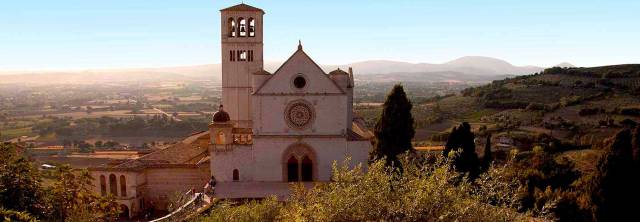
Basilica Facciata, Assisi, Italy

Basilica Facciata, Assisi, Italy

I have a somewhat big decision to make, one that I’ve been thinking about for several months, and I’ve been pretty stressed about it. I’m so bad at making even small decisions, and the big ones can overwhelm me. I keep settling on a course of action, and trying to make it stick, but then the pros and cons will start circling back again. I’m trying to focus on the pros, that there are good things to both paths, and everything will be okay either way. I know this. But it’s not just the cons that haunt me, it’s the decision itself. I get this way even when I have to decide whether to go out for the evening or stay in. Sometimes a migraine can come as a relief, making the decision for me, even as it frustrates me with my limitations.

My friend Judith McCune Kunst is teaching a poetry class in Italy this month. Before I tell you how this ties into my big decision, let me share one of my favorite of her poems, which was published in The Atlantic in March, 2000.

THE GUEST

When Chiqui asked me if my sleep in her house
had been good, I told the truth with a sweep
of my hands: The mattress sags, I said, and left
for Spanish class.
                     She dragged the mattress
off its frame and propped it in the narrow hall.
She pulled the larger, slightly newer mattress off
her and her husband's bed and hauled it
back to mine.
                     Now when Chiqui asks me
how I've slept, I lie: Just fine, I say,
though by this time I've learned
the Spanish word for shame.

I’ll give you a moment to recover from that. It took me several before I could breathe properly again.

Are you ready to continue? Okay. So Judith is teaching a class in Italy, and ten days ago she posted on Facebook that she was traveling to Assisi, the birthplace of Saint Francis, and said to message her with prayer requests and she would pray for us in that holy place.

If you had asked me what I needed to cope with this decision-making process, I would have probably said a better to-do list, a wise advisor, or for something to happen that irrevocably made the decision for me. I realize now that this was a serious lapse of imagination. What I actually needed, and what was provided, was for a poet friend to pray for me on a sacred pilgrimage.

The nature of my decision is that I can’t really take any action on it until the end of April. There is data I won’t have till then, either. So it will be a few more weeks before events are set in motion, before I can stop thinking about it.

But in the meantime, my friend’s prayer perches like a soft bird on my shoulder, like the gentle animals to whom Saint Francis is said to have preached the gospel. I always thought they must have known it already, that Good News that we humans try to pass on to each other in broken English and Spanish and Italian. I think the birds are born knowing it. I think that’s what they sing to each other about, on these April mornings when I’ve dared to leave my bedroom window open a crack, their sweet songs reaching me in my slumber and cheering me for the day ahead.

I think the birds of Assisi already knew the gospel, but I think they still listened intently to Francis as he preached, their little heads tilted as the medieval Italian words filled their ears. Jesus referenced birds when he said, “Your heavenly Father knows what you need.” He already knows. But we pray for each other anyway. I imagine the great-great-great — and far beyond that — great-grandchildren of Francis’s sparrows tilting their heads to listen to my friend as she prays by the slender cypress trees. And God is there, too, his head inclined, nodding intently, even though he already knows.

***

You can read more of Judith’s poetry and prose, including updates of her month in Italy, at her website, www.judithkunst.com.

Bake for them two

One year ago today I wrote an essay. It was a little sermon, really, using all the skills and knowledge I’d learned at seminary: exegesis (digging into the historical, Biblical, cultural, and literary background of a Bible passage), “big idea” sermon writing, and application. It represents decades of thought, prayer and Bible study, not just of this passage, but the whole Bible, Old Testament and New. This is what I have to offer. After the recent “religious liberty” rulings in North Carolina and Mississippi, I think it’s even more important to ask ourselves what is more Christian? To insist on our rights at the expense of others’ rights? Or to serve, sacrificially, even if it costs us something? We don’t have to wonder, Jesus addressed this issue in the Sermon on the Mount. Christians, our Jesus said “Go with them two.”

Jessica Kantrowitz's avatarTen Thousand Places

canstockphoto9505469In Jesus’ time, the nation of Israel was under Roman rule. The Israelites were allowed to live there and practice their faith for the most part, but they had to pay taxes to Caesar and obey the Roman laws.

To the Israelites, the Romans were evil and ungodly. They had no place ruling over God’s chosen people in God’s chosen nation. That land had been promised to Moses and his descendants when God brought them out of Egypt. Their very presence in the land was blasphemous.

One of the Roman laws stated that any man could be required to drop what he was doing and carry a Roman soldier’s equipment for him for up to a mile. In the Sermon on the Mount, with his followers gathered around him, Jesus referenced that law and told his followers what they should do in that case:

“If anyone forces you to go…

View original post 987 more words

Then not just my feet, but my head and hands as well!

Jesus washing Peter's feet

Jesus washing Peter’s feet, by Sister Marie Boniface

It’s Maundy Thursday, and this is one of my favorite passages in the whole Bible. I am busy and tired and overwhelmed, and I don’t have more than a minute to post this morning, but I am taking that minute to imagine myself as Peter, intense, passionate, often bumbling Peter, who loves Jesus with his whole heart and mind and, one night after this exchange is going to deny Him three times.

It was just before the Passover Festival. Jesus knew that the hour had come for him to leave this world and go to the Father. Having loved his own who were in the world, he loved them to the end.

The evening meal was in progress, and the devil had already prompted Judas, the son of Simon Iscariot, to betray Jesus.  Jesus knew that the Father had put all things under his power, and that he had come from God and was returning to God;  so he got up from the meal, took off his outer clothing, and wrapped a towel around his waist.  After that, he poured water into a basin and began to wash his disciples’ feet, drying them with the towel that was wrapped around him.

He came to Simon Peter, who said to him, “Lord, are you going to wash my feet?”

Jesus replied, “You do not realize now what I am doing, but later you will understand.”

“No,” said Peter, “you shall never wash my feet.”

Jesus answered, “Unless I wash you, you have no part with me.”

“Then, Lord,” Simon Peter replied, “not just my feet but my hands and my head as well!”

Jesus answered, “Those who have had a bath need only to wash their feet; their whole body is clean.

And I read this poem by Rainer Marie Rilke last night, from the book The Book of Hours: Love Poems to God, and it seems to me to be the same thing.

I live my life in widening circles
that reach out across the world.
I may not complete this last one
but I give myself to it.

I circle around God, around the primordial tower.
I’ve been circling for thousands of years
and I still don’t know: am I a falcon,
a storm, or a great song?

God at the center, Jesus offering to wash our feet as we offer ourselves, bumbling, not knowing either exactly who we are or who God is, but moving ever around and through and for God, hoping that our life is what our Creator meant it to be, washed once and for all yet still tripping and falling in the mud, rising and soaring. And through it all, always talking to the One at the center of our being, shy but eager to know our role in the Passion. We want to wash our Lord’s feet but find Him, instead, knelt over ours as we throw up our hands in confusion and praise.

***

Soundtek, if you are reading this, you won the giveaway! Please email me your address at tenthousandplacesblog@gmail.com so I can send you Matt’s book!

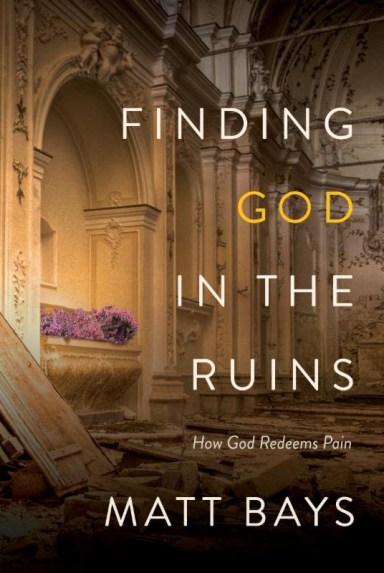
Finding God in the Ruins: A book review and giveaway

FGitR“Sometimes it feels as if God has invited Himself into my pain, when I had hoped to be invited into His healing. We want a God who heals our wounds, but it seems we have a God who heals our hearts.”
~ Matt Bays

When I first signed up to be part of the blog tour for Matt Bays’ book Finding God in the Ruins: How God Redeems Pain, I was excited to be a part of promoting the book of an author I already loved. Two things have happened since then: I read the book and loved it even more, and, even before the official launch and blog tour could begin the book took off like wildfire, word of mouth, Matt’s message of hope in despair spreading from heart to heart, from friends to friends of friends, each person who read or even heard about it telling others: Get this book, now.

So now my time has finally come to tell you about Matt’s book, and, well, you might already know about it. It is a bestseller on Amazon, in several categories. Ann Voskamp wrote about it. (Read a excerpt from Finding God in the Ruins on New York Times bestselling author Ann Voskamp’s website: http://bit.ly/1Pa4R7C). Laura Parrot Perry wrote about it. If you search Finding God in the Ruins on Facebook or Twitter you will see post after post by people who have found this book and found hope and redemption in it.

But on the off chance that you have not heard of it, I’m honored to have the chance to share it with you. And I have a copy to give away! Keep reading for details.

Matt Bays grew up in a hell that he didn’t fully understand. His stepfather was abusive and his older brother learned to replicate that abuse. Matt grew up, got married, and went into ministry, and tried to push away those memories and keep them buried in his past. When he finally realized he couldn’t live like that anymore, and started seeing a counselor to try to articulate his pain, he began to uncover truths not only about his own life but about how broken the church can be in providing support for those who are speaking up about their struggles and their doubts.

For years I had longed for the church to be a safe place where I could reexamine my faith with fear and trembling and anger. I needed it to be a place where I could ask the tough questions — where I could expose God’s short sale on my life, on Robert’s life, on Keegan’s life, on yours. But the church wasn’t the place I’d hoped it would be.

I’m guessing my church would have given me six months to work things out rather than the six years it would take…

Matt writes honestly about getting angry with God, walking away from God, even giving God the middle finger. As he faces the memories and pain of his childhood, and the present pain of his sister’s cancer, he rages at God for not providing healing. But it is through that rage, through that honest baring his heart, that he discovers God’s presence with him in the wreckage. As the title of the book suggests, Matt finds that God doesn’t remake his life into something different. Instead, God sits with him in the ruins. Just like Frederick Buechner wrote about Job, “God is not an answer man can give, God says. God himself does not give answers. He gives himself, and into the midst of the whirlwind of his absence gives himself.”

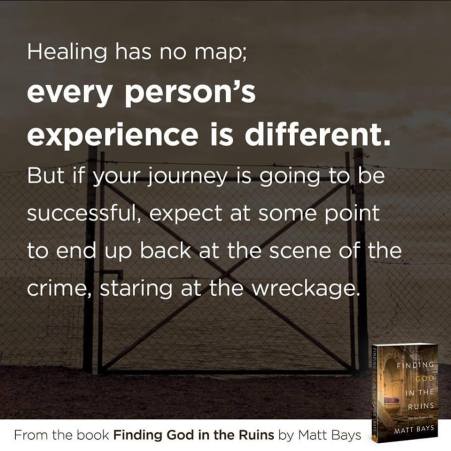
But Matt does not stop with his own story and his own encounter with God’s absence and presence. Matt wants to free us, too, to tell our stories, to be unafraid and to trust that their is enough grace for us, whether it takes us six months to work things out or six years, or more. “Healing has no map;” Matt says:

every person’s experience is different. But if your journey is going to be successful, expect at some point to end up back at the scene of the crime, staring at the wreckage. People will tell you to move on, and they are partly right. But if you have tried and can’t seem to, you must go back and see what happened with new eyes. And then you must try to tell your story without trying to make it palatable — for anyone. You have to tell the truth — the whole truth — expecting the painful passages to come when you do. If it gets to be too much, take a break. Dog-ear the page and return to it when you’re good and ready, but plan to finish the book because there’s a beautiful ending to it.

Matt Bays meme 1

Matt writes with the eloquence of a poet, and with the heart of a pastor. He offers us his story, and whether we relate to the specific details or not, Finding God in the Ruins makes us feel less alone.

***

I have a copy to give away! Just leave a comment here or on my Facebook page and I will pick one commenter at random to receive Matt’s book. *Update 3/23: soundtek won!*

On Matt’s website you can find a free sample chapter, a trailer/music video, and links to places to order the book.

You can find quotes and links from the other bloggers in the tour here.

***

I received a free advance copy of the book in return for my honest review.

No more fatal flaws

whiteme_1The past couple of days I’ve been struggling to focus and get my work done. I have a to-do list that’s quite long, commitments that I’ve made to things that need to get done this weekend. And as the hours have passed and not much has gotten done I’ve felt this vague sense of shame about it. I don’t do negative self-talk, really — the words in my head tend to be more free-flowing and random — but I do negative self-feelings. I sink into familiar feelings of shame, that go back to when I was a kid and I couldn’t explain what I was experiencing physically. “I don’t feel good,” was all I had, and I don’t remember exactly where the message came from, but somehow I internalized it: “You’re fine, get over it, do what you’re supposed to do.”

Even more than that, I somehow got the message that if I didn’t feel good it was somehow my fault. I can’t really explain it. Maybe it was because my mom was really into health food and vitamins, and I sometimes balked at the orange juice with brewer’s yeast or carob bars instead of chocolate. Maybe I felt bad for sneaking candy (successfully) or those bright orange cheese puffs (unsuccessfully — kids, pro-tip, wash your hands and face after) at parties. But somehow I grew up thinking that the headaches, nausea, fatigue, light-sensitivity, sound sensitivity, inability to focus, overeating — all the strange migrainey symptoms that could come in any combination, often without the tell-tale headache — that they weren’t really real, or a good enough reason to go home (oh what I would have given for an ailment that showed up on the thermometer at the nurse’s office!), and that if I was just a better kid I wouldn’t feel so yucky anyway. No one ever told me that, I don’t think. I just put together the pieces weirdly. And that feeling continued into adulthood, the sense of shame whenever a migraine came on.

I’ve done a lot of work on that. But it’s amazing how, even after years of migraines and years of working through exactly this issue, it still takes me hours and hours to frame days like today as, “I have a bad migraine,” rather than, “I’m being so lazy and unfocused today, what’s wrong with me?”

Does anyone else struggle with this feeling? I’m going to speak some truths to myself today, and you can listen along:

You have a bad migraine today.

You have a lot that needs to get done, but you might not be able to get it all done, because YOU HAVE A BAD MIGRAINE TODAY.

You are not making excuses, that’s just how it is.

You didn’t do anything wrong; you didn’t make yourself have a migraine. You just have one.

You are doing the best that you can.

You are trying really hard.

Your body is telling you that you need to rest.

It’s okay. Rest.

You’re not lazy. You’re ill.

Or, maybe you’re exhausted, worn down, over-stressed.

Life can be insanely stressful, you know. Not because you’re doing it wrong, just because it is.

You are not lazy. You do not have a fatal flaw of laziness, or spaciness, or excuse-making.

You work so hard. You try SO hard.

Having a chronic illness is hard enough without blaming yourself for it.

Having a chronic illness is hard enough without misdiagnosing yourself.

You have a bad migraine today.

That’s all.

Love,
Jessica

***

Stay tuned Monday for an exciting book review and give-away! Unless I can’t get it done, because I have a bad migraine. But I’m going to try.