What does it mean to be a Christian?

plan

S. D. found the irony in this; I think it’s incredibly profound.  Why do we expect God to give us an easy life?  What do we think this is all about, anyway?  (And by “we” I mean “me”).

Another friend emailed me this recently, a wonderful reminder of our purpose here:

The chief purpose of life is not happiness, but the knowledge of God. One reason that the problem of evil seems so puzzling is that we tend to think that if God exists, then His goal for human life is happiness in this world.  God’s role is to provide comfortable environment for His human pets.  But on the Christian view this is false.  We are not God’s pets, and man’s end is not happiness in this world, but the knowledge of God, which will ultimately bring true and everlasting human fulfillment.  Many evils occur in life which maybe utterly pointless with respect to the goal of producing human happiness in this world, but they may not be unjustified with respect to producing the knowledge of God.”
In Memorium

Fr. Richard John Neuhaus, 1936 – 2009

“As children of a culture radically, even religiously, devoted to youth and health, many find it incomprehensible, indeed offensive, that the word “good” should in any way be associated with death. Death, it is thought, is an unmitigated evil, the very antithesis of all that is good.

“Death is to be warded off by exercise, by healthy habits, by medical advances. What cannot be halted can be delayed, and what cannot forever be delayed can be denied. But all our progress and all our protest notwithstanding, the mortality rate holds steady at 100 percent.”

In the rest of this article, Fr. Neuhaus talks about his near death experience nine years ago.  Read it here.

“We live the given life, and not the planned.” Wendell Berry

This did not go at all as planned, if I ever had a plan.  It had something to do with impressing everybody, but doing it without appearing to, effortlessly, the way I tell jokes,without smiling, looking away afterwards, leaving people to laugh or not, too cool to acknowledge my own cleverness.

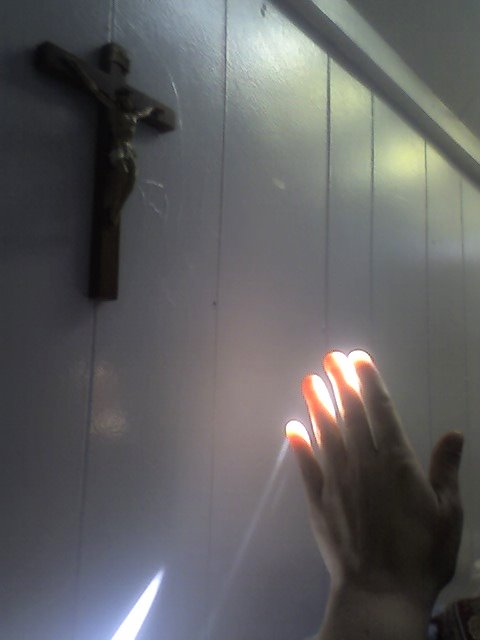
But I was broken out of my intellect, my intention, my talent by the brokenness of my body, and though I wanted to relate to Christ in his witty reparte, his compassion, his healing, I now relate most to his twisted form on the cross, eyes shut in pain, not yet dead, not yet ressurrected, not yet ascended.  My Lord, the suffering, naked, four inch plastic form on the eight inch wooden cross.

I am not making a theology out of this.  Far be it from me.  I am telling you what I do not know, not what I know.   I am in pain all the time.  I am dizzy, nauseaus, exhausted, and this is before the side effects from the medications kick in.

Jesus’ features are not twisted in agony.  If you didn’t know better you might almost think he looked peaceful.  But I think that I recognize the movement inward that a long-suffering spirit makes.  It is close to meditation.  You have less to do with the world, with what is going on around you.  Physical and emotional sensation takes over and then, somehow, you sink below that, to a place deeper than that.

The contemplatives teach that at our very center the Spirit is constantly praying; that our act of prayer consists of joining in awareness with that ongoing prayer.   This is the only kind of prayer I can hope for, now.

I place a finger on each nail and press the wooden cross to my heart, the broken body of Christ against my own.

I am here to kneel.

If you came this way,
Taking the route you would be likely to take
From the place you would be likely to come from,
If you came this way in may time, you would find the hedges
White again, in May, with voluptuary sweetness.
It would be the same at the end of the journey,
If you came at night like a broken king,
If you came by day not knowing what you came for,
It would be the same, when you leave the rough road
And turn behind the pig-sty to the dull facade
And the tombstone. And what you thought you came for
Is only a shell, a husk of meaning
From which the purpose breaks only when it is fulfilled
If at all. Either you had no purpose
Or the purpose is beyond the end you figured
And is altered in fulfilment. There are other places
Which also are the world’s end, some at the sea jaws,
Or over a dark lake, in a desert or a city—
But this is the nearest, in place and time,
Now and in England.

If you came this way,
Taking any route, starting from anywhere,
At any time or at any season,
It would always be the same: you would have to put off
Sense and notion. You are not here to verify,
Instruct yourself, or inform curiosity
Or carry report. You are here to kneel.

This is an exerpt from Eliot’s The Four Quartets, and it is a vivid description of the experience I have been having this past year, which I can also find described in books like The Dark Night of the Soul by Saint John of the Cross.

The Latin for “dark” is obsura — obscure. We don’t understand why the removal of our joy, our peace, our dearly loved connection with our Lord is necessary, but we trust that it is. We have prayed to give Him everything, and it turns out that the taking away of everything includes the things we depended on for our faith. These things are not He. As a character in a Charles Williams novel says, “Neither is this Thou.”

We wanted to live for Him. We find we can barely live at all. We wanted to conquer the world for His Kingdom. We find we can not even conquer ourselves.

Even this is too much explanation. It is obscure. I am not here to instruct myself, nor to carry report. I am here to kneel.

*Thanks to Sleight of Hand for sending me to this passage.