Wrapping up 2015 and setting intentions for 2016

Setting her Intention by Jessica Kantrowitz

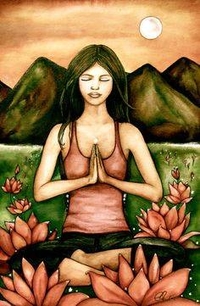
My attempt to draw the Anjali Mudra. She is naked for aesthetic and symbolic reasons, and not at all because I don’t know how to draw clothes.

I’ve written about how Savasana, the meditation at the end of a class is one of my favorite things about yoga. Another of my favorite things is setting an intention. At the beginning of the class you place your hands, palms together, in front of your heart and decide what your intention is going to be for the class. You decide it yourself — the instructor never tells you what it should be. It can be anything you want: to be present, to strengthen your body, to connect with God, to let go of anxiety, or anything else you feel you need.

Your hands in front of your heart — Anjali Mudra — seal your intention. I’ve been doing it in other areas of my life, too, like before bed, sealing my intention to rest and not worry about the next day. Or on the way to work, sealing my intention to be focused and engaged. I’ve been doing it on a broader basis, as well, for years and even decades. It’s different from a to-do list or a list of New Year’s resolutions because it holds itself: You don’t have to do anything more once your intention is sealed in your heart. It’s not something you strive to accomplish. It’s more like turning in a particular direction so that your natural movement takes you where you’ve decided to go.

For me, for the last two years, this has had a lot to do with writing. The rest of this post is a summary of the last two years, my intentions and what has come of them. If you only have a few minutes, though, and want to skip to the action point of this post, here it is: What is your intention for the coming year? Is it different from last year? Take a few moments to sit with your eyes closed, hands together in front of your heart, to breathe deeply, and to consider what direction you want to turn for 2016. Set your intention, and then let go, trusting that you have placed it in your heart.

In May of 2014 I turned 40 and I set my intention to write. In a post entitled Forty: A preface I wrote:

I have some ideas, some thoughts I’d like to share, some stories I’d like to tell. I have some inklings and some convictions, some anecdotes and some parables, some bluntly factual reports and some metaphorical fictions.

They’re in me. I feel them brewing.

Ever since I was five or six I’ve wanted to be a writer. I still have stories from those days, mostly about cats and unicorns, with an overabundance of commas and adverbs. I’ve kept up my writing in various ways over the last thirty five years, through journaling, writing poems and short stories, several brief attempts to formulate novels and, most recently, blogging. I sent stories to literary journals in my late twenties, had a writing partner for a while in my early thirties. Yet I remember thinking, as early as college, that as much as I wanted to write, I didn’t have my stories yet — my life experience to draw on. I kept writing anyway. But I had this strong feeling that it wasn’t until I was forty that I was going to be able to write anything real. That feeling has stayed with me.

Three weeks ago I turned forty. And I feel it. It’s time.

For a while now I’ve been thinking about what Anne Lamott said in Bird by Bird:

You own everything that happened to you. Tell your stories. If people wanted you to write warmly about them, they should have behaved better.

There are other people in my stories. Some haven’t behaved that well, and their bad behavior is part of my story. But, still, this doesn’t feel quite right to me. *I* haven’t behaved well in other people’s stories. And other people have blogs (and theoretical book deals) too. So I’ve been worried, not wanting to be unjust or to write to validate myself at another’s expense.

But then Glennon Melton posted this the other day:

When internet writers ask me for advice- one of the first things I tell them is: ”If you can avoid defending yourself for being human, you might have enough energy to keep writing. Don’t defend yourself, and don’t get your needs confused. You don’t need to be right- you just need to write.

So, I am going to write, knowing that I may not be right about everything, but knowing, too, that I have to write. “A bird doesn’t sing because it has an answer,” said Maya Angelou. “It sings because it has a song.”

I have a chronicle, a myth, a fable; I have a memoir and an apologue. I have a saga, a romance, a spiel; I have a scoop and a cliffhanger. I have a song.

After that post I started blogging more frequently and writing longer posts, more like essays than the brief observations I’d been posting before. And that year I wrote, among other things, a post entitled Things I’ve been wrong about for most of my life, part one. It was the processing of a difficult time in my life, and of a difficult relationship, and I needed Anne, Glennon, and Maya to help me know how to write it. To tell my stories. Not to be right, but to write. Not because I had an answer, but because I had a song.

On New Year’s Eve of 2014, I set my intentions for 2015:

My new year’s resolution this year is to mostly keep doing what I’ve been doing, because I think I’m on the right track. I will not be dieting because diets make you fatter, and I will not be hitting the gym — though I would love to, actually — because I have a bunch of little chronic injuries at the moment. The one big thing I want to do next I’ve already signed up for: A writer’s workshop through The Frederick Buechner Center at Princeton Seminary. I am really excited about it. It’s the first time I’ve spent money on my writing, the first time I’ve been to a conference in seven years, and the first time I’ve been to a seminary in nine years. Don’t tell Gordon-Conwell that I’m cheating on them with Princeton.

But the things that I want to focus on next year are the same things that I’ve been focusing on this year. Nothing new or particularly ambitious. But they work for me.

1) Be the best nanny and editor I can — focus on being present and paying attention.
2) Write weekly (I can’t swing daily right now, but I’m getting good at weekly).
3) Do yoga and bike when I can.
4) Keep seeing friends and family in person as well as connecting online.
5) Eat mostly healthy food and resist equally the temptations to eat too much and too little.
6) Look for ways to connect with God, and don’t be discouraged when I can’t find Him in the same places I used to.

To briefly touch on nos 1 and 3-6, I did those things mostly well, but not always. Being a good nanny got harder when I moved from a family with one little girl to one with three children under five. I felt like a good nanny a lot less. But I think I still mostly did my best, so that counts. I did yoga and biked when I could, but a knee injury slowed me down, and when my wheel broke at the end of the summer I made the difficult decision to pay down my debt and wait till the spring to get my bike fixed. I saw lots of friends in person, and stayed connected with many others online. I ate too many pastries when the winter got tough in February and March, but I started eating mostly healthy again in the spring. And I did keep turning my focus toward God, setting God as my intention and focus again and again throughout the year, even though that looked different in 2015 than it did in, say, 2006 when I was doing daily Bible readings and intercession-style praying. Prayer in 2015 looked more like a deep breath and lifting up a person, a thought, a worry, a hope, a fear, a praise, or simply gratitude to God.

Back to writing. Thirteen days after I’d set my New Year’s intentions, my friend Glennon shared Things I’ve been wrong about for most of my life, part one on her Momastery Facebook page, and 30,000 people read it. Thirty thousand people read about a time in my life when I’d felt isolated and alone in my confusion and struggle, and hundreds of them said, “Me, too.” Thirty thousand people read something I’d written, which is kind of more than I’d ever dreamed, except that in my dreams they were holding my book in their hands. My 12 year old self was impressed but confused when I told her about it. We hadn’t published a book, so were we a writer or not? The internet is a weird and wonderful place, I told her. You’ll get used to it; but not really.
For three weeks in a row there were blizzards Sunday into Monday.

For three weeks in a row there were blizzards Sunday into Monday.

At the end of January, 2015, it started snowing, and pretty much kept snowing all the way through February. For a couple of months most of my blog posts were about the weather and living through it in Boston:

The darkest night of the year

Florida: A true story

Boston in January

Self-talk

Of monster and men

Consider the birds of the air

Dear February

Before we move on from that topic, I would just like to add that there was so much snow in Boston last winter that it didn’t completely melt until July 14th. Here is the NPR article for proof.

On April 1st I moved on from the weather to write about something that had been weighing on my heart for a long time. Someone who disagreed with my essay asked me why I felt I had to write it, and I said: It wanted to be written, and I couldn’t write anything else until I did. Bake for them two went viral on a scale I never expected, and I have spent a lot of the rest of the year trying to figure out what that means for my writing career. Was this my big break or just a freak vicissitude of the internet? Where did I go from there? Was this a subject about which I had more to say? I processed with my writer friends, two of whom rolled up their sleeves and helped me wade through the 1500+ comments (thank you, Judi and Heather!!). I went to the writer’s workshop and was able to pose some of my questions to Rachel Held Evans, as well as other wonderful writers and editors.

by Denna Jones

by Denna Jones

Some of my questions had answers, and some of them still don’t. But one thing going viral taught me is that I don’t have much control over what happens next. All I can do is to keep writing whatever is on my heart. I’ve had posts I’m proud of only reach 100 people, and others gain traction and reach 500, 1000, or 15,000 (the latter was my June post about Sam and Anne Lamott). But I don’t get to decide which ones catch on. All I can do is keep writing what is in me, and keep being curious about where and for whom my writing might be relevant. Going viral didn’t lead to a book deal, but it did help to get noticed by editors at Think Christian and The Good Men Project, who published my Bake for them two piece and my Sam and Anne Lamott piece, respectively. (The Good Men Project also gave my piece the gorgeous artwork above.) And that, in turn, helped me to write a respectable author’s bio.

The answer to, “Do I have anything more to say on this subject?” turned out to be, yes, but really only three things. In my follow-up posts to Bake for them two I wrote about why we need to stop saying “love the sinner, hate the sin, about how my dad’s choice influenced my own, and, in answer to those who asked me why I as a Christian supported gay marriage and full inclusion of LGBT people into the body of Christ, my testimony.

In September and October, continuing to follow my intention, I took part in a six week writing contest for Mythgard Institute. This was pure fun — I got to write micro-fiction and even a poem, inspired by Tolkien-related prompts and specific word limits and guidelines. They are going to do it again next year if anyone would like to take part. I was completely surprised and honored to win the literary prize (judges’ choice) for my “minute mystery” and the popular prize (readers’ choice) for my poem. They will be a part of an ebook, available soon from Oloris Publishing. (My twelve year old self was much more impressed that we won an award for writing a story than she was by going viral for an essay. She still doesn’t get what an ebook is, but, honestly, I don’t either. A book with no pages? Maybe in another 29 years we will start to get the hang of things.)

I swung and missed a few times, too: I entered a poetry contest and another micro-fiction contest that I lost, and sent three or four article proposals to magazines that were turned down. But rejection letters are badges of honor, and proof that you are writing and moving forward. I also received the discouraging news that it was next to impossible to get a book of essays published unless you already had a successful book, or, “Unless you are Anne Lamott” as one editor told me. But that is good information, as well.

I have some ideas for where I’d like to go in 2016. But, since the best laid plans of mice and men “gang aft agley” and since “We live the given life, and not the planned” I am not focusing so much on specific goals or resolutions. Instead, I am setting the same intention I did back in May of 2014: To write. My friends Heather and Glennon shared with me this great TED talk by Elizabeth Gilbert, in which she wrestles with similar struggles, and comes to the same conclusion: Write. I probably won’t go viral again in 2016. I may not get a book deal, or publish another article, or win another contest. But I know what I will be doing, week after week: Paying attention to the world around me and then sitting in front of my computer trying to organize my thoughts and write them down.

Other intentions for 2016:

1) Be the best nanny and editor I can — focus on being present and paying attention.
2) Look for ways to actively work for racial justice.
3) Do yoga, bike and walk when I can.
4) Keep seeing friends and family in person as well as connecting online.
5) Eat mostly healthy food and resist equally the temptations to eat too much and too little.
6) Look for ways to connect with God, and don’t be discouraged when I can’t find Him in the same places I used to.
7) Keep breathing deeply, forgiving myself and others, and letting go of pain from the past.
8) Read books!
9) Go outside!
10) Take care of myself, even if that means saying no to things I really want to do, or that others really want me to do.

What about you? What are your intentions for 2016? Let me know in the comments. And thank you so much to all of you who have visited Ten Thousand Places this year, who have shared my posts, and especially to those who have left such thoughtful comments, even those that disagreed with me. Will, Brian, Meredith, Hope, Suzy, Juanita, Rachel, Soundtek, Somewhat Anonymous, Judith, David, Dawn, Mary, Linda, Elaine, SueAnn, Cindy, Liza, Michelle, Frodo, Beth, Debbie, Steve, Scarlett, Alethea, Julianne, Donna, Mike, Rachael, Monique, Olivia, amgregory, patiencewithquestions, joyfulmelody, Robyn, taracope, and everyone else who took the time to share, your words meant so much to me. I hope to see you back here next year.

Love,
Jessica


Homelessness and acts of kindness

*Quick note about the snow: For those of you who are bothered by the snow falling on my blog, I apologize. To tell you the truth, I set it up several years ago and can’t figure out how to remove it. It only lasts through December. I love it, myself, but if you are having trouble reading the posts because of it, please send me an email at tenthousandplacesblog@gmail.com and I will send you the text of today’s post. Thanks!

Yesterday evening I smiled at and greeted a homeless man outside of CVS. He asked me to buy him a soda and I was so excited! Something I could actually do! (I usually say no, sorry to people who ask for money. It’s a complicated issue, and I know some people feel strongly about giving to whoever asks without judgement, but based on various experiences and trainings, my decision for now is to acknowledge people, look them in the eye and treat them like a human being, and say yes whenever they ask me to buy them food or a drink, but no to money.) Anyway, it was so fun to be able to say yes this time. I asked him what kind of soda he wanted, and then told him I was getting a flu shot so it might be a couple of minutes and he said, “That’s okay, no hurry.” I loved that our roles had reversed, that he was extending grace to me. I needed someone to tell me it was okay to be a little late. I’d been on time all week.

The painting I made at Common Art

The painting I made at Common Art

*****
It’s actually not that hard to find food in Boston — there are churches and soup kitchens that serve hot meals, and several food pantries open throughout the week. I had a homeless friend a few years ago that I hung out with quite a bit, and he took me to a few meals, as well as some other services and activities. I still have a painting that I made at an Episcopal church that supplies materials and space every Wednesday for anyone who wants to participate. I kept whispering to my friend, “Is it okay for me to be here? I’m not homeless.” And he answered, “Yeah, it’s okay. It’s for everyone.” You could keep your painting or leave it with them and they would put it on display and/or for sale, and save the profits for you for when you returned. I kept mine, feeling it would be dishonest to have someone buy my piece thinking it was by a homeless person.

*****
I was homeless for a month, but not really. I had a lease signed for an apartment for October 1st, but the community where I’d lived for seven years had changed their guidelines and even though they didn’t have another tenant for my room for the month of September, I wasn’t welcome there anymore. I have tried for two years and three months to think of how to write those last two sentences truthfully without sounding judgmental and bitter. I don’t feel judgmental and bitter. I have done a lot of work on forgiving them and forgiving myself. But I think I must still be because it keeps coming out that way. I don’t want to write to judge people and to garner sympathy. I want to write to find the deeper truth of our common humanity. I want to say, look at us, we are all broken and doing the best we can, living on scraps of grace from one another.

But that September was a hard month. My things were in storage in the basement of the apartment where I’d live in October. One of the women in the community generously babysat my 10+ houseplants. If I hadn’t had a job in Boston I could have stayed with my parents in New Hampshire, but that would have been too far a commute. My best friend lived in Burlington, about 45 min to a 2 hour commute, depending on the vagaries of Boston’s rush hour. One of the families I babysat for had a guest room, but they could only offer it for a few scattered days that month; the other families might have offered if I’d asked, but they didn’t have space.

So I pieced together the different options, stayed in NH a few days, in Burlington a few, and with my local friends a few. I lived out of my trunk, and spent hours and hours in rush hour traffic. But of course I was never unsafe. I was never in danger of having to sleep outside or in my car. I had lots friends and family outside of Boston who would have taken me in, given me a couch if they didn’t have a bed. And I had a steady income and a signed lease, for which I’d written a check for first and last month’s rent plus a security deposit. Honestly, being able to write that check was a miracle. I can’t really explain it. I mean, I know I worked and people paid me and I deposited their checks, but I don’t know how I managed to set aside that much money. I never had before, and I haven’t since.

*****
It’s Saturday today and I’m tired. I’m up to a 35+ hour work week, which is the most I’ve worked in ten years. My health is somewhat better, but more what makes me able to do it is years of practice pacing myself, emotionally and physically, and knowing what I need on days off, which is often to be alone and do nothing, or just little things. And I’ve been paying down my debt from when I was sick a few years ago, and that’s necessary and feels good.

Still, I don’t know if I can keep up this pace indefinitely. I started volunteering at a homeless shelter at the same time that one of my nanny jobs added a shift, and it’s really good to be out in the world physically doing something, caring for kids and families that can’t pay me the top rate for a Boston nanny. It’s only two hours a week, but it’s hard, for many reasons.

I am doing it for now, but I’m praying and wondering if there might be a different way for me to serve at some point in the future. We’ll see. For now it’s going okay, putting one foot in front of the other, just doing the next thing that needs to be done. The thing that encourages me the most is that despite the busyness I’ve still been able to write and post something on the blog almost every week. The other stuff, the sodas, the volunteering, the Love Flash Mobs (I’ll get to that in a minute), that’s good to do, but I feel like Someone gave me a job description a while back, and that’s the priority for me: “Pay attention. Write what you see.” Do any of you have a job description written on your heart like that?

*****
I have a friend, Aimee Parrot, who is also a writer. Three years ago she came home to find that her husband and writing partner had taken his life. Actually it was two years, eleven months, and 29 days ago. This Monday, December 21st, will be the three year anniversary of that day. Aimee has started a Facebook page called Dispel the Darkness, to help us work together to bring light to those who are struggling. For the past 29 days, Dispel the Darkness has been doing 31 days of kindness, leading up to December 21st. Back in November Aimee wrote,

Today is the first day of the month leading up to the third anniversary of my husband’s death. He is gone, but so many are still struggling with depression, anxiety, post-traumatic stress, bipolar disorder, schizophrenia and other diseases of the brain. For many, the world is a dark and threatening place. They feel there is no kindness. No light.

Will you join me? Starting today, and for each of the next 30 days leading up to December 21st — the shortest day of the year — I am going to do everything I can to spread light. I am going to be kind. Some of my acts of kindness may cost a few dollars, while others are free. I am going to start today by making a few kindness cards — just card stock with a few kind words and maybe a drawing — and leaving them for people who live in my apartment complex.

Every day, I will post a new idea for an act of kindness, and a video or image that demonstrates the importance of casting light into the darkness surrounding mental illness. If you are so inclined, please share. I want the coming month to be one that helps people who need it in a concrete way. The month will culminate with what I hope will be a massive, worldwide day of kindness on December 21st.

I meant to share this with you when it started, sorry, but there’s still a chance to be involved with Aimee’s worldwide day of kindness coming up on Monday. Do you know what? Aimee’s not asking anything of us. She’s offering us something. She’s showing us our own power. We have it in us to heal others. We have it in us to change someone’s life, and even to save it. You’re not just another cog in the machine, going about your day, working to pay the bills. You hold the light that another soul needs. Whether you follow Dispel the Darkness and share your act of kindness, or do it quietly on your own, you can be part of something bold and bright on Monday.

Coincidentally, and also miraculously, there is going to be another Love Flash Mob over at Momastery on Monday. As big as the other ones have been, this one looks like it will be even bigger. And what a big love flash mob means is that lots of regular non-millionaire people like you and me give small amounts, and because there are so many of us it becomes HUGE. Subscribe to Momastery and watch your email on Monday morning (or follow Momastery on Facebook), and watch the magic happen. I’ll be making my donation in honor of Aimee and Tony, and looking around for a way to show kindness to someone in person, too. After all, we’re all in this together, doing the best we can, giving each other scraps of grace. And that’s the best I can write about it all, at least for today.

Love,
Jessica

Welcoming the dark

IMG_0478

Sunset at Arnold Arboretum

Sunset in Boston these days is at 4:12 pm. Today it finds me sitting on my couch finishing up an editing job, glancing now and then out my eastward facing window at the darkening sky. More than the cold and the snow, winter in New England is defined by me by these early sunsets. It’s still day by the clock, I still have two hours of work on work days and two hours till dinner on non-work days, and four hours after that till bedtime, but night has set in and the next six hours will be passed under artificial lights.

There is something called Seasonal Affective Disorder which means that the person becomes depressed in fall and winter, but I don’t know many people who aren’t affected by the encroaching darkness. It’s just harder to move about in the dark; even with all the lights on you can’t trick your body and spirit into thinking it’s light out. So I’ve found that it helps me to acknowledge the difference. I try to notice when the sun is setting, to take a moment to look out the window, say goodbye to the light, and welcome the darkness. Sometimes it’s just a brief glance and a deep breath, others I take the time to light a candle, say a prayer, or put my hands over my heart in anjali mudra, the gesture of greeting that is also how you set an intention in yoga. I would rather stay in sunlight, but since the night is here I welcome it, acknowledge the sadness and fear that accompany it, and set my intention to move through it as well as I can.

Anjali Mudra by Claudia Tremblay

Anjali Mudra by Claudia Tremblay

Scraps of poems and passages help me, too. I’ll share a few of them here in case they are useful to you, too.

Steadily and continuously that process went on, till now, as he faced his enemies, he felt the interior loss which had attacked him at other stages of his pilgrimage grown into a final overwhelming desolation.  He said to himself again, as he so often said, “This also is Thou,” for desolation as well as abundance was but a means of knowing That which was All.
~Charles Williams, War in Heaven

(Sometimes I say to myself simply, “This also is Thou.”)

And though the last lights off the black West went
Oh, morning, at the brown brink eastward, springs–
Because the Holy Ghost over the bent
World broods with warm breast and with ah! bright wings.
~Gerard Manley Hopkins

I love to think of those lines while watching a winter sunset.

Goodness is stronger than evil;
Love is stronger than hate;
Light is stronger than darkness;
Life is stronger than death;
Victory is ours through Him who loves us.
~Desmond Tutu

Light is stronger than darkness, even when it seems like the darkness is winning.

O holy night!
The stars are brightly shining
It is the night of the dear Savior’s birth!
Long lay the world in sin and error pining
Till he appeared and the soul felt its worth.
A thrill of hope the weary soul rejoices
For yonder breaks a new and glorious morn!
~Adolphe Adam

Gregory Boyle writes movingly about what it means for the soul to find its worth in his book Tattoos of the Heart.

The Welcoming Prayer
Welcome, welcome, welcome.
I welcome everything that comes to me today
because I know it’s for my healing.
I welcome all thoughts, feelings, emotions, persons,
situations, and conditions.
I let go of my desire for power and control.
I let go of my desire for affection, esteem,
approval and pleasure.
I let go of my desire for survival and security.
I let go of my desire to change any situation,
condition, person or myself.
I open to the love and presence of God and
God’s action within. Amen.
~Father Thomas Keating

That’s a lot to let go of all at once; it helps me to just focus on one or two of those things at a time.

Do you have a ritual for welcoming the dark?

Love,
Jessica


How to save a life

loveoneanother My heart is heavy for Paris and Beirut today. It has been heavy for Syria and her refugees for a long time. I want to drop everything and fly to Germany and the refugee camps and help people, somehow, I don’t know how. I want to do something. Of course, as I told my friend the other day, I would be next to useless there. I would be overwhelmed and I would have a migraine all the time and just need to lie down. In fact, I did drop everything, sixteen years ago when I was in seminary, and flew to Croatia to help the seminary students who were working with refugees from the Bosnian War. But when I got there, it turned out the students had all left for the summer. I spent a month doing paperwork and cleaning for the seminary instead. I also went to Turkey that summer after the earthquake (though that was unplanned), and five years later to Morocco to try to help out some midwives there who were saving premature babies. I was pretty much useless in both those places, though it was fascinating and humbling to see how people responded to the presence of an American. The Turks, bleeding and shaking in makeshift tents next to the rubble of their homes thanked me for being there, as if America itself had come to their aid. But I had no medical knowledge, no training, nothing really to offer them.

So going over there, to Europe or the Middle East, is not really how I personally can best help. But I believe I can, and each of you reading this can, too. I believe that there are people all around us who have the potential for great works of love or great acts of destruction, and our presence in their lives could make the difference in which of these they choose. And I believe that it’s not necessarily great acts of altruism that make that difference, but the small things we do each day, how we choose to look upon people and respond to them, whether we choose to respond to anger with anger, or to do the hardest thing and offer gentleness in exchange.

What if we looked at every person who gave us an angry look, who cut us off in traffic, who interrupted us in a meeting, who spread rumors about us in the office, as a potential mass shooter, as a potential suicide bomber? And what if our gentle response to their anger made them stop and reconsider? What if the person who honked and yelled at me yesterday because I wasn’t pulling out of the parking space they were waiting for was on the brink of snapping, but if I smiled and rolled down my window and looked him in the eye I could have given him another day of peace, another chance to find hope? Instead, I got stubborn and passive-aggressive, and took another minute to adjust the heat and the radio settings before I pulled out. And even then, driving away, I felt anger washing over me. I wished I had stayed longer, I wished I had turned off the car and kept him waiting, claiming my space and my rights, even though the kids were hungry and tired and needed to get home for lunch and a nap. Driving away, I suddenly felt so angry and such a sense of injustice that tears came to my eyes.

Where does anger like that come from? It usually happens to me in the car. People are just awful to each other in their cars here in Boston. I think it is because we can’t really see each other. We don’t look each other in the eye, we just see a two thousand pound metal vehicle. We don’t have the subtlety of expression, we can’t tell if the other person looks sad or scared, all we have are blinkers and horns to try to communicate our opinions and feelings. We don’t know that the person who just cut us off was up all night with a sick toddler and had to go to a job they hate even though they are also sick. We don’t know that the person tailgating us is getting old and having trouble telling how close she is. All our empathy and compassion is reduced to a single feeling of right and wrong, justice and injustice, getting our way and making sure the other person knows it. I am such a kind person, usually, when I am face to face with people. At least, I remember to try. But in the car it is different.

And so I try to remember, and to love people with my driving. To smile and wave and say thank you when people let me go, even though I know they can’t hear me. To let people go in front of me, even if I technically have the right of way.  That’s the other thing about driving in Boston — the city wasn’t designed by architects, it evolved haphazardly and inconsistently. So while in other cities there is some kind of structure and order, and you turn when the lights tell you to turn, in Boston there are many places where it’s just never your turn to go. If we didn’t stop and let each other go, we’d never get anywhere. And generally you know when you are waiting to turn that someone, eventually, will notice you and let you out. We depend on it, or none of us would ever get anywhere. People are kind to each other here, too.

One morning this past June the kids I nanny hadn’t been napping well but they all fell asleep in the car, so I decided to just drive around for an hour to give them a solid rest. They live near an intersection on the border of Roslindale and West Roxbury, and I drove through that intersection about three or four times in that hour, looping around to find places to drive without getting too far from home in case they woke up. There were a lot of police cars and ambulances there, and I wondered what had happened. It wasn’t until I got home from work that evening and turned on the news that I saw that a potential terrorist had been shot and killed there by the police. It was just fifty yards or so from where the kids and I had passed several times that morning. Half a mile from their house. About a mile from mine.

There is not much I can do right now for the Syrian refugees, shivering in tents on concrete floors as the cold weather sets in. There’s not much I can do for the families of the victims of the shootings in Paris and Beirut. But I can smile and wave and let people go ahead of me in traffic. I can humanize the driver in the car that cut me off and extend compassion to him or her. And I can get out of my car, and off of the internet — another closed-in vehicle that keeps me from really seeing the person I am interacting with — and actually get out into the city and interact with people. I can’t help the children drowning in the Mediterranean, but I signed up to lead a playgroup at a local homeless shelter. I can remember that everyone I meet is fighting a great battle, and give them a moment of refreshment and rest, a kind word in a world that has maybe been cruel to them. I can remember that we have no choice, that we must love one another or die.

lamplighthouseladder

Love,
Jessica


How to write a blog post

Great blue heron

Discovering the Water’s Edge by Mark Slawson

“There are no unsacred places;
there are only sacred places
and desecrated places.”
~from How to Write a Poem by Wendell Berry

I’ve been feeling discouraged lately. I have some foot problems and a knee problem that have been keeping me from going for walks and doing yoga, and I need that exercise as much for emotional health as for physical. I also need it for my work. I do two marathon days of 10 hours each with three kids, and I need to be strong to make it through.

I also had an argument with a friend the other day, where we were crossing wires and each hurting the other. We talked about it and we’re fine now, but it left me feeling familiarly frustrated with how easy it is to say something stupid or hurtful — how in fact it seems like the harder I try the more blunders and absurdities I end up adding to the list of things that haunt me at night when I can’t sleep. And then I drive in Boston and people are so mean to each other sometimes, and so angry.

I don’t get outside much in my current jobs. The little kids go from activity to nap to activity, and the big ones have to go straight home from school to do their homework. The boy I watch on Fridays is just a (very cute) homebody, and if we get out it’s usually just for a walk around the block. So I was surprised and excited when he agreed to a walk around Jamaica Pond this afternoon.

I wish my phone took better pictures, but believe me, it was lovely at Jamaica Pond today. Still, I was feeling low and just kind of dull, and the autumn colors weren’t stirring as much joy in me this year as they usually do. Also, the first thing we saw when we stepped out of the car was writing scrawled on the curb — a variation of the “call Sally for a good time” except with explicit details about what the good time would entail, and what I assume was the poor girl’s actual phone number. And I thought — people suck. I suck. Why can’t we all get it together?

Still, I was at a gorgeous pond with an adorable four year old, so I settled myself into my job description as a writer (via Frederick Buechner): “Pay attention.”

The water level at the pond was much lower than it had been the last time I was there. J and I walked on a little beachy area below the landscaped stones that usually mark the edge of the pond. We threw stones into the water, and then sticks. We examined fallen branches and played walking games that J invented. I told him there was a really cool tree I wanted to show him, and he put the hood up on his sweatshirt and put his little hands in his pockets as we walked. We acted on suggestions from both parties: “Let’s climb that tree!” “Let’s go up those steps and see what’s on top.” “I’ll take one step then you take one step then I take two then you take two.” “Let’s go see where the old mansion used to be.”

My feet hurt a little bit, but the red and orange maples and the slope of the hills were beginning to get through my malaise. We traced the outline of the old mansion up on Pinebank Promontory and read the little plaques with its history and the history of the pond. Then we looped back down towards where the car was parked. We still had 20 minutes till we had to leave to pick up his big sister, so I tried to think of something to do.

“Do you want to throw rocks into the water again?”

“Okay.”

We went back down on the drought-created beach, and started walking but suddenly there was a large flapping and a great blue heron moved away from us a few feet, startled by our proximity. We quickly went back up onto the path and sat down to watch it. I’ve lived in this area for nine years, and this is the first year I’ve ever seen a blue heron at the Pond. It seemed a little precarious. I’m used to seeing them in more secluded places. Jamaica Pond gets hundreds of visitors a day, lots with dogs. J and I watched as it resumed its slow stalk for fish, its long, S-shaped neck moving in concert with its feet. I explained that it was walking slowly like that so the fish wouldn’t notice it, and that when it saw one it would jab its long beak underwater and snap it up. Funnily enough, the heron’s walk looked a lot like one of the walking games we’d just been playing. J told me a joke:

“Why did the pelican get in trouble at the restaurant? Because he couldn’t pay his big bill!”

Suddenly the heron’s head jerked forward, there was a splash, and it came back up with a perfect little rainbow trout in its beak. It was exciting and dramatic and beautiful, and in that moment joy broke through to me again, celebrating the heron’s catch with a little boy on the path by Jamaica Pond. We watched for a while longer, chatting with others who had stopped to watch, and I exulted in their happiness, too. The heron caught one more fish while we were there, and missed one. People took pictures and smiled at each other, and laughed at J’s cute and wise comments.

It was a sacred place we’d stumbled onto, just yards away from the desecrated curb where we’d started. But there are no unsacred places, Berry said, and it’s true. It’s just that I needed the heron, and the maple trees, and J to help me remember.

On the murders in Charleston

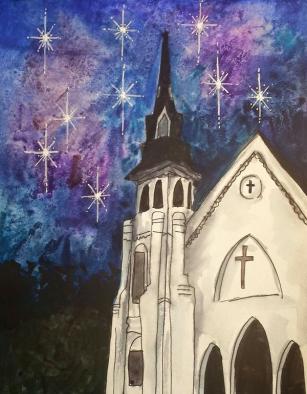
Painting for Mother Emmanuel by Ty Poe

Painting for Mother Emmanuel by Ty Poe

Ever since Wednesday night I’ve been reading post after post by black women and men sharing about what Charleston means to them, and the deep pain and injustice that is still inflicted, every day, on people of color in this country. One theme that has been emerging is the request for white people to do something — to first say they’re sorry for what has happened and listen to the pain and the stories of black men and women, and to then find ways to work to combat the systemic racism in America. Some writers offered suggestions. But many emphasized that it is up to white people to find ways to do it. As Karen Walrund wrote:

“Finally, remember that while racism is an issue that black and brown people have to deal with, it is not our issue to fix. Racism is a systemic problem created by those in power — white power — and therefore it is an issue that only those in power can fix. So please keep this in mind before asking any of your black friends or acquaintances what it is you can do to fight racism: while the question comes from an instinct that is certainly understandable, as an ally, what we really need is for you to be creative and come up with ways that you can put an end to racism yourself. To be even more blunt: being creative for you is not our job.”

I don’t have many ideas yet. But I’m still listening, and I’m trying to be creative. I definitely appreciate that Karen’s call is to be creative, rather than to be organized or to be efficient — creative is more up my alley.

I did have two ideas, neither of which made a lot of sense, but which I did anyway. One was to write a poem, which I’ll share in a minute. And the other was to go to church. If you know me or have been following this blog for a while, you know that it has been a while, and that I’ve had a long and complicated relationship with Christian community. It was just two weeks ago that I wrote about a nightmare I had about going to a church service.

But I just kept thinking about those nine people, faithfully showing up for a Wednesday night prayer meeting, and I knew I had to be brave and go, to honor them. It was a good Sunday to be there, for other reasons that I’ll probably write about soon. It wasn’t particularly profound in terms of the reason I’d come, to bear witness to the men and women killed in Charleston, grieve with the body of Christ, and vow to work towards racial justice in this country.  The pastor spoke briefly about Charleston and said a prayer, naming all nine of the people murdered. The rest of the service was dedicated to something big happening at that specific church which needed to be discussed, and that was fine. But I felt whatever purpose I’d had in going had been fulfilled. We prayed, we bore witness. And the things the church is working through will help it to continue to work for justice and reconciliation.

But there is more to be done. It’s a busy week, so I don’t have time to write much more. But I’ll share my poem. It was inspired by Yolanda Pierce, Osheta Moore, Karen Walrund, Deidre Riggs, Austin Channing Brown, and many others. It was inspired by black women, but it was written to white people, and to myself in particular. What will our response to Charleston be? What work are we being called to do?

On the murders in Charleston

If you only have something nice to say,
Be quiet.

Now is not the time for niceties,
For crying, “Peace, peace”
When there is no peace.

If you have a voice
HOWL

If you have a soul
LAMENT

If you have a prayer, fine.
Say it softly to yourself.

But if you want God to hear you
SHOUT

If you want to pray for peace
WAIL

Rend your garments
Fall to the ground

And stay there until God answers you.
And then get up and do the work.